Institutional capacity development for sustainable aquaculture and fisheries: Strategic partnership with local institutions
View/
Date
2008Page views
4,795ASFA keyword

AGROVOC keyword
Geographic names

Metadata
Show full item recordShare
Abstract
Many people living in the rural areas in the Philippines, as in other developing countries in Southeast Asia, depend on aquatic resources for their food and livelihood. For the past two decades, the Aquaculture Department of the Southeast Asian Fisheries Development Center (SEAFDEC-AQD) has been working with fishing communities and people’s organizations, business sector, local government units, national government agencies, non-government organizations (NGOs) and academic and other research institutions to promote the efficient conservation, management and sustainable development of the country’s fisheries and aquatic resources so that these may continue to serve the needs of the people today and tomorrow.
Using the lessons learned from those two decades of multi-sectoral and inter-disciplinary collaborations, SEAFDEC-AQD launched in late 2006 a project called Institutional Capacity Development for Sustainable Aquaculture (ICDSA) to hasten the transfer to and adoption by coastal villagers of appropriate technologies that would enhance the productivity of aquatic resources and at the same time safeguard the fragile balance of the aquatic ecology.
The experience of SEAFDEC in coastal resource management shows that it is important to engage the collaboration of the local government units and other “on-the-ground” institutions, such as NGOs and people’s organizations, to be able to introduce effectively any social and technological interventions to target community-beneficiaries. However, before a fruitful collaboration among these institutions could be attained, there is a need to build their capacities, and those of the beneficiaries, for the vital roles that they play in the implementation of livelihood projects and environmental management programs.
As of January 2008, SEAFDEC-AQD is implementing ICDSA projects in four provinces—Antique, Capiz, Guimaras and Northern Samar in central Philippines. In the pipeline are similar projects for a province in southern Philippines and two provinces in the north.
Keywords
capacity building aquatic resources management sustainable aquaculture Malalison, PhilippinesSuggested Citation
Agbayani, R. F., & Toledo, J. D. (2008). Institutional capacity development for sustainable aquaculture and fisheries: Strategic partnership with local institutions. In K. Tsukamoto, T. Kawamura, T. Takeuchi, T. D. Beard, Jr., & M. J. Kaiser (Eds.), Fisheries for Global Welfare and Environment: Memorial Book of the 5th World Fisheries Congress 2008 (pp. 435-448). Tokyo: Terrapub.
Type
Conference paperCollections
- Conference Proceedings [300]
Related items
Showing items related by title, author, creator and subject.
-
Development of a sustainable mangrove crab industry through science-based research
(Secretariat, Southeast Asian Fisheries Development Center, 2017)Farming of mangrove crab (or mud crab) species, e.g. Scylla serrata, S. tranquebarica and S. olivacea has long been established in the Philippines although the preferred species for growing is S. serrata. The Philippines’ total production of mangrove crab from aquaculture in 2013 was estimated at 16,160 metric tons valued at PhP 5.2 billion, making the country the second top producer of mangrove crab in the world (FAO, 2015). The sources of crab seeds for farming are from the wild and in recent years, a small percentage from hatcheries. Degradation of the natural habitat and uncontrolled collection of all sizes of crabs have resulted in the depletion of the natural population of mangrove crab. As a stopgap measure, the Bureau of Fisheries and Aquatic Resources (BFAR) together with the provincial and municipal government issued ordinances that prohibit the gathering and selling of crablets (≤3 cm) outside the municipality of origin to reduce not only the volume of harvest from the natural habitat but also the collection and trading of ovigerous (berried) females. This has resulted to increased acceptability of hatchery-reared crab juveniles by crab growers. Through the R&D efforts of the Philippine-based SEAFDEC Aquaculture Department, dissemination of sustainable management of mangrove crab culture to the region has been intensified for a sustainable mangrove crab industry in Southeast Asia. -
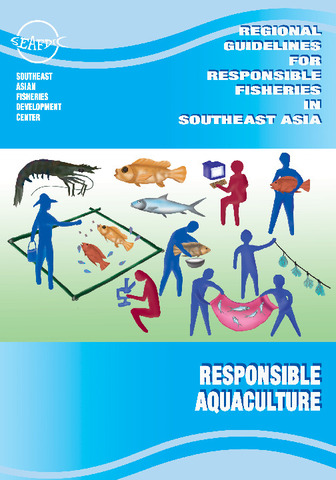
Regional guidelines for responsible fisheries in Southeast Asia: Responsible aquaculture
Bagarinao, TeodoraThis 43-page guidebook presents the code of conduct that has been re-written, expanded, clarified and annotated with definitions and examples to consider the fish farming industries in Southeast Asia. The source of the ... (Aquaculture Department, Southeast Asian Fisheries Development Center, 2005)
-
Sustaining environmental integrity in the midst of intensified aquaculture development
(Secretariat, Southeast Asian Fisheries Development Center, 2015)The escalating aquaculture production from Southeast Asia during the past decades seems inevitable notwithstanding its significant contribution to economic growth and guaranteed food security of the countries in the region. Despite its good prospects, the region’s aquaculture sector is being confronted with various issues that should be addressed to enable it to develop sustainably and contribute unceasingly to poverty alleviation in the region. Responsible aquaculture has been practiced in the region as means of easing the crisis in capture fisheries; however, this has to be matched with effective approaches that address concerns on the fishery resources that are deteriorating. Resource enhancement of economically important aquatic species has been considered as one of the effective approaches that would help protect and restore the aquatic resource habitats and stocks, the latter connotes stock enhancement. As could be gleaned from the current scenario of fisheries in the Southeast Asian region, the recurring over-exploitation of common natural resources has affected the livelihoods of fishers and coastal communities. The imbalanced extraction of natural aquatic resources and natural recruitment has worsened through the years and if left unabated could result in the extinction of many of the region’s endemic aquatic species. It is for such consequences that the Aquaculture Department of the Southeast Asian Fisheries Development Center, while intensifying its efforts in developing sustainable aquaculture, is also promoting resource enhancement as these two approaches are expected to enhance the region’s fishery resources and food security in view of their perfect roles in improving the productivity of aquatic stocks and status of the natural habitats. Nonetheless, aquaculture techniques have always been used to facilitate the stock enhancement of commercially important, threatened and endangered aquatic species. The National Oceanic and Atmospheric Administration of the USA defines stock enhancement as “restoration aquaculture” or the release of hatchery-bred juveniles of fish and shellfish to the wild, and considers this approach as a management tool to recover depleted stocks due to overfishing and habitat loss. The Food and Agriculture Organization of the United Nations has demonstrated that stock enhancement is a type of culture based fisheries since part of the life cycle of certain aquatic species is being controlled in hatcheries before the seeds or juveniles are transplanted or released into open waters — freshwater or brackishwater or marine environments — and allowed to propagate or grow on natural foods until reaching harvestable size.