The effect of micro algal diet and rearing condition on gonad maturity, fecundity and embryonic development of the window-pane shell, Placuna placenta Linnaeus.
View/
Date
2002Page views
1,994ASFA keyword

AGROVOC keyword
Taxonomic term

Metadata
Show full item recordShare
Abstract
Immature Placuna placenta (Linnaeus) broodstock were given the micro algae Isochrysis galbana (T-ISO) Parke and Tetraselmis tetrahele (G.S. West) at different combinations and density levels and reared in tanks with or without mud substrate. The animals were also reared in the estuary and fed on available natural food. Monthly examination of gonad histology showed a significantly higher gonad index in broodstock reared in tanks with mud substrate than without (P < 0.05). In addition, those given a high-density algal diet (200,000 cells ml−1, 3:1 mixture of I. galbana and T. tetrahele) had a significantly faster gonad development than the low-density diet (100,000 cells ml−1, 1:1 mixture) fed broodstock reaching sexual maturity and gonad index of 330±14 after 1 month (P < 0.0001). P. placenta given the low-density algal diet attained gonad maturity after 3 months and estuary-reared animals after 2 months.
Seawater irradiated by ultraviolet light (925–1395 mW h/l) induced spawning of all mature P. placenta. Estuary-reared animals had a higher fecundity and larger eggs and a higher percentage of fertilized eggs developed to straight-hinged larvae than those reared under other condition. Animals given a low-density algal diet released low number of small eggs which did not fertilize. Natural spawning also occurred in the estuary 2 months after stocking.
Suggested Citation
Madrones-Ladja, J. A., dela Peña, M. R., & Parami, N. P. (2002). The effect of micro algal diet and rearing condition on gonad maturity, fecundity and embryonic development of the window-pane shell, Placuna placenta Linnaeus. Aquaculture , 206(3-4), 313-321. https://doi.org/10.1016/S0044-8486(01)00704-9
Type
ArticleISSN
0044-8486Collections
- Journal Articles [1266]
Related items
Showing items related by title, author, creator and subject.
-
Series: Aquaculture extension manual; No. 34
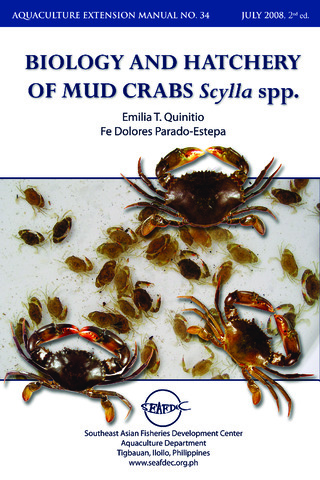
Biology and hatchery of mud crabs Scylla spp.
Quinitio, Emilia T. ; (Aquaculture Department, Southeast Asian Fisheries Development Center, 2008)
This manual includes the biology of mud crab, and describes principles and procedures for spawning the mature crabs (Scylla serrata, S. tranquebarica, and S. olivacea) and rearing the zoea to fly size crabs. It focuses on the hatchery rearing of S. serrata as this species is more economically viable than the two other species. The techniques may be modified depending on the conditions or problems encountered in a specific site.
; (Aquaculture Department, Southeast Asian Fisheries Development Center, 2008)
This manual includes the biology of mud crab, and describes principles and procedures for spawning the mature crabs (Scylla serrata, S. tranquebarica, and S. olivacea) and rearing the zoea to fly size crabs. It focuses on the hatchery rearing of S. serrata as this species is more economically viable than the two other species. The techniques may be modified depending on the conditions or problems encountered in a specific site. -
Nickel-induced pathohistologic alterations in Oreochromis mossambicus
(Aquaculture Department, Southeast Asian Fisheries Development Center, 1996)A pathohistologic study was conducted to determine the effects of nickel on the testes of maturing Mozambique tilapia, Oreochromis mossambicus. The fish were treated with 0.5 mg/L and 1.0 mg/L sublethal dose of nickel sulphate for four weeks. A week reduction in spermatogenic activity together with the disintegration of seminiferous tubules and spermatocytes are commonly observed in the 0.5 mg/L-treated fish. This results in the scattering of germ cells and the occurrence of spaces within the spermatocysts. Pyknotic nuclei are also seen in some specimens. Connective tissues and blood cells invade the damaged regions of the organ. Enlargement of Sertoli cells and interstitial cells are also observed. These effects are more pronounced in the 1.0 mg/L-treated testes. Relatively low levels of nickel in aquatic ecosystems impose a great danger to the reproduction and survival of Mozambique tilapia. -
Series: Technical report / SEAFDEC Aquaculture Department; No. 1
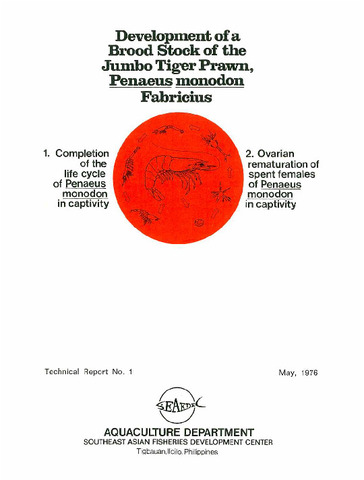
Development of a brood stock of the jumbo tiger prawn, Penaeus monodon Fabricius
(Aquaculture Department, Southeast Asian Fisheries Development Center, 1976)The full-scale cultivation of sugpo, P. monodon Fabricius, could only be realized if there is an assurance of continuous supply of fry. Obviously, a steady supply will depend largely on the availability of spawners. In December 1975, roughly after 2 1/2 years of intensive study, for the first time in the world, SEAFDEC Aquaculture Department has succeeded in inducing P. monodon to mature and produce normally the first generation of postlarval fry, thereby successfully effecting the completion of P. monodon's life cycle while in captivity. Another significant study the Department has initially carried out which could help augment and stabilize the supply of spawners and eventually stimulate the establishment of more prawn hatcheries and the development of ponds for prawn culture as a major export-oriented, dollar-earning industry, is the possible development of ovarian rematuration of spent spawners.