Diagnostic and preventive practices for iridovirus in marine fish
View/

Downloads: 2,991
Date
2002Page views
4,261ASFA keyword

AGROVOC keyword
Metadata
Show full item recordShare
Abstract
The first outbreak of red sea bream iridoviral disease (RSIVD) caused by red sea bream iridovirus (RSIV) was recorded among cultured red sea bream (Pagrus major) in 1990 in Ehime, Shikoku, Japan. Since then, the disease has caused mass mortalities of many cultured marine fishes. From 1990-2000, RSIVD was detected in 31 cultured marine fish species, including 28 Perciformes, 2 Pleuronectiformes and 1 Teteraodontiformes, in 18 prefectures in the southwestern part of Japan. The infected fish are lethargic and show severe anemia, petechiae of the gills, and enlargement of the spleen. Histopathologically, the disease is characterized by the presence of enlarged cells in the spleen, heart, kidney, liver and gills that are deeply stained with Giemsa solution.
Diagnostic methods for RSIV, such as the observation of stained imprints or tissue sections, an immunofluorescent (IF) test with a monoclonal antibody (MAb) and a polymerase chain reaction (PCR) technique have been developed. The IF test with MAb is commonly used in the rapid diagnosis of RSIV-infected fish. For an effective control measure against RSIVD, a formalin-killed vaccine has been developed and this showed a significant effect in red sea bream under both experimental and field conditions.
Suggested Citation
Nakajima, K. (2002). Diagnostic and preventive practices for iridovirus in marine fish. In Y. Inui & E. R. Cruz-Lacierda (Eds.), Disease Control in Fish and Shrimp Aquaculture in Southeast Asia - Diagnosis and Husbandry Techniques: Proceedings of the SEAFDEC-OIE Seminar-Workshop on Disease Control in Fish and Shrimp Aquaculture in Southeast Asia - Diagnosis and Husbandry Techniques, 4-6 December 2001, Iloilo City, Philippines (pp. 75-79). Tigbauan, Iloilo, Philippines: SEAFDEC Aquaculture Department.
Type
Conference paperISBN
9718511601Related items
Showing items related by title, author, creator and subject.
-
Status of threatened species and stock enhancement activities in the Philippine fisheries
(Aquaculture Department, Southeast Asian Fisheries Development Center, 2006)The paper provides the lists of fisheries related species perceived to be extinct, rare, threatened and endangered as covered under the CITES, IUCN and the Bureau of Fisheries and Aquatic Resources (BFAR)-Fisheries Administrative Order (FAO) No. 208. The listings of freshwater fisheries resources constitute mostly finfishes that are all, except for one, found in the CITES list, the rest under the IUCN red lists and none in the BFAR list. Majority of the listed species are also specific to some areas like Lanao Lake, few in the RINCONADA lakes of Bicol and scarce in some other minor lakes where they are found to be endemic. Most of the indigenous cyprinid species are of commercial value to the locality and are the main source of fish protein in the daily life of the fisherfolk. The listings of marine finfishes constitute mostly sharks and seahorses which are all, except for one, found in the CITES list, the rest under the IUCN Red List and none in the BFAR-FAO list. Although BFAR listed 20 species of whales and dolphins under its FAO 208, marine mammals are not included in this report. Most of the indigenous shark species are becoming rare and extinct due to the rampant shark Status of Threatened Species and Stock Enhancement Activities in the Philippine Fisheries with the rising demand of shark fins smuggled or exported abroad. These marine finfishes are distributed in coastal waters. The listings of marine gastropods, mollusks, crustaceans and echinoderms are all found in the BFAR-FAO listings as Rare, Threatened and Endangered, while few and selective under the CITES and IUCN lists. Accordingly, these are the most common marine resource commodities that are over-exploited, gleaned and gathered illegally, and frequently exported or smuggled out of the country by unscrupulous traders. -
Thailand's concerns in endangered species and stock enhancement
(Aquaculture Department, Southeast Asian Fisheries Development Center, 2006)The paper provides a comprehensive list of endangered freshwater, brackishwater, and marine aquatic species in Thailand. The Thai Department of Fisheries is breeding some of the endangered species under the “Rehabilitation of Thai Local Fishes and Aquatic Animals Project.” Some of these species are bred for restocking in the wild. -
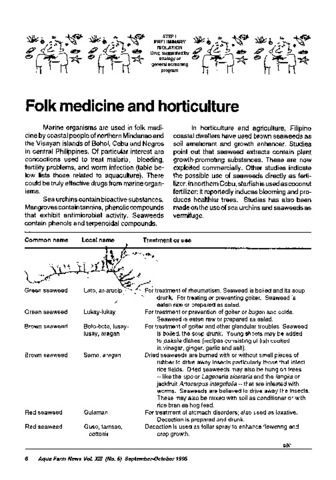
Folk medicine and horticulture
(Aquaculture Department, Southeast Asian Fisheries Development Center, 1995)The article discusses the uses of marine organisms in folk medicine and in horticulture in the Philippines. Commonly used marine organisms are the different varieties of seaweeds, sea urchin, sea cucumber, turtle, crocodile and fishes such as grouper and rabbitfish.