Enrichment potential of HUFA-rich thraustochytrid Schizochytrium mangrovei for the rotifer Brachionus plicatilis

View/
Date
2009Page views
1,533ASFA keyword

AGROVOC keyword
Taxonomic term

Metadata
Show full item recordShare
Abstract
An enrichment experiment was performed to evaluate the changes in lipid and essential fatty acid contents of the rotifer Brachionus plicatilis fed with freeze-dried cells of tropical thraustochytrid Schizochytrium mangrovei (Isolate IAo-1). Rotifers starved for 24 h were fed with S. mangrovei cells at 200, 300, 400, 500, 600 and 700 mg L−1. Enrichment was carried out at two periods (Short-term = 5 h; Long-term = 10 h) to determine the optimum time needed for the maximum enrichment of the rotifers. There was an overall significant increase in the total lipid, arachidonic acid (AA) and docosahexaenoic acid (DHA) contents of rotifers after feeding with freeze-dried S. mangrovei indicating the successful uptake of these nutrients in the rotifer's biochemical composition. On the other hand, docosapentaenoic acid (DPA) did not change significantly in enriched rotifers. Results of the present study indicate that both factors, feeding concentrations and enrichment periods, significantly affected the lipid, AA and DHA contents of rotifers. Uptakes of lipid, AA and DHA significantly increased with increasing feeding concentrations except for those fed the highest feeding concentration of 700 mg L−1 for 10 h. Moreover, lipid and AA contents of enriched rotifers were significantly higher during the short-term enrichment period while DHA contents were significantly higher during the long-term enrichment period. Therefore, it is concluded that the feeding concentration of 700 mg L−1 at an enrichment period of 5 h is optimum in the AA and DHA enrichment of rotifers. The strategic scheme of combining the proper amount of enrichment product and the duration of enrichment in boosting the DHA contents of rotifers will effectively ensure a reliable production of nutritionally superior rotifers at a minimal cost. This will ultimately contribute to the success of rearing marine fish larvae in the hatchery.
Suggested Citation
Estudillo-del Castillo, C., Gapasin, R. S., & Leaño, E. M. (2009). Enrichment potential of HUFA-rich thraustochytrid Schizochytrium mangrovei for the rotifer Brachionus plicatilis. Aquaculture , 293(1-2), 57-61. https://doi.org/10.1016/j.aquaculture.2009.04.008
Type
ArticleISSN
0044-8486Collections
- Journal Articles [1267]
Related items
Showing items related by title, author, creator and subject.
-
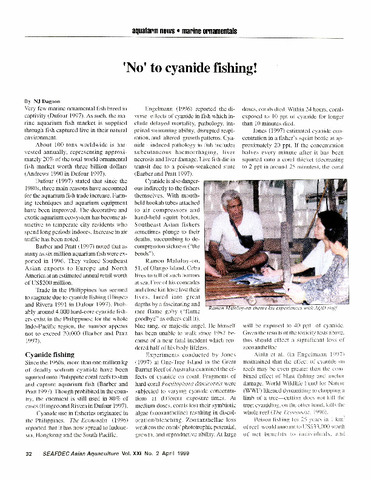
'No' to cyanide fishing!
(Aquaculture Department, Southeast Asian Fisheries Development Center, 1999) -
The Philippine industry: Marine tropical fish
(Aquaculture Department, Southeast Asian Fisheries Development Center, 1992) -
CRM in the Philippines: Lessons learned
(Aquaculture Department, Southeast Asian Fisheries Development Center, 1996)Philippine coastal communities can become capable fishery resource managers and that their management practices can become largely self-sustaining if the project approach focuses on assisting fishermen to learn how to help themselves. Community organization is an essential part of the process and should not be viewed as an end product in itself. There are also no quick fixes, and projects require a complex array of activities if large numbers of coastal residents are to be assisted. In some of these projects, the control of illegal fishing combined with limiting of commercial fishing to offshore areas and good coastal habitat management resulted in a doubling of daily fish catch and income for small-scale fishermen. However, even with the best of management, the total fishery harvest is limited and further increases in individual fishing income can only come from reducing total fishing effort. This will require a system of control on access to the resource to limit the number and kind of fishing gears and to divide the resource equitably. Assisting coastal communities to devise and implement realistic equitable access controls is the major challenge facing coastal resource co-management.