The morphology and life cycle of the gill monogenean (Pseudorhabdosynochus lantauensis) on orange-spotted grouper (Epinephelus coioides) cultured in the Philippines
View/
Date
2010Page views
2,532ASFA keyword

AGROVOC keyword
Taxonomic term

Metadata
Show full item recordShare
Abstract
The morphology of Pseudorhabdosynochus lantauensis is described. It is the most numerous parasite recovered from the gills of cultured orange-spotted grouper Epinephelus coioides in the Philippines and is smaller compared with similar species reported in Hong Kong, Malaysia and Indonesia. This species is characterized by having an overlapping dorsal bar and short copulatory organ.
The life cycle of the gill monogenean is also described. One mature parasite lays at least 10-22 eggs/day. Eggs are oval (0.021-0.120 mm) with a spiral filament attached to one end. Eggs hatch into free-swimming larvae (oncomiracidia) within 2-6 d at 30°C and 30 ppt. The rate of hatching of various eggs is highly variable, that is, some eggs hatch in 2 d while others take 6 d. The oncomiracidium can attach to the grouper host within 8 h. Upon attachment, the oncomiracidium metamorphoses to an adult parasite in 4-7 d. The parasite becomes fully mature and delivers eggs in 7 d. Without a host, the life span of oncomiracidium is only 4-8 h. The life cycle is complete in 13-20 days (eggs to oncomiracidium 2-6 d; oncomiracidium to adult parasite 4-7 d; adult to fully mature and egg delivery parasite 7 d). This is the first report on the morphology and life cycle of P. lantauensis from the Philippines.
Suggested Citation
Erazo-Pagador, G., & Cruz-Lacierda, E. R. (2010). The morphology and life cycle of the gill monogenean (Pseudorhabdosynochus lantauensis) on orange-spotted grouper (Epinephelus coioides) cultured in the Philippines. European Association of Fish Pathologists Bulletin , 30(2), 55-64. http://hdl.handle.net/10862/2132
Type
ArticleISSN
0108-0288Collections
- Journal Articles [1267]

Except where otherwise noted, this item's license is described as http://creativecommons.org/licenses/by/2.5/scotland/
Related items
Showing items related by title, author, creator and subject.
-
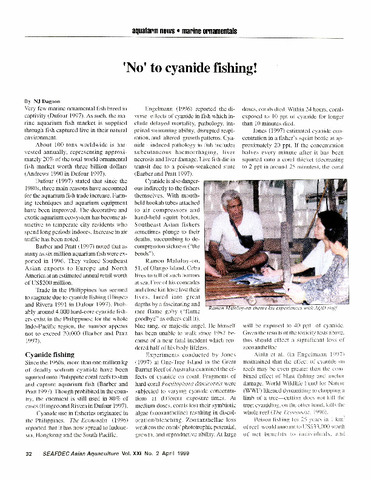
'No' to cyanide fishing!
(Aquaculture Department, Southeast Asian Fisheries Development Center, 1999) -
The Philippine industry: Marine tropical fish
(Aquaculture Department, Southeast Asian Fisheries Development Center, 1992) -
CRM in the Philippines: Lessons learned
(Aquaculture Department, Southeast Asian Fisheries Development Center, 1996)Philippine coastal communities can become capable fishery resource managers and that their management practices can become largely self-sustaining if the project approach focuses on assisting fishermen to learn how to help themselves. Community organization is an essential part of the process and should not be viewed as an end product in itself. There are also no quick fixes, and projects require a complex array of activities if large numbers of coastal residents are to be assisted. In some of these projects, the control of illegal fishing combined with limiting of commercial fishing to offshore areas and good coastal habitat management resulted in a doubling of daily fish catch and income for small-scale fishermen. However, even with the best of management, the total fishery harvest is limited and further increases in individual fishing income can only come from reducing total fishing effort. This will require a system of control on access to the resource to limit the number and kind of fishing gears and to divide the resource equitably. Assisting coastal communities to devise and implement realistic equitable access controls is the major challenge facing coastal resource co-management.