Abalone hatchery


Share
Abstract
This manual contains information on abalone hatchery operation, including site selection, design, culture of natural food, broodstock management, spawning, nursery, packing and transport, and profitability analyses.
Subjects
Abalone culture Handbooks and manuals
Suggested Citation
Fermin, A. C., dela Peña, M. R., Gapasin, R. S. J., Teruel, M. B., Ursua, S. M. B., Encena II, V. C., & Bayona, N. C. (2008). Abalone hatchery. Tigbauan, Iloilo, Philippines: SEAFDEC Aquaculture Department.
Type
BookISBN
9789718511855Series
Aquaculture extension manual; No. 39Format
31 p. : col. ill.
Koleksi
Related items
Showing items related by title, author, creator and subject.
-
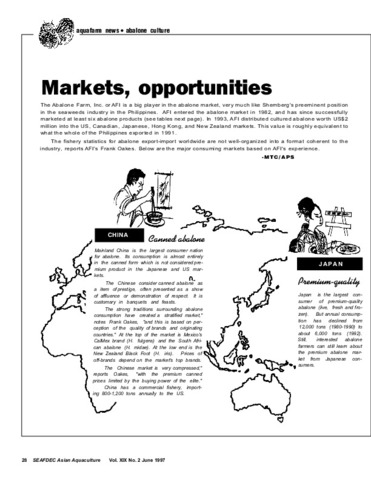
[Abalone] markets, opportunities
(Aquaculture Department, Southeast Asian Fisheries Development Center, 1997) -
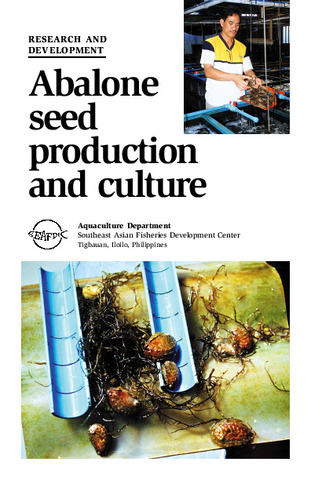
Abalone seed production and culture
(Aquaculture Department, Southeast Asian Fisheries Development Center, 2000)Details the research conducted at AQD for the tropical abalone Haliotis asinina. AQD has developed the rudiments of a hatchery protocol. -
Enriched Ulva pertusa as partial replacement of the combined fish and soybean meals in juvenile abalone Haliotis asinina (Linnaeus) diet
(Springer Verlag, 2020)The potential of enriched Ulva pertusa meal as feed ingredient in abalone juveniles, Haliotis asinina was evaluated. Four isonitrogenous and isolipidic diets were formulated which contain 27% protein and 5% lipid. Enriched U. pertusa meal replaced 0% (control), 10%, 20%, and 30% of protein from fish and soybean meals in the formulated diets. Thirty randomly selected abalone juveniles with average weight and shell length of 0.45 g ± 0.01 and 12.71 mm ± 0.01, respectively, were placed in each of the twelve 60-L oval fiberglass tanks equipped with a flow-through seawater system. Abalone were given diets at 3–5% body weight daily for 120 days in three replicate samples. Results showed no significant differences (p > 0.05) in percent weight gain, shell length, specific growth rate, feed conversion ratio, and protein efficiency ratio even up to 30% replacement level. Apparent dry matter digestibility of U. pertusa meal in abalone diet was 92%. Crude protein content of the abalone fed diets 1 (10% enriched U. pertusa meal) and 3 (30% enriched U. pertusa meal) was significantly (p < 0.05) higher than those fed on basal diet. Enriched U. pertusa meal can partially replace fish and soybean meals as protein source in formulated diets for abalone, Haliotis asinina juveniles.