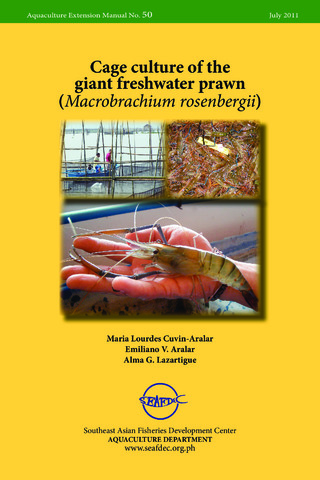
Cage culture of the giant freshwater prawn (Macrobrachium rosenbergii)

Date
2011Page views
10,924ASFA keyword

AGROVOC keyword
Taxonomic term

Metadata
Show full item recordShare
Abstract
An extension manual describing biology, site requirement, grow-out operations, health management, harvest, post harvest handling and processing, and economic analysis.
Suggested Citation
Cuvin-Aralar, M. L., Aralar, E. V., & Lazartigue, A. G. (2011). Cage culture of the giant freshwater prawn (Macrobrachium rosenbergii). Tigbauan, Iloilo, Philippines: SEAFDEC Aquaculture Department.
Type
BookISSN
0115-5369Series
Aquaculture extension manual; No. 50Format
[viii], 30 p. : col. ill.
Collections
Related items
Showing items related by title, author, creator and subject.
-
Aquaculture in Malaysia
(Aquaculture Department, Southeast Asian Fisheries Development Center, 1995)Aquaculture in Malaysia is experiencing rapid growth. Total production in 1992 amounted to 79,699 tons valued at RM 207.4 million. These figures are 23% and 25% higher than the previous year's. Semi-culture of the cockle Anadara granosa was still predominant, contributing about 70% of the total output. Culture and production of the oyster Crassostrea iredalei is still insignificant. Sea bass Lates calcarifer constituted over 80% of the production from marine cages. Cage culture of grouper Epinephelus sp., snapper Lutjanus sp. and pompano Trachinotus blochii were also done in much smaller scale. The mangrove snapper Lutjanus argentimaculatus was recently spawned in captivity and larvae and juveniles were produced. In 1992, the tiger shrimp Penaeus monodon constituted about 87% of brackishwater pond production. Pond culture of the white shrimp P. merguiensis and the mudcrab Scylla sp. is at the experimental stage. Red tilapia hybrid was the major freshwater species cultured in cages, with 1,486 tons harvested in 1992. Freshwater pond production was valued at RM 100.85 million, 22% of which was due to the eel Anguilla japonica. Production of freshwater ornamental fishes is also becoming significant. Other exotic species recently bred and cultured are the African catfish Clarias gariepinus and the pacu Piaractus brachypomus. The indigenous freshwater catfish Mystus nemurus and carp Probarbus julleini have recently been bred in captivity and cultured experimentally. Lately, there have been attempts to culture non-conventional species such as the bullfrog Rana catesbeiana, the soft-shell turtle Trionyx sinensis, and aquatic ornamental plants. -
Research on crustaceans
(Aquaculture Department, Southeast Asian Fisheries Development Center, 1995)Crustacean research at the SEAFDEC Aquaculture Department during the last three years focused mostly on the tiger shrimp Penaeus monodon. Studies were done along six problem areas: (1) developing spawning techniques for captive broodstock, (2) defining physico-chemical levels tolerable by larvae or postlarvae, (3) finding alternative feeds or fertilizers for extensive culture, (4) reducing the cost and evaluating the quality of formulated feeds for semiintensive culture, (5) preventing and controlling disease, and (6) documenting the chemicals used in shrimp culture and their effects on the environment. To reduce feed costs, substitutes for expensive feed components were screened and the specific nutrient requirements of tiger shrimp during culture were determined. A few studies were made on other crustaceans. The vitellogenin levels during maturation of the white shrimp P. indicus were measured. The digestibility of feedstuffs was also tested in the white shrimp. Culture techniques are being developed for the mudcrab Scylla serrata in ponds, pens, and cages. -
Research on seaweeds and mollusks
(Aquaculture Department, Southeast Asian Fisheries Development Center, 1995)Research on seaweeds focused on the carrageenan-producing Kappaphycus alvarezii and the agar-producing Gracilaria spp. Growth of K. alvarezii was better on horizontal lines than on vertical or cluster lines from bamboo rafts. All morphotypes (brown green, and red) grew faster at 50 cm than at 100 cm below the water surface, but the green morphotype showed better carrageenan properties. A socioeconomic survey of K. alvarezii farming in Panagatan Cays, Antique revealed that a farmer has an average annual production of 3 tons/ha (dry) with the fixed bottom and hanging longline methods. Three species of Gracilaria in natural beds in lloilo showed monthly variations in biomass and agar quality; G. heteroclada had the highest biomass and gel strength. When this species was grown in tanks, growth and agar sulfate content were influenced by the interaction of light, salinity, and nutrients. Enriched and unenriched stocks of G. heteroclada differed in agar quality. When G. heteroclada was grown with the tiger shrimp Penaeus monodon in extensive ponds, the highest growth rate and production were obtained at the seaweed stocking density of 250 g/m2; this was in November when average water temperature, transparency, and salinity were low. Salinity tolerance varies among Gracilaria species.Oyster (Crassostrea iredalei) and mussel (Perna viridis) farming in Western Visayas were assessed in 1992 in terms of the culture methods, socioeconomics, marketing, and profitability. A more localized survey of oyster and mussel fanning was conducted through rapid rural appraisal in two coastal towns in 1993. A farmer-participatory study followed in 1994 for the culture of oysters, mussels, seaweeds, and rabbitfishes in a river mouth in Dumangas, lloilo. Green mussel, brown mussel (Modiolus metcalfei), and seaweeds transplanted to Dumangas from Capiz have reproduced. In another study, the green mussel was tested as a biological filter in tiger shrimp ponds; shrimps stocked with mussels grew better than those without. A nationwide survey on the Placuna placenta fishery in 1993 showed 27 remaining 'kapis' beds; many others have been depleted due to excessive gathering, pollution, siltation, and trawling. Broodstocks are being developed to produce 'kapis' seed for grow-out and restocking. For the first time at AQD, adult donkey-ear abalone Haliotis asinina from the wild spawned naturally in laboratory tanks. Juvenile abalones can be successfully grown on Gracilaria or abalone diet.