Spawning of tiger grouper Epinephelus fuscoguttatus and squaretail coralgrouper Plectropomus areolatus in sea cages and onshore tanks in Andaman and Nicobar Islands, India

View/
Date
2013Page views
1,485ASFA keyword

AGROVOC keyword
Taxonomic term

Metadata
Perlihat publikasi penuhShare
Abstract
The broodstock of two grouper species, tiger grouper Epinephelus fuscoguttatus and squaretail coralgrouper Plectropomus areolatus, were maintained in sea cages near Rutland Island, Andaman and Nicobar Islands, India, and their spawning performance was monitored from June 2007 to December 2010. E. fuscoguttatus generally spawned monthly in association with the new moon phase, for 8–9 months each year. Each year, they underwent a 3- to 4-month refractory period between February and June then recommenced spawning in May–July. P. areolatus showed a different spawning pattern to E. fuscoguttatus, spawning for less than 6 months each year, also in association with the new moon, and demonstrating much longer refractory periods (up to 15 months) than E. fuscoguttatus. Analysis of temperature data from the sea cage site showed that water temperature was significantly lower during spawning events than during comparable non-spawning periods. We postulate that one factor inhibiting spawning is higher water temperatures exceeding the upper thermal inhibitory limit for both grouper species during the hotter months of the year. Selected broodstock fish of both species were also maintained in onshore tanks fitted with recirculating filtration systems, but the spawning performance of both grouper species in the onshore tanks was inferior to broodstock held in the sea cages. E. fuscoguttatus maintained in onshore tanks spawned during only 5 months of the 42-month study period, whereas E. fuscoguttatus held in the sea cages spawned during 29 months over the same time frame. P. areolatus held in onshore tanks over the same period did not spawn, whereas P. areolatus held in sea cages spawned during 16 months out of the 42-month study period.
Suggested Citation
Rimmer, M. A., Thampisamraj, Y. C., Jayagopal, P., Thineshsanthar, D., Damodar, P. N., & Toledo, J. D. (2013). Spawning of tiger grouper Epinephelus fuscoguttatus and squaretail coralgrouper Plectropomus areolatus in sea cages and onshore tanks in Andaman and Nicobar Islands, India. Aquaculture , 410-411, 197-202. https://doi.org/10.1016/j.aquaculture.2013.06.022
Type
ArticleISSN
0044-8486Koleksi
- Journal Articles [1267]
Related items
Showing items related by title, author, creator and subject.
-
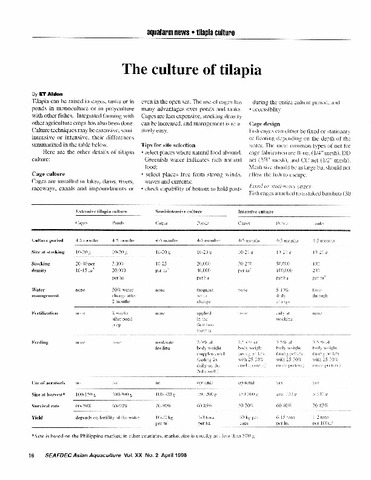
The culture of tilapia
(Aquaculture Department, Southeast Asian Fisheries Development Center, 1998) -
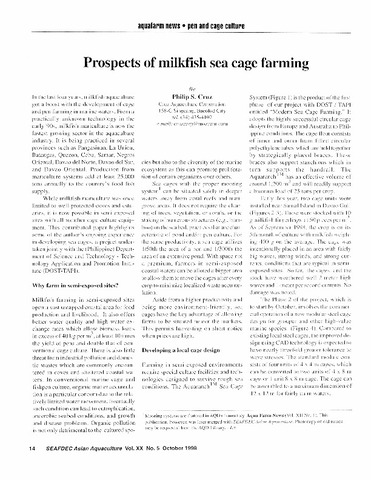
Prospects of milkfish sea cage farming
(Aquaculture Department, Southeast Asian Fisheries Development Center, 1998) -
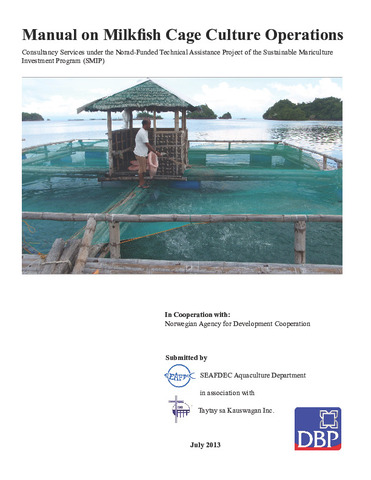
Manual on milkfish cage culture operations
(Aquaculture Department, Southeast Asian Fisheries Development Center, 2013-07)Milkfish (Chanos chanos, or bangus) culture is the largest finfish aquaculture industry in the Philippines and continues to be a top aquaculture commodity primarily because it is easy to culture and can be grown in a wide range of environments. Milkfish thrives in freshwater, brackishwater, marine, and even hypersaline habitats. Milkfish production is increasing rapidly with much of the production moving away from the traditional culture in brackishwater ponds to fish cages in coastal marine waters. To provide a general view of the milkfish culture industry, brief descriptions on breeding, hatchery production, and nursery operation are included in this manual. This manual is meant to serve as a guide for those interested to venture into marine cage farming of milkfish. Milkfish culture has been practiced in the Philippines, Indonesia, and Taiwan for centuries and has been the focus of aquaculture research in a number of institutions for several decades. Innovations in culture practices as a result of information from research data and from farmer’s experiences have been adopted by industry practitioners and these are documented in the recently published book entitled Milkfish Aquaculture in Asia (Liao and Leano, 2010). The recent concern about the rapid growth of aquaculture and its possible environmental impacts, and risks that can threaten the sustainability of this expanding industry has also been the subject of many conferences to develop good management practices in aquaculture. Principles and guidelines on better management practices in marine finfish culture had been drafted and included in this manual.