Preliminary trials of combined Artemia rearing and salt production in earthen salt ponds in the Philippines
View/
Date
1980Author

Page views
3,539ASFA keyword

AGROVOC keyword
Metadata
Show full item recordShare
Abstract
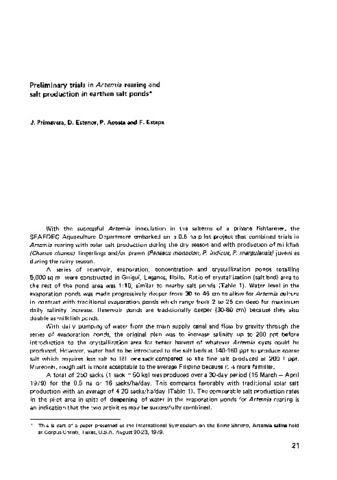
This paper describes trials at combining Artemia rearing with salt production during the dry season, in newly-constructed earthen salt ponds (reservoir, evaporation, concentration, and crystallization ponds, total area of 5,000 m2 at the Leganes, Iloilo Station of the SEAFDEC Aquaculture Department.
Salt production by the solar method amounted to 250 sacks of slat over 30 days or an average of 8 sacks/day (1 sack = 50 kg).
Two successful Artemia inoculations were undertaken in May and June 1979 respectively : in both cases the adult stage was reached after 1 week. The May population died off when the salinity was suddenly increased by salt addition. The June population gradually disappeared at the onset of the rainy season.
Suggested Citation
Primavera, J. H., Estenor, D., & Acosta, P. (1980). Preliminary trials of combined Artemia rearing and salt production in earthen salt ponds in the Philippines. In G. Persoone, P. Sorgeloos, O. Roels, & E. Jaspers (Eds.), The Brine Shrimp Artemia. Proceedings of the International Symposium on the brine shrimp Artemia salina, Corpus Christi, Texas, USA, August 20-23, 1979. (Vol. 3. Ecology, Culturing, Use in Aquaculture, pp. 207–214). Wetteren, Belgium: Universa Press.
Type
Conference paperCollections
- Conference Proceedings [300]
Related items
Showing items related by title, author, creator and subject.
-
Preliminary trials in Artemia rearing and salt production in earthen salt ponds
(Aquaculture Department, Southeast Asian Fisheries Development Center, 1979)The authors report on the production of Artemia obtained on a 0.5 ha pilot project with combined trials in Artemia rearing with solar salt production during the dry seasons and with production of milkfish (Chanos chanos) fingerlings and/or prawn (Penaeid sp.) juveniles during the rainy season in the Philippines. -
Effect of dietary organic acid salts, potassium diformate and sodium diformate on the growth performance of male Nile tilapia Oreochromis niloticus
(Verlag Natur & Wissenschaft, 2011)The effect of two organic acid salts on the production performance of juvenile male Nile tilapia Oreochromis niloticus were studied in two separate experiments. In the first trial the fish (initial size: 7.84kg) were fed commercial feed supplemented with 0,3% potassium diformate (KDF) while in the second trial the fish (initial size: 16.48 kg) were fed diets supplemented with 0,3% sodium diformate (NDF). The control group for both trials used the same commercial fish feed with no supplementation. The feeding trials lasted for 74 and 78 days, respectively. Results showed that the supplementation of either KDF or NDF significantly improved growth and feed conversion of male Nile tilapia compared to the control group. The fish in the KDF treatment had a mean final weight of 51.4g and FCR of 1.81 compared to 45.4g and 1.97, respectively, for the control. Mean final weight and FCR of fish in the NDF treatment were 66.2g and 0.69, respectively, while those of the control were 58.7g and 0.77. The condition factor of the fish in both trials was not affected by treatment. -
Nutrient flow and physicochemical profile studies of an integrated poultry-salt-Artemia-milkfish-sea bass-shrimp pond production system
(Wetteren, Belgium: Universal Press, 1987)The physicochemical and biological parameters of an integrated flow-through poultry-salt-Artemia-milkfish-sea bass-shrimp pond production system were monitored for 6 months to determine the pattern of nutrient changes and associated plankton communities as water passed through the system. A 20 ha salt farm in Negros Oriental, Philippines, was used as a model of the integrated system. The construction of a poultry farm at the inlet reservoir provides continuous fertilization and allows considerable control of nutrient inputs to the pond system. Nutrients increase markedly in the chicken pond and in subsequent ponds undergo cycles of biological assimilation and bacterial mineralization. Principal component analysis ordinates temporal and spatial changes in 33 variables that were monitored. Using scatter diagrams of the principal components enabled separation of ponds adjacent to the crystallization bed and ponds high in fish biomass from the rest of the system. Variables that served to numerically delineate the ponds in this manner were salinity, phosphate, ammonia, alkalinity, turbidity, acidity, microplants, pico- and nannoplankton. The implications of this ordination in relation to pond management techniques is discussed.