Polyculture of milkfish (Chanos chanos) and tiger prawn (Penaeus monodon Fab.) with and without supplemental feeding


Share
Abstract
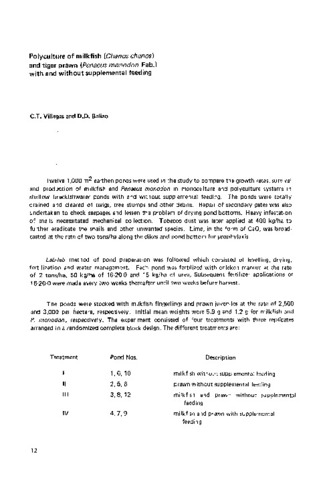
Twelve 1,000 m2 earthen ponds were used to compare the growth rates, survival and production of milkfish (Chanos chanos) and prawn (Penaeus monodon) in monoculture and polyculture systems in shallow brackishwater ponds and without supplemental feeding. The low production and survival rates obtained were attributed to the lack of natural food; the high salinity during the first month of culture could be one of the causes of the high mortality of prawn observed in both mono and polyculture systems. Although the results of the trial were not ecouraging, it is possible that high yields may be obtained from the combination of the 2 species given enough natural food and favourable water conditions.
Suggested Citation
Villegas, C. T., & Baliao, D. D. (1980). Polyculture of milkfish (Chanos chanos) and tiger prawn (Penaeus monodon Fab.) with and without supplemental feeding. SEAFDEC Aquaculture Department Quarterly Research Report , 4(3), 12-14. http://hdl.handle.net/10862/2373
Type
ArticleCollections
Related items
Showing items related by title, author, creator and subject.
-
1989 annual report
(Aquaculture Department, Southeast Asian Fisheries Development Center, 1990)The report describes the activities of the Center during the year 1989 regarding the various research studies conducted, and the training, extension, and information services provided. -
1988 annual report
(Aquaculture Department, Southeast Asian Fisheries Development Center, 1989)Since its establishment in 1973, AQD has shown sustained achievements in aquaculture, thus contributing greatly to the progress of the aquaculture industry in the region. Continuing research on prawn culture at AQD has ... -
Philippine National Standard: Organic aquaculture
(Bureau of Agriculture and Fisheries Standards, 2016)The Philippine National Standard (PNS) for Organic Aquaculture (PNS/BAFS 112:2016) was originally prepared and adopted in 2012. Organic aquaculture encourages polyculture production system, promotes the use of indigenous/endemic species under the extensive and semi-intensive culture systems, reduces/minimizes inputs of artificial ingredients, prohibits the use of genetically modified organisms (GMOs), and considers ecological conditions necessary for sustainable aquaculture production. The PNS for Organic Aquaculture was revised by the Technical Working Group (TWG) organized by the Bureau of Agriculture and Fisheries Standards (BAFS) through a Department of Agriculture (DA) Special Order No.476, Series of 2015. The TWG is composed of members representing the Bureau of Fisheries and Aquatic Resources (BFAR), Organic Certification Center of the Philippines (OCCP), Southeast Asian Fisheries Development Center Aquaculture Department (SEAFDEC-AQD), Philippine Council for Agriculture, Aquatic and Natural Resources Research and Development (PCAARRD) and Central Luzon State University (CLSU). This PNS was presented and reviewed during the consultative meetings with the concerned stakeholders in Region I (Pangasinan) and Region XI (Davao City). Comments gathered during the consultations were carefully evaluated by the TWG and included accordingly in the final version of this standard. Drawn from the general principles of the Philippine National Standard on Organic Agriculture, this PNS on Organic Aquaculture attempts to cover the aquaculture production and postharvest operations in order to ensure the integrity of organic products. The requirements for the inclusion of Substances and Criteria for the development of the list of substances shall follow the Philippine National Standards for Organic Aquaculture and the Guidelines for the Production, Processing, Labelling and Marketing of Organically Produced Foods (GL 32-1999). The revision of this PNS was undertaken in order to achieve equivalence with the existing international standards and its future amendment, and takes into consideration the new developments and inclusion of the identified potential species for organic aquaculture. Thus, this PNS identifies minimum requirements on documentation, conversion to organic aquaculture, parallel production, selection of site, interaction with surrounding ecosystem, organic fertilization, aquatic plants, aquatic animal sources/origin, breeding and hatchery management, aquatic animal nutrition and feeding, aquatic animal health and welfare, harvesting, post-harvest handling, transport and processing, storage, and social aspects.