Guidelines for the conversion of mangroves to ponds


Share
การอ้างอิง
SEAFDEC/AQD (1988). Guidelines for the conversion of mangroves to ponds. Aqua Farm News , 6(1), 7. http://hdl.handle.net/10862/2678
Type
magazineArticleISSN
0116-6573คอลเลกชัน
- Aqua Farm News [286]
Related items
Showing items related by title, author, creator and subject.
-
Technologies in Mangrove-Friendly Aquaculture. Final Report of and Papers Presented to the On-Site Training on Mangrove-Friendly Aquaculture, Hai Phong City, Socialist Republic of Vietnam, 19-30 April 1999
(Aquaculture Department, Southeast Asian Fisheries Development Center, 2000)This document contains the final report of and papers presented as lecture materials, to the On-Site Training on Mangrove-Friendly Aquaculture held in Hai Phong City, Socialist Republic of Vietnam from 19 to 30 April 1999. This document replaces the Advance Copy of the Report issued in May 1999. Fourteen experts on mangroves and aquaculture served as lecturers and resource persons. Technologies in Mangrove-Friendly Aquaculture, in general were introduced, taking into consideration the results of the Workshop on Mangrove-Friendly Aquaculture, 11-15 January 1999, Iloilo City, Philippines. The On-Site Training was participated in by 25 participants; 20 from Vietnam and 5 from Cambodia. The conduct of the On-Site draining was an offshoot of the Project SD/AQ99-CM01 with the SEAFDEC Secretariat which also allocated the necessary funds from the Japanese Trust Fund. The Canada-ASEAN Centre based in Singapore provided funds for the participation of the trainees from the Kingdom of Cambodia. -
Series: Aquaculture extension manual; No. 77
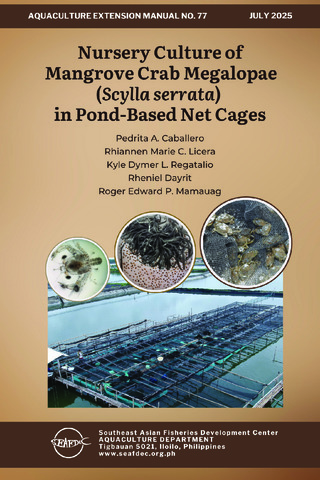
Nursery culture of mangrove crab megalopae (Scylla serrata) in pond-based net cages
Caballero, Pedrita ; ; Regatalio, Kyle Dymer ; ; Mamauag, Roger Edward (Aquaculture Department, Southeast Asian Fisheries Development Center, 2025-07)
This manual, titled “Nursery Culture of Mangrove Crab Megalopae (Scylla serrata) in Pond-Based Net Cages,” is part of SEAFDEC/AQD’s effort to assess the potential of using megalopae as the starting stock in pond-based net cage nurseries. The method is intended to enhance survival rates during the grow-out stage. Given the increasing availability of hatchery-reared megalopae and the high cost of crab instars, the manual also evaluates the cost-effectiveness and practical advantages of using megalopae in nursery operations. Hatchery-sourced megalopae offer key benefits over wild-caught ones, including consistent supply, environmental sustainability, disease-free status, species certainty, and stable pricing. This approach could help increase hatchery production cycles and lower overall production expenses in the crab farming industry. The manual covers various aspects, including mangrove crab biology, site selection, pond preparation, nursery management, packing and transport procedures, and economic analysis. The authors hope this resource will serve as a practical guide for crab farmers, farm managers, aquaculture professionals, technicians, and students by providing essential knowledge on science-based aquaculture practices.
; ; Regatalio, Kyle Dymer ; ; Mamauag, Roger Edward (Aquaculture Department, Southeast Asian Fisheries Development Center, 2025-07)
This manual, titled “Nursery Culture of Mangrove Crab Megalopae (Scylla serrata) in Pond-Based Net Cages,” is part of SEAFDEC/AQD’s effort to assess the potential of using megalopae as the starting stock in pond-based net cage nurseries. The method is intended to enhance survival rates during the grow-out stage. Given the increasing availability of hatchery-reared megalopae and the high cost of crab instars, the manual also evaluates the cost-effectiveness and practical advantages of using megalopae in nursery operations. Hatchery-sourced megalopae offer key benefits over wild-caught ones, including consistent supply, environmental sustainability, disease-free status, species certainty, and stable pricing. This approach could help increase hatchery production cycles and lower overall production expenses in the crab farming industry. The manual covers various aspects, including mangrove crab biology, site selection, pond preparation, nursery management, packing and transport procedures, and economic analysis. The authors hope this resource will serve as a practical guide for crab farmers, farm managers, aquaculture professionals, technicians, and students by providing essential knowledge on science-based aquaculture practices. -
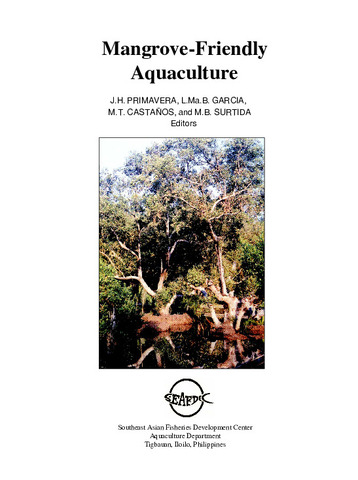
Mangrove-Friendly Aquaculture : Proceedings of the Workshop on Mangrove-Friendly Aquaculture organized by the SEAFDEC Aquaculture Department, January 11-15, 1999, Iloilo City, Philippines
(Aquaculture Department, Southeast Asian Fisheries Development Center, 2000)The proceedings have three review papers on the mangroves of Southeast Asia, silvofisheries, and Indonesia's integrated mangrove forest and aquaculture systems. The rest of the papers, all on mangrove-friendly aquaculture efforts are from the Philippines, Japan, Thailand, Vietnam, Malaysia, Brunei Darussalam, Indonesia, and Cambodia. All the countries represented had varied methodologies, with Cambodia in its initial stages while some countries like Indonesia and Thailand have tested methodologies. The proceedings include a tabulation of the reported mangrove-friendly technology by country -- e.g. silvofisheries in ponds (mangrove and fish/shrimp/mudcrab) and pens (mangrove and mudcrab). The workshop recommendations are classified into three major topics: problems associated with mangroves, problems associated with aquaculture practices, and socioeconomic and cultural issues.