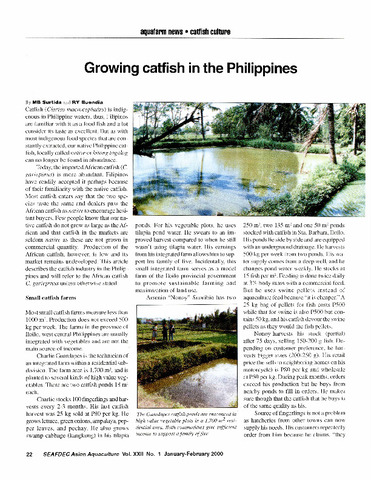
Growing catfish in the Philippines


Share
Abstract
The catfish industry in the Philippines is budding and projected to expand in the coming years. This is evident from conversations with active catfish farmers who all hope to be able to expand production, whether backyard or commercial because their present production can hardly supply the demands of buyers. NIFTDC, a fisheries technology and development center in Dagupan City, Philippines, however, says that unless the government has a catfish program, expansion of the industry would be slow. Work on catfish research is only just starting and the culture methods remain to be on a gut feel basis. The farmers are left to survive on their own. Luckily for them, catfish is hardy, easy to grow, and has a growing market. Clearly, if catfish can provide cheap protein for more people, scientific support must be made available for the farmers.
Suggested Citation
Surtida, M. B., & Buendia, R. Y. (2000). Growing catfish in the Philippines. SEAFDEC Asian Aquaculture , 22(1), 22-24, 33. http://hdl.handle.net/10862/2728
Type
magazineArticleISSN
0115-4974Koleksi
Related items
Showing items related by title, author, creator and subject.
-
'No' to cyanide fishing!
(Aquaculture Department, Southeast Asian Fisheries Development Center, 1999) -
The Philippine industry: Marine tropical fish
(Aquaculture Department, Southeast Asian Fisheries Development Center, 1992) -
CRM in the Philippines: Lessons learned
(Aquaculture Department, Southeast Asian Fisheries Development Center, 1996)Philippine coastal communities can become capable fishery resource managers and that their management practices can become largely self-sustaining if the project approach focuses on assisting fishermen to learn how to help themselves. Community organization is an essential part of the process and should not be viewed as an end product in itself. There are also no quick fixes, and projects require a complex array of activities if large numbers of coastal residents are to be assisted. In some of these projects, the control of illegal fishing combined with limiting of commercial fishing to offshore areas and good coastal habitat management resulted in a doubling of daily fish catch and income for small-scale fishermen. However, even with the best of management, the total fishery harvest is limited and further increases in individual fishing income can only come from reducing total fishing effort. This will require a system of control on access to the resource to limit the number and kind of fishing gears and to divide the resource equitably. Assisting coastal communities to devise and implement realistic equitable access controls is the major challenge facing coastal resource co-management.