The SEAFDEC/AQD experience in stock enhancement


Share
นามธรรม
The Aquaculture Department (AQD) of the Southeast Asian Fisheries Development Center (SEAFDEC) started stock enhancement activities in 2000 as part of the Coastal Fishery Management Project in Malalison Is., Culasi, Antique, Philippines (SEAFDEC/AQD 1998). This was the same year as the Bangkok Declaration and Strategy for Aquaculture Development (NACA/FAO, 2000), which affirmed the potential of stock enhancement to increase fish supply. Since then, research on seed production, and release and monitoring strategies has been initiated on the abalone (Haliotis asinina), seahorses (Hippocampus barbouri, and H. kuda), mud crabs (Scylla serrata, S. olivacea and S. tranquebarica), top shell (Trochus niloticus), and window-pane oyster (Placuna placenta). Closing the life cycle and mass production of juveniles have been attained for most of these species, but actual releases have been conducted only for abalone and mud crabs. In this review article, we describe the present situation of stock enhancement of abalone, mud crab and seahorse at AQD.
การอ้างอิง
Okuzawa, K., Lebata, J., Buen-Ursua, S. M. A., & Quinitio, E. T. (2006). The SEAFDEC/AQD experience in stock enhancement. In J. H. Primavera, E. T. Quinitio, & M. R. R. Eguia (Eds.), Proceedings of the Regional Technical Consultation on Stock Enhancement for Threatened Species of International Concern, Iloilo City, Philippines, 13-15 July 2005 (pp. 17-26). Tigbauan, Iloilo, Philippines: Aquaculture Department, Southeast Asian Fisheries Development Center.
Type
Conference paperISBN
9789718511794Related items
Showing items related by title, author, creator and subject.
-
Application of DNA-based markers in stock enhancement programs
Romana-Eguia, Maria Rowena R. (Aquaculture Department, Southeast Asian Fisheries Development Center, 2006)
Aquaculture and fisheries management require tools for identifying individuals or groups of aquatic organisms for the purpose of monitoring performance (growth, survival and behavior) and stock structure. In aquaculture research, commercially important traits of tagged individuals are assessed to generate supportive data for selective breeding, genetic improvement and commercial-scale fish farming. Fisheries management employs identification systems for the evaluation of stock abundance, population dynamics and documentation of wild and hatchery-bred stocks. Stock structure analysis is useful in the planning and implementation of sound stock management and more importantly, in stock enhancement programs. Blankenship and Leber (1995) underscored the inclusion of tagging/marking strategies for released hatchery stocks in the guidelines for responsible marine stock enhancement. Identifying and keeping track of introduced stocks in release habitats allows an assessment of their adaptability in the wild (Allendorf et al., 1988) and the success of the reseeding and/or restocking effort. Although often used interchangeably, the terms ‘tags’ and ‘markers’ differ by definition. Tags are artificial or synthetic materials that are attached to the aquatic organism to allow individual or group identification while markers are traits or characters either applied or inherent to the organism (Thorsteinsson, 2002). Tags/markers are essential in evaluating resource distribution patterns, behavior, migration and movement of stocks, dynamics of exploited aquatic populations and evolutionary processes, all of which comprise baseline information for any stock management, enhancement and conservation program in aquaculture and fisheries (Allendorf et al 1988, Mulvey et al., 1998).
(Aquaculture Department, Southeast Asian Fisheries Development Center, 2006)
Aquaculture and fisheries management require tools for identifying individuals or groups of aquatic organisms for the purpose of monitoring performance (growth, survival and behavior) and stock structure. In aquaculture research, commercially important traits of tagged individuals are assessed to generate supportive data for selective breeding, genetic improvement and commercial-scale fish farming. Fisheries management employs identification systems for the evaluation of stock abundance, population dynamics and documentation of wild and hatchery-bred stocks. Stock structure analysis is useful in the planning and implementation of sound stock management and more importantly, in stock enhancement programs. Blankenship and Leber (1995) underscored the inclusion of tagging/marking strategies for released hatchery stocks in the guidelines for responsible marine stock enhancement. Identifying and keeping track of introduced stocks in release habitats allows an assessment of their adaptability in the wild (Allendorf et al., 1988) and the success of the reseeding and/or restocking effort. Although often used interchangeably, the terms ‘tags’ and ‘markers’ differ by definition. Tags are artificial or synthetic materials that are attached to the aquatic organism to allow individual or group identification while markers are traits or characters either applied or inherent to the organism (Thorsteinsson, 2002). Tags/markers are essential in evaluating resource distribution patterns, behavior, migration and movement of stocks, dynamics of exploited aquatic populations and evolutionary processes, all of which comprise baseline information for any stock management, enhancement and conservation program in aquaculture and fisheries (Allendorf et al 1988, Mulvey et al., 1998). -
Fishery stock enhancement in Malaysia
(Aquaculture Department, Southeast Asian Fisheries Development Center, 2006)Species extinction is a global issue that requires all nations to practice sustainable management. This paper aims to examine the status of endangered fisheries species in Malaysia, and highlight some resource management initiatives including the restocking and stock enhancement program in the country. Its scope covers only aquaculture-based species, which is in line with the Program on Stock Enhancement for Species of International Concern being implemented by the Southeast Asian Fisheries Development Center/Aquaculture Department in the Philippines. -
Fisheries, aquaculture and stock enhancement in Lao PDR
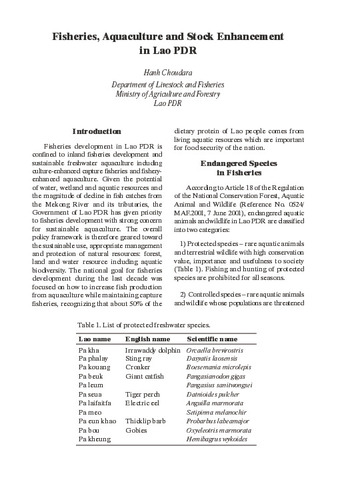
(Aquaculture Department, Southeast Asian Fisheries Development Center, 2006)Fisheries development in Lao PDR is confined to inland fisheries development and sustainable freshwater aquaculture including culture-enhanced capture fisheries and fishery-enhanced aquaculture. Given the potential of water, wetland and aquatic resources and the magnitude of decline in fish catches from the Mekong River and its tributaries, the Government of Lao PDR has given priority to fisheries development with strong concern for sustainable aquaculture. The overall policy framework is therefore geared toward the sustainable use, appropriate management and protection of natural resources: forest, land and water resource including aquatic biodiversity. The national goal for fisheries development during the last decade was focused on how to increase fish production from aquaculture while maintaining capture fisheries, recognizing that about 50% of the dietary protein of Lao people comes from living aquatic resources which are important for food security of the nation.