Stock enhancement activities in the Union of Myanmar


Share
Abstract
Presented in the paper are the stock enhancement programs of the Union of Myanmar which is being implemented by the Department of Fisheries. The State’s vision is to assist the national economy by promoting livelihood programs for rural people through the development of the fisheries sector. To achieve such goal, one of the major activities is to undertake a stock enhancement program which has been implemented since 1983. The DOF subsidizes the annual seeding of freshwater fish and prawns into natural waters. Species used in seeding include common carp (Cyprinus carpio), tilapia (Oreochromis), rohu (Labeo rohita), catla (Catla catla), and featherbacks fish (Notopteridae), freshwater prawn Macrobrachium and tiger shrimp Penaeus monodon. Activities include annual stocking of seeds in the Ayeyarwaddy River and its tributaries, lakes, reservoirs, dams and other bodies of water.
Suggested Citation
Win, K. M. (2006). Stock enhancement activities in the Union of Myanmar. In J. H. Primavera, E. T. Quinitio, & M. R. R. Eguia (Eds.), Proceedings of the Regional Technical Consultation on Stock Enhancement for Threatened Species of International Concern, Iloilo City, Philippines, 13-15 July 2005 (pp. 117-120). Tigbauan, Iloilo, Philippines: Aquaculture Department, Southeast Asian Fisheries Development Center.
Type
Conference paperISBN
9789718511794Related items
Showing items related by title, author, creator and subject.
-
Status of threatened species and stock enhancement activities in the Philippine fisheries
(Aquaculture Department, Southeast Asian Fisheries Development Center, 2006)The paper provides the lists of fisheries related species perceived to be extinct, rare, threatened and endangered as covered under the CITES, IUCN and the Bureau of Fisheries and Aquatic Resources (BFAR)-Fisheries Administrative Order (FAO) No. 208. The listings of freshwater fisheries resources constitute mostly finfishes that are all, except for one, found in the CITES list, the rest under the IUCN red lists and none in the BFAR list. Majority of the listed species are also specific to some areas like Lanao Lake, few in the RINCONADA lakes of Bicol and scarce in some other minor lakes where they are found to be endemic. Most of the indigenous cyprinid species are of commercial value to the locality and are the main source of fish protein in the daily life of the fisherfolk. The listings of marine finfishes constitute mostly sharks and seahorses which are all, except for one, found in the CITES list, the rest under the IUCN Red List and none in the BFAR-FAO list. Although BFAR listed 20 species of whales and dolphins under its FAO 208, marine mammals are not included in this report. Most of the indigenous shark species are becoming rare and extinct due to the rampant shark Status of Threatened Species and Stock Enhancement Activities in the Philippine Fisheries with the rising demand of shark fins smuggled or exported abroad. These marine finfishes are distributed in coastal waters. The listings of marine gastropods, mollusks, crustaceans and echinoderms are all found in the BFAR-FAO listings as Rare, Threatened and Endangered, while few and selective under the CITES and IUCN lists. Accordingly, these are the most common marine resource commodities that are over-exploited, gleaned and gathered illegally, and frequently exported or smuggled out of the country by unscrupulous traders. -
Fishery stock enhancement in Malaysia
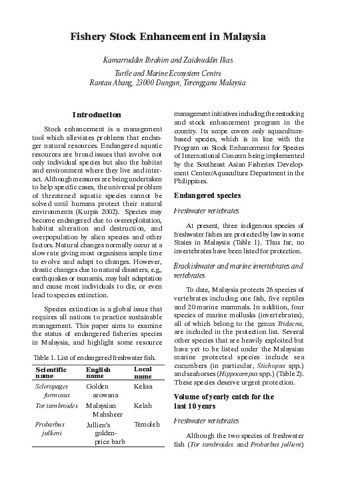
(Aquaculture Department, Southeast Asian Fisheries Development Center, 2006)Species extinction is a global issue that requires all nations to practice sustainable management. This paper aims to examine the status of endangered fisheries species in Malaysia, and highlight some resource management initiatives including the restocking and stock enhancement program in the country. Its scope covers only aquaculture-based species, which is in line with the Program on Stock Enhancement for Species of International Concern being implemented by the Southeast Asian Fisheries Development Center/Aquaculture Department in the Philippines. -
Fisheries, aquaculture and stock enhancement in Lao PDR
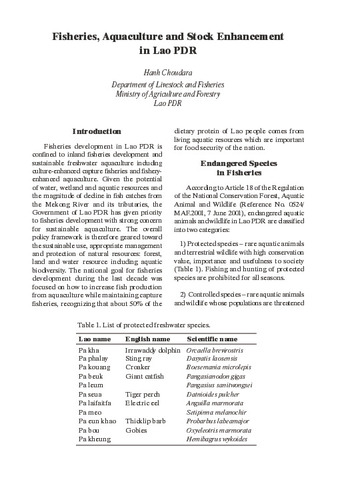
(Aquaculture Department, Southeast Asian Fisheries Development Center, 2006)Fisheries development in Lao PDR is confined to inland fisheries development and sustainable freshwater aquaculture including culture-enhanced capture fisheries and fishery-enhanced aquaculture. Given the potential of water, wetland and aquatic resources and the magnitude of decline in fish catches from the Mekong River and its tributaries, the Government of Lao PDR has given priority to fisheries development with strong concern for sustainable aquaculture. The overall policy framework is therefore geared toward the sustainable use, appropriate management and protection of natural resources: forest, land and water resource including aquatic biodiversity. The national goal for fisheries development during the last decade was focused on how to increase fish production from aquaculture while maintaining capture fisheries, recognizing that about 50% of the dietary protein of Lao people comes from living aquatic resources which are important for food security of the nation.