The filter net [tangab] fishery in Iloilo Strait, Philippines: Food and livelihood for coastal communities in the midst of waste of non-target fishery resources
View/

Date
2008Author

Page views
5,725ASFA keyword

AGROVOC keyword
Metadata
Show full item recordShare
Abstract
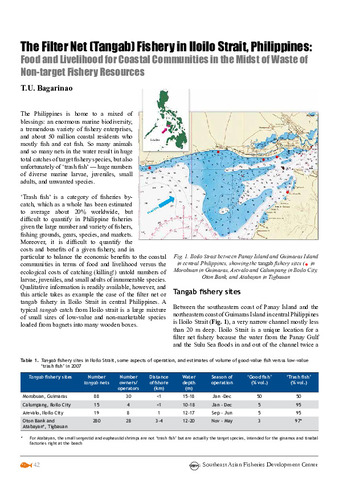
The Philippines is home to a mixed of blessings: an enormous marine biodiversity, a tremendous variety of fishery enterprises, and about 50 million coastal residents who mostly fish and eat fish. So many animals and so many nets in the water result in huge total catches of target fishery species, but also unfortunately of ‘trash fish’ — huge numbers of diverse marine larvae, juveniles, small adults, and unwanted species.
'Trash fish' is a category of fisheries bycatch, which as a whole has been estimated to average about 20% worldwide, but difficult to quantify in Philippine fisheries given the large number and variety of fishers, fishing grounds, gears, species, and markets. Moreover, it is difficult to quantify the costs and benefits of a given fishery, and in particular to balance the economic benefits to the coastal communities in terms of food and livelihood versus the ecological costs of catching (killing!) untold numbers of larvae, juveniles, and small adults of innumerable species. Qualitative information is readily available, however, and this article takes as example the case of the filter net or tangab fishery in Iloilo Strait in central Philippines. A typical tangab catch from Iloilo strait is a large mixture of small sizes of low-value and non-marketable species loaded from bagnets into many wooden boxes.
Suggested Citation
Bagarinao, T. (2008). The filter net [tangab] fishery in Iloilo Strait, Philippines: Food and livelihood for coastal communities in the midst of waste of non-target fishery resources. Fish for the People , 6(3), 42-47. http://hdl.handle.net/20.500.12066/770
Type
magazineArticleISSN
1685-6546Collections
- Fish for the People [41]
Related items
Showing items related by title, author, creator and subject.
-
Beginnings: SEAFDEC/AQD, CFRM, and Malalison Island
(Aquaculture Department, Southeast Asian Fisheries Development Center, 1996)The paper documents the community fishery resources management activities of Southeast Asian Fisheries Development Center, Aquaculture Department (SEAFDEC/AQD) in Malalison Island, Antique, Philippines. -
CRM in the Philippines: Lessons learned
(Aquaculture Department, Southeast Asian Fisheries Development Center, 1996)Philippine coastal communities can become capable fishery resource managers and that their management practices can become largely self-sustaining if the project approach focuses on assisting fishermen to learn how to help themselves. Community organization is an essential part of the process and should not be viewed as an end product in itself. There are also no quick fixes, and projects require a complex array of activities if large numbers of coastal residents are to be assisted. In some of these projects, the control of illegal fishing combined with limiting of commercial fishing to offshore areas and good coastal habitat management resulted in a doubling of daily fish catch and income for small-scale fishermen. However, even with the best of management, the total fishery harvest is limited and further increases in individual fishing income can only come from reducing total fishing effort. This will require a system of control on access to the resource to limit the number and kind of fishing gears and to divide the resource equitably. Assisting coastal communities to devise and implement realistic equitable access controls is the major challenge facing coastal resource co-management. -
Series: Summary of Proceedings No. 1/2013;
Fishery resource assessment of Taal Lake, Batangas, Philippines
(PCAARRD-DOST, 2013)An assessment of fishery resources of Taal Lake was conducted from January to December of 2010. Fish landed catch survey was done in major landing sites of 11 coastal towns around the lake. Sampling was done 20 days a month during peak landing time at 2 days interval. A participatory approach was done by training and hiring fisherfolk leaders to be the data enumerators of their respective towns. A survey form was used to gather the number of fishermen, boats and gears, catch/species composition, volume of catch, gears used, and fishing effort. A total of 1,054 fisherfolk was recorded in Taal Lake. Inventory of the fishing gear listed a total of 2,084 units of 15 different types of fishing gears used in the lake. Gill net was the most dominant gear with 1,258 units or about 60% of the total gears operating in the lake. Three active gears were identified namely, beach seine, motorized push net, and ring net. The average catch per unit effort of gill net was 6.6kg/day while beach seine, motorized push net, and ring net were 26 kg/day, 544 kg/day and 30 kg/day, respectively. There were 1,484 units of boat operating in the lake, of which 1,110 were motorized, 168 non-motorized, and 206 bamboo raft. Previous data showed that total fish production from 1996 to 2000 has declined from 1,420 mt to 882 mt. The highest catch was 1,672 mt in 1998. In 2010, the total production was 273.62 mt, a reduction of 69.7% from the 1998 production. A total of 47 species were recorded comprising of 38 finfishes, four crustaceans, three mollusks, and two reptiles. Of the finfishes caught, four were endemic, 10 introduced and 24 migratory species. The major fishes caught in the lake were Sardinella tawilis, 39.2%, Chanos chanos (26.2%), Oreochromis niloticus (10.8%), Parachromis managuensis (4.8%), and Glossogobius guirus (3.2%). New record of introduced species include pangasius (Pangasianodon hypopthalmus), jaguar fish (Parachromis managuensis), bighead carp (Aristicthys nobilis), red pacu (Macropopum colossoma), janitor fish (Pterygoplichthys disjunctivus), and freshwater turtle (Pelodiscus sinensis).