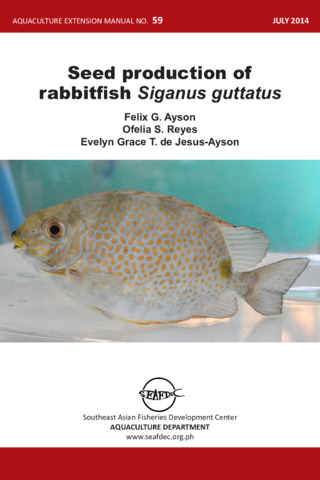
Seed production of rabbitfish Siganus guttatus


Share
抄録
This manual is mainly intended to serve as a practical guide to fishfarmers and other stakeholders interested to venture in operating a rabbitfish hatchery. It details site selection, hatchery design & layout, and protocols in broodstock management, spawning, larval rearing, and harvest & transport. It has also a section on natural food production for rabbitfish larvae.
Suggested Citation
Ayson, F. G., Reyes, O. S., & de Jesus-Ayson, E. G. T. (2014). Seed production of rabbitfish Siganus guttatus. Aquaculture Department, Southeast Asian Fisheries Development Center.
Type
BookISSN
0115-5369シリーズ
Aquaculture extension manual; No. 59Format
19 pages : color illustrations
Collections
Related items
Showing items related by title, author, creator and subject.
-
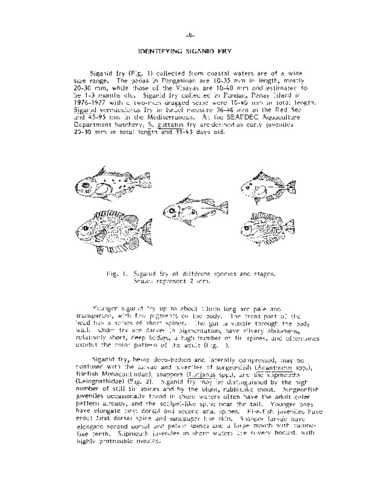
Identifying siganid fry
(Aquaculture Department, Southeast Asian Fisheries Development Center, 1988) -
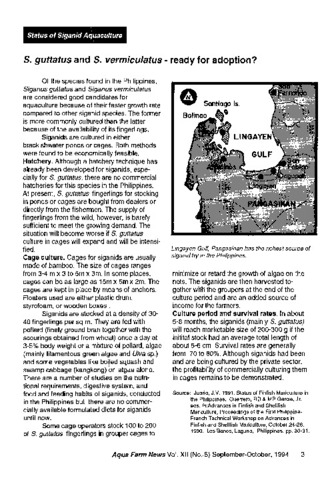
S. guttatus and S. vermiculatus - ready for adoption?
(Aquaculture Department, Southeast Asian Fisheries Development Center, 1994) -
Series: JIRCAS Working Report;No. 35
Notable features of fatty acid composition in mangrove fish species
(Japan International Center for Agricultural Sciences, 2003)Fatty acid composition was determined in several mangrove and commercial species, mangrove red snapper, rabbitfish, milkfish and striped jack that were sampled in the Central Philippines, with special reference to arachidonic acid (AA) and eicosapentaenoic acid (EPA). As overall traits, the mangrove species had intermediate or high AA and docosahexaenoic acid (DHA) levels and low EPA levels compared to species in the high and temperate northern hemisphere, consequently having high AA/EPA ratios. The present results suggest that AA may be nutritionally much more important in tropical/mangrove species than in cold/cool water species. The information of the present study can be used as a guideline for development of appropriate artificial diets for broodstock and/or larvae in mangrove areas.