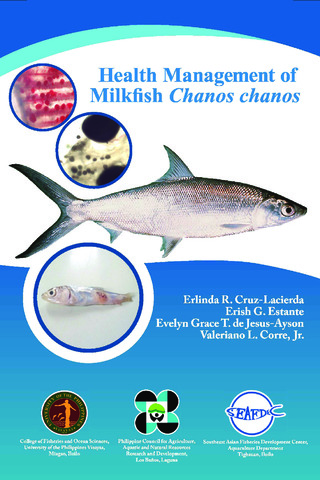
Health management of milkfish Chanos chanos
View/
Date
2015-06Page views
14,817ASFA keyword

AGROVOC keyword
Taxonomic term

Metadata
Show full item recordShare
Abstract
This monograph provides updated information on diseases of marine and brackishwater cultured milkfish in the Philippines. The information presented here is largely based on the results of a three-year research project on milkfish at the University of the Philippines Visayas funded by the Department of Science and Technology (DOST). The project involved surveillance and monitoring of hatchery, nursery and grow-out operations for occurrence of diseases as well as on disease diagnosis, prevention and control. Previously documented reports in the Philippines and in other documents, both published and unpublished, are also included in this monograph. The diseases are discussed on a culture phase basis, that is, disease problems encountered in hatchery-reared larvae and fry are listed first, followed by diseases observed in fingerlings and juveniles grown in nursery and grow-out culture areas, and adult stages maintained in broodstock facilities. Information regarding the causative agent, diagnostic procedures, and methods of prevention and control for each disease are provided, if available.
Suggested Citation
Cruz-Lacierda, E. R., Estante, E. G., de Jesus-Ayson, E. G. T., & Corre Jr., V. L. (2015). Health management of milkfish Chanos chanos. Tigbauan, Iloilo, Philippines: Aquaculture Department, Southeast Asian Fisheries Development Center.
Type
BookISBN
9786219526906Format
36 pages : color illustrations ; 23 cm
Collections
Related items
Showing items related by title, author, creator and subject.
-
Management of fish health in broodstock and larvae of milkfish, sea bass and grouper
(The Oceanic Institute, 1996)Historically, reports on the occurrence of disease problems in milkfish, seabass and grouper were mainly on the isolation and identification of etiological agents. Studies on the tolereance of fish to chemotherapeutants were also conducted. Various species of vibrios and gill-infesting parasites have been associated with diseases in all life stages of these fish. Presently, mortalities due to diseases of unknown etiology, environmental failure and nutritional or husbandry shortfalls affect successful fry production in the hatchery. Morphological deformities in hatchery-produced milkfish fry is a major problem to be solved. In seabass fry production, swim-bladder stress syndrome occasionally occurs and results in mass mortalities. In larval grouper culture, the problem of low survival is being addressed through improved husbandry and nutrition. For cage-held broodstock that naturally spawn in captivity, such as milkfish and grouper, the main problem is fouling of net enclosures in the cages. However, for fish that need hormonal manipulation to spawn, such as seabass and snapper, stressful handling procedures during sampling and hormone injection may lead to injuries and scale loss. The damaged areas become focal points for secondary bacterial infection. Future fish health management strategies in these fish should incorporate a holistic approach to include environmental monitoring, nutritional manipulation, immunostimulants and vaccine use, and biological control in addition to pathogen exclusion in the rearing system and the fish. -
Nursery and grow-out operation and management of milkfish
(Aquaculture Department, Southeast Asian Fisheries Development Center, 1988)This paper reviews the results of studies on the pond culture of milkfish Chanos chanos Forsskal at the SEAFDEC Leganes Brackishwater Station, Leganes, Iloilo since its establishment in 1973. Substantial contribution on the nursery system includes increased stocking density and survival through the use of nylon substrates, supplemental feeding with rice bran, the use of hatchery-reared and stunted fingerlings as alternative sources of stocks, and improvements in the acclimation process. Studies on monoculture and polyculture in grow-out ponds investigated the use of stunted fingerlings, kitchen or algal nursery ponds, stock manipulation techniques, increased stocking density using the plankton method, method frequency and quantity of fertilization, modular pond culture system, and initial findings on fish diseases. Constraints setting back increased production in the Philippines are discussed. -
Pests/parasites and diseases of milkfish in the Philippines
(Aquaculture Department, Southeast Asian Fisheries Development Center; International Development Research Centre; Island Publishing House, Inc., 1984)This paper presents all known parasites of milkfish (Chanos chanos ) in the Philippines. The major parasitic groups include acanthocephalans, copepods, isopods, and heterophyid flukes. The number of parasitic species found in ponds is small compared with those harbored by the fish in its natural environment. Parasites with a direct life cycle usually survive in ponds as flagellates, ciliates, myxosporidians, coccidia, and parasitic arthropods under improper management. The methods of treatment, prevention and control of these parasites are discussed.