Training Handbook on Rural Aquaculture: Recent submissions
Now showing items 21-32 of 32
-
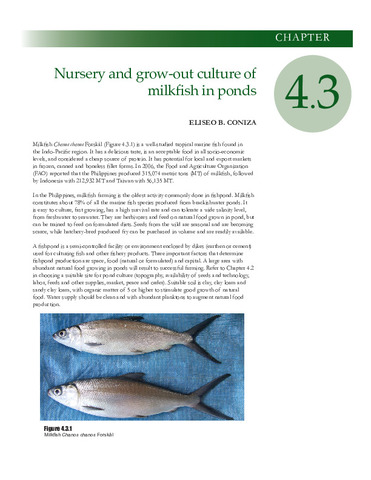
Nursery and grow-out culture of milkfish in ponds
(Aquaculture Department, Southeast Asian Fisheries Development Center, 2009) -
Grow-out culture of seabass, grouper and snapper in ponds
(Aquaculture Department, Southeast Asian Fisheries Development Center, 2009) -
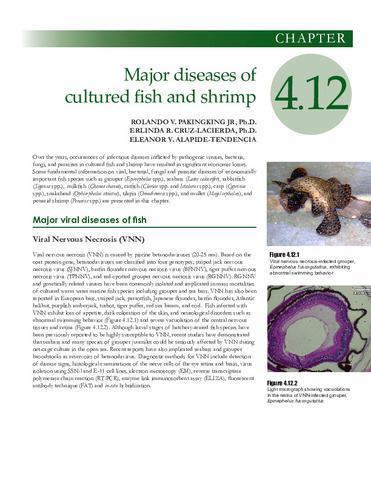
Major diseases of cultured fish and shrimp
Pakingking, Rolando V., Jr. ; ; Tendencia, Eleonor (Aquaculture Department, Southeast Asian Fisheries Development Center, 2009)
-
Aquafeed: formulation, processing of feed ingredients and feed preparation
(Aquaculture Department, Southeast Asian Fisheries Development Center, 2009) -
Nutrient requirements of tropical aquaculture species
(Aquaculture Department, Southeast Asian Fisheries Development Center, 2009) -
Nursery culture of high-value fish species in brackishwater ponds
(Aquaculture Department, Southeast Asian Fisheries Development Center, 2009) -
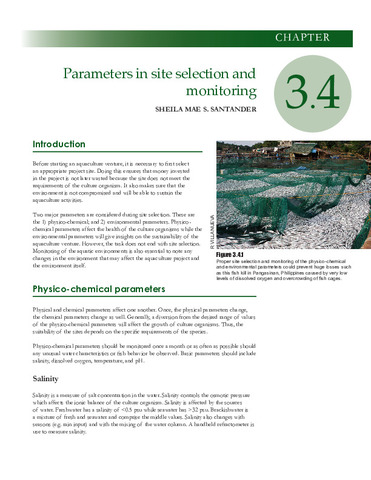
Parameters in site selection and monitoring
(Aquaculture Department, Southeast Asian Fisheries Development Center, 2009)Before starting an aquaculture venture, it is necessary to first select an appropriate project site. Doing this ensures that money invested in the project is not later wasted because the site does not meet the requirements of the culture organism. It also makes sure that the environment is not compromised and will be able to sustain the aquaculture activities. Two major parameters are considered during site selection. These are the 1) physico-chemical; and 2) environmental parameters. Physico-chemical parameters affect the health of the culture organisms while the environmental parameters will give insights on the sustainability of the aquaculture venture. However, the task does not end with site selection. Monitoring of the aquatic environments is also essential to note any changes in the environment that may affect the aquaculture project and the environment itself. -
Coral reefs
(Aquaculture Department, Southeast Asian Fisheries Development Center, 2009) -
Seagrasses
(Aquaculture Department, Southeast Asian Fisheries Development Center, 2009) -
Mangroves
Lebata-Ramos, Ma. Junemie Hazel L. (Aquaculture Department, Southeast Asian Fisheries Development Center, 2009)
-
Sustainable rural aquaculture: concepts and approaches
(Aquaculture Department, Southeast Asian Fisheries Development Center, 2009)This introductory chapter will discuss principles and concepts on community-based aquaculture. The Regional code of conduct for responsible aquaculture will be part of it. -
Guide to readers
(Aquaculture Department, Southeast Asian Fisheries Development Center, 2009)In the ASEAN region, fisheries play an important role in producing food, generating income, and accelerating national social and economic development. Ironically, the fishing communities are the least benefited from the bounties of the vast fishery resources in the region. To make it worse, the fisherfolk were further marginalized in the development and exploitation of the fishery resources especially in aquaculture during the past decades. In fact, they are now suffering from the destruction of fishery resources caused by illegal and irresponsible fishing and aquaculture practices. Fishery communities are exposed to multiple dimensions of poverty (inadequate services, low level of education, politically poorly organized communities, and vulnerability), which are complicated to solve within a short term. In order to address the grinding poverty among the fisherfolk, access to technology may need to be improved. One way is disseminating the science-based technologies on aquaculture that were developed by SEAFDEC Aquaculture Department after 35 years of research-and-development. Hence, this handbook, which gives fisherfolk communities a lot of options to earn from aquaculture. The important thing though is that this handbook presents the technologies in the context of prudent resource management and resource use such that communities and aquaculture entrepreneurs will make sustainable living and enable future generations to do the same.