Mangroves as mud crab habitats


Date
2017Author
Page views
7,419ASFA keyword
aquaculture economics 
aquaculture techniques
associated species
cage culture
crab culture
culture effects
feeds
feeding
habitat improvement (biological)
habitats
mangrove swamps
mangroves
marine crustaceans
monoculture
polyculture (aquaculture)
population density
population dynamics
resource conservation
seedlings
stocking (organisms)
stocks
aquaculture techniques
associated species
cage culture
crab culture
culture effects
feeds
feeding
habitat improvement (biological)
habitats
mangrove swamps
mangroves
marine crustaceans
monoculture
polyculture (aquaculture)
population density
population dynamics
resource conservation
seedlings
stocking (organisms)
stocks
AGROVOC keyword
Metadata
Show full item recordShare
Abstract
The paper reports the use of mangroves by Scylla species both as wild and culture habitats. Based on published literature, natural mangrove crab populations are described in terms of population density, dispersal and movement within and outside mangroves, crab burrows and associated mangrove species. Strategies for Scylla conservation depend on the kind of mangrove habitat - (mangrove) restoration for open fringing mangroves where crab recruitment and abundance are determined by habitat availability vs stock enhancement in closed basin mangroves with restricted recruitment and limited movement of crabs.
Mangrove crabs are also reared in monoculture in mangrove cages and pens, or in polyculture with milkfish in extensive ponds (where mangroves used to thrive). The paper describes a SEAFDEC Aquaculture Department study to evaluate the effects of mud crab net pen systems on mangrove macroflora, and the replacement of dietary trash fish with low-cost pellets. Results showed that incomplete, low-cost pellets can replace fish biomass requirement in mud crab diets, but that crab presence resulted in fewer mangrove seedlings and saplings. Economic analysis showed the viability of crab culture in mangrove pens using a combination of fish biomass and pellets to reduce the requirement for (low-value) fish, which is a food item of poor coastal communities.
Suggested Citation
Primavera, J. H. (2017). Mangroves as mud crab habitats. In E. T. Quinitio, F. D. Parado-Estepa, & R. M. Coloso (Eds.), Philippines : In the forefront of the mud crab industry development : proceedings of the 1st National Mud Crab Congress, 16-18 November 2015, Iloilo City, Philippines (pp. 99-103). Tigbauan, Iloilo, Philippines: Aquaculture Department, Southeast Asian Fisheries Development Center.
Type
Conference paperISBN
9789719931072Collections
Related items
Showing items related by title, author, creator and subject.
-
Milkfish ponds from mangroves
Bagarinao, Teodora (Aquaculture Department, Southeast Asian Fisheries Development Center, 1998)
-
Series: Aquaculture extension manual; No. 77
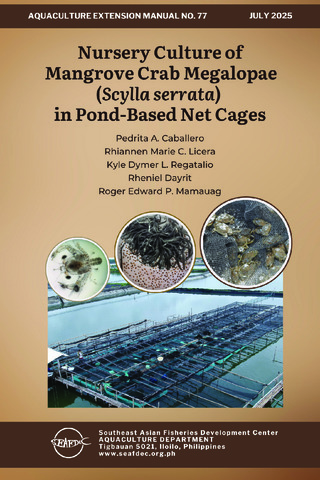
Nursery culture of mangrove crab megalopae (Scylla serrata) in pond-based net cages
Caballero, Pedrita; ; Regatalio, Kyle Dymer ; ; Mamauag, Roger Edward (Aquaculture Department, Southeast Asian Fisheries Development Center, 2025-07)
This manual, titled “Nursery Culture of Mangrove Crab Megalopae (Scylla serrata) in Pond-Based Net Cages,” is part of SEAFDEC/AQD’s effort to assess the potential of using megalopae as the starting stock in pond-based net cage nurseries. The method is intended to enhance survival rates during the grow-out stage. Given the increasing availability of hatchery-reared megalopae and the high cost of crab instars, the manual also evaluates the cost-effectiveness and practical advantages of using megalopae in nursery operations. Hatchery-sourced megalopae offer key benefits over wild-caught ones, including consistent supply, environmental sustainability, disease-free status, species certainty, and stable pricing. This approach could help increase hatchery production cycles and lower overall production expenses in the crab farming industry. The manual covers various aspects, including mangrove crab biology, site selection, pond preparation, nursery management, packing and transport procedures, and economic analysis. The authors hope this resource will serve as a practical guide for crab farmers, farm managers, aquaculture professionals, technicians, and students by providing essential knowledge on science-based aquaculture practices. -
Fish habitats in a small, human-impacted Sibunag mangrove creek (Guimaras, Philippines): a basis for mangrove resource enhancement
; Bagarinao, Teodora; (Elsevier, 2012)
The fish assemblage of a small, open access mangrove creek highly influenced by aquaculture farms, was studied for the first time in the Philippines as a baseline of such system as well as examining the degree of ecological disturbance among fish habitats, as basis for the necessity to rehabilitate mangrove resources aiming to balance human activities and mangrove functioning. In total, 475 fishes (total weight = 3875 g) were captured and 50 species representing 32 families were identified. Thirty two species were represented by small numbers (< 5 individuals). Commercial species was considerably high (~23 species) but majority were low grade commercial species. Total species, species diversity and fish abundance consistently showed a decreasing pattern from outside creek to inner creek. Fish habitats exhibited substantial differences following a distinct spatial segregation of fish communities, a dominance of non-shared species and a minimal species overlapping inside the creek, which is attributable to the existing mangrove fragmentation associated with aquaculture ponds in the area. Increasing levels of disturbances were observed within the creek indicating ‘stress’ as a result of overutilization of mangroves by aquaculture farms. Our results confirmed the need to rehabilitate mangrove resources in this area. The development of mangrove resources through reforestation, coupled by strict regulation of fishing activities and aquaculture ponds will reduce ecological stress in the area and regain gradually a robust mangrove functioning that will improve fish diversity, fisheries and productivity of adjacent coastal systems by creating a suitable fish nursery, feeding ground and refuge habitat.