Fisheries, cultivation and research aspects of mud crab (Genus Scylla) in China
View/
Date
2015Page views
3,726
AGROVOC keyword
Taxonomic term

Geographic names

Metadata
Show full item recordShare
Abstract
Mud crabs are distributed only along the coastal areas of southeast China. Of the four Scylla species found in China, Scylla paramamosain is the dominant species. The annual wild catch of mud crabs in mainland China was 60,000-70,000 mt. The highest annual production from farming was 120,000 mt.
The main species cultured is S. paramamosain. Fattening (involves the feeding of immature female crabs until their ovaries become mature), polyculture and monoculture are commonly practiced. Farming is done in earthen ponds and pens in intertidal zone and mangrove area. The seeds for farming are mostly from the wild and only about 10% are sourced from the hatchery. Occurrence of diseases and differences in the population are the main problems in mud crab farming in China. At present, research activities on mud crab that are being undertaken include reproductive biology, hatchery and farming technology. Further research on the prevention of diseases and development of formulated diets (ingredient selection, nutritional requirements, pellet size, shape and stability) are necessary.
Suggested Citation
Wang, G.-Z. (2015). Fisheries, cultivation and research aspects of mud crab (Genus Scylla) in China. In E. T. Quinitio, F. D. Parado-Estepa, Y. C. Thampi Sam Raj, & A. Mandal (Eds.), Proceedings of the International Seminar-Workshop on Mud Crab Aquaculture and Fisheries Management, 10-12 April 2013, Tamil Nadu, India (pp. 7-15). Tamil Nadu, India: Rajiv Gandhi Centre for Aquaculture (MPEDA).
Type
Conference paperISBN
9788192989815Related items
Showing items related by title, author, creator and subject.
-
Larval rearing of mud crab (Scylla): What lies ahead
; ; Quinitio, Emilia T. ; ; ; ; ; ; ; (Elsevier, 2018)
The increasing global demand for mud crabs (genus Scylla) and threats to the wild populations highlight the urgency of fully rearing them in captivity. Despite considerable progress in mud crab production, most crab farms still rely heavily on wild-caught crablets and juveniles while the low and inconsistent success rates of larviculture remain as the main bottleneck impeding the development of mud crab aquaculture. Over the years, numerous studies have been conducted to determine the optimum larval rearing parameters, the ontogenic changes in digestive function and feeding behaviour, and the diets for different larval stages. These data, however, are dispersed and not summarised to inform culture practices. This review provides an update on the current progresses and to pinpoint the gaps in knowledge regarding mud crab larval rearing. We include all four mud crab species under the genus Scylla, i.e. Scylla serrata, Scylla olivacea, Scylla tranquebarica and Scylla paramamosain. Knowledge compiled in this review serves as an important guideline for prospective mud crab larviculture. Future research should gear towards filling in the gaps in our knowledge to advance mud crab larval rearing, thus fully incorporating mud crab into the aquaculture sector.
; ; ; ; ; ; ; (Elsevier, 2018)
The increasing global demand for mud crabs (genus Scylla) and threats to the wild populations highlight the urgency of fully rearing them in captivity. Despite considerable progress in mud crab production, most crab farms still rely heavily on wild-caught crablets and juveniles while the low and inconsistent success rates of larviculture remain as the main bottleneck impeding the development of mud crab aquaculture. Over the years, numerous studies have been conducted to determine the optimum larval rearing parameters, the ontogenic changes in digestive function and feeding behaviour, and the diets for different larval stages. These data, however, are dispersed and not summarised to inform culture practices. This review provides an update on the current progresses and to pinpoint the gaps in knowledge regarding mud crab larval rearing. We include all four mud crab species under the genus Scylla, i.e. Scylla serrata, Scylla olivacea, Scylla tranquebarica and Scylla paramamosain. Knowledge compiled in this review serves as an important guideline for prospective mud crab larviculture. Future research should gear towards filling in the gaps in our knowledge to advance mud crab larval rearing, thus fully incorporating mud crab into the aquaculture sector. -
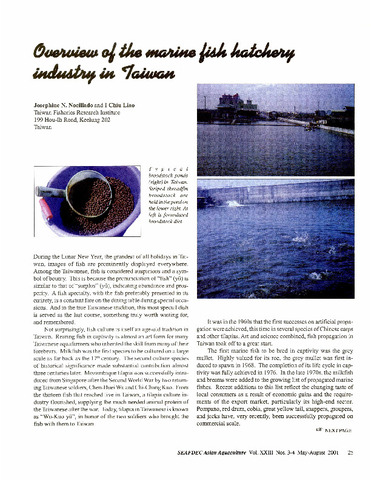
Overview of the marine fish hatchery industry in Taiwan
(Aquaculture Department, Southeast Asian Fisheries Development Center, 2001)Although fish culture itself is an age-old tradition in Taiwan, it was in the 1960s that the first successes on artificial propagation were achieved, with several species of Chinese carps and tilapias. The first marine fish to be bred in captivity was the grey mullet; it was first induced to spawn in 1968. Various other species have since been added to the list of propagated marine fish. The characteristics of the marine fish hatchery industry in Taiwan are outlined, considering both the outdoor pond and indoor tank systems. Future prospects are very good; Taiwan now exports marine fish larvae and fingerlings to many of its Asian neighbours and there are some 60 marine fish species for which commercial larval production is possible. -
Kaleidoscope of the prawn industry
(Aquaculture Department, Southeast Asian Fisheries Development Center, 1989)