Survival of larval milkfish, Chanos chanos, during changeover from endogenous to exogenous energy sources

ดู/
วันที่
1990Page views
3,672ASFA keyword

AGROVOC keyword
Taxonomic term

เมตาดาต้า
แสดงระเบียนรายการเต็มShare
นามธรรม
Survival of laboratory-reared larvae of milkfish, Chanos chanos , during transition from the prelarval to postlarval stages was examined in relation to the changeover of energy sources. The prelarval and early postlarval stages of the fish can be divided into 5 phases; 1) rapid growth corresponding to rapid yolk less rapid yolk resorption; 3) stagnant growth with rapid yolk resorption, yolk being still the only nutrient for the larvae; 4) stagnant growth based on both yolk and exogenous food, from the onset of feeding to the complete exhaustion of yolk; and 5) rapid growth based solely on exogenous food. The survival rate decreased when the larvae depended solely on yolk, then leveled off when they had both endogenous and exogenous energy sources, and again declined when they came to depend totally on exogenous food. Feeding during the period from the onset of feeding to complete yolk resorption seems important for the successful survival of milk-fish larvae thereafter.
การอ้างอิง
Kohno, H., Duray, M., Gallego, A. & Taki, Y. (1990). Survival of larval milkfish, Chanos chanos, during changeover from endogenous to exogenous energy sources. In R. Hirano & I. Hanyu (Eds.), The Second Asian Fisheries Forum: Proceedings of the Second Asian Fisheries Forum, Tokyo, Japan, 17 - 22 April 1989 (pp. 437-440). Manila, Philippines: Asian Fisheries Society.
Type
Conference paperคอลเลกชัน
- Conference Proceedings [300]
Related items
Showing items related by title, author, creator and subject.
-
Series: Aquaculture extension manual; No. 25
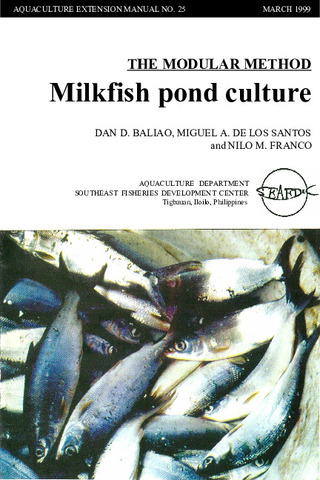
The modular method: Milkfish pond culture
(Aquaculture Department, Southeast Asian Fisheries Development Center, 1999)The modular method of milkfish culture (Chanos chanos) described in the manual is an improvement over the traditional extensive method. The manual is intended for the use of fish farmers and aquaculturists, extensionists, and students of aquaculture not only in the Philippines, but also in other milkfish-producing countries in Southeast Asia and the world. It covers the following: Interesting facts about milkfish -- biological characteristics, artificial breeding of milkfish; Design and operation of modular pond system -- pond preparation, stocking in the nursery or transition ponds, stocking in the rearing ponds, care of stock, pond utilization and production schedule, harvest and post-harvest; and, Economics and costing. -
Evaluation of organic and inorganic fertilizers in brackishwater milkfish ponds
(Elsevier, 1989)The study was conducted in twelve 144-m2 ponds to evaluate the effect of different organic and inorganic fertilizers on the growth, survival, gross production, and profitability of marketable milkfish. The following treatments were used: Treatment I, SEAFDEC traditional fertilization practice (16-20-0 at 50 kg/ha and 45-0-0 at 15 kg/ha); Treatment II, half-dosage of Treatment I; Treatment III, chicken manure at 0.5 ton/ha; and Treatment IV, MASA (processed from agricultural and industrial wastes) fertilizer at 0.5 ton/ha. All treatments were applied once in every 2 weeks. No significant difference (P > 0.05) existed in the harvest and production of milkfish among the treatments. However, economic indicators such as return-on-investment (ROI), payback period, and marginal analysis ranked the performance of the fertilizer treatments in the order of I, II, III and IV. Fish kills occurred in three ponds applied with chicken manure and MASA fertilizer. This could have been due to a heavy build-up of organic matter in the pond bottom which led to the collapse of the benthic algal community, depletion of dissolved oxygen and the presence of hydrogen sulfide. It is therefore suggested that a lower dosage of organic fertilizer should be applied in ponds especially during the rainy season. -
Milkfish breeding and hatchery technology at SEAFDEC/AQD
(Aquaculture Department, Southeast Asian Fisheries Development Center, 1999)Describes the techniques already adopted by the private sector: broodstock management, broodstock diet, commercial fry production, live transport, and larval diet. A list of AQD research publications on milkfish is included.