Preliminary capture, husbandry and induced breeding results with the milkfish, Chanos chanos (Forskal)


Share
Abstract
The program objective is to breed the milkfish, Chanos chanos (Forskal), in captivity and to raise the fry from the egg, undertaking any research and development which may be necessary to attain that goal.
In this, the first year of the project, eight very mature fish were captured and deemed ready for final spawning inducement. One fish (with eggs 0.818 mm in diameter) hydrated and was partially ovulated by two injections of 25 mg salmon gonadotrophin SG-G100. The eggs were not fertilized. The injection procedure or excessive handling and sampling of three other fish resulted in early atresia (reabsorption) of the oocytes. Two fish died from the sampling and handling procedures, and two proved to be too immature with eggs below 0.6 mm in diameter.
Preliminary results indicate that oocytes of 0.8 mm and above are at a critical stage (or beyond) at which immediate hypophysation is needed. Injection cannot be delayed. Excessive handling or stress at this stage causes rapid atresia of the oocytes. It appears that oocytes of about 0.7 mm are more suitable for reacting positively to injections. The size of an ovulated egg is about 1.2 mm in diameter.
The level and dose rate of SG-G100 used for mullet (20)µg/g body weight) appears too high for the milkfish. A dose of between 12 and 15 µg/g body weight is suggested at present.
A resident population of adults of varying ages, numbering over 50 fish, has been assembled. Some were brought from the island of Hawaii to Oahu by land and sea involving 18 hours of travel. All survived the journey. Consequently a small operating satellite field center has been established on Hawaii.
A total of 179 dead adult fish have been used for future compilation of age, weight/length, GSI, scale and otolith data. All of the samples are stored. Determination of the GSI for Hawaiian fish indicated a rapid maturation of oocytes and spermatids in June, with a peak spawning period in July and early August.
Adult fish have been placed under photoperiod and temperature-regulated conditions to promote maturation out of season.
General husbandry methods have been developed for adults in captivity, and a diet formulated which appears to be acceptable.
The work on health care is proving to be very informative. Safe handling systems have been developed using ice, and hypotheses made for the results of this treatment and general conditions of stress. Autopsies on dead fish have revealed growths and evidence of heart attack and gastritis. Techniques using commercially available human clinical test kits are proving useful indicators of stress; for example, the presence of hemoglobin and ketones in the mucus increases with stress.
Eye lens protein analyses are being undertaken to determine any different racial origins of milkfish.
Suggested Citation
Nash, C. E., & Kuo, C.-M. (1976). Preliminary capture, husbandry and induced breeding results with the milkfish, Chanos chanos (Forskal). In Proceedings of the International Milkfish Workshop Conference, May 19-22, 1976, Tigbauan, Iloilo, Philippines (pp. 139-159). Tigbauan, Iloilo, Philippines: Aquaculture Department, Southeast Asian Fisheries Development Center.
Type
Conference paperCollections
Related items
Showing items related by title, author, creator and subject.
-
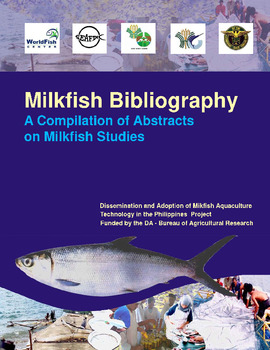
Milkfish bibliography: a compilation of abstracts on milkfish studies
(WorldFish Center, 2007)Milkfish Bibliography covers 700 references on milkfish biology; broodstock management and fry, fingerling and egg collection and production; milkfish culture systems; health and nutrition; post harvest technology; socioeconomic and related studies; and environment and ecology. Included references range from published/unpublished documents, theses, journal articles, to project reports and conference papers. -
Ongoing research studies on maturation and spawning of milkfish, Chanos chanos at the brackishwater shrimp and milkfish culture applied research and training project, Jepara, Indonesia
(Aquaculture Department, Southeast Asian Fisheries Development Center, 1976)The paper gives an account of the research work carried out at Jepara, Indonesia, on induction of maturity of milkfish in ponds and enclosures, and procurement of the spawners from the wild for seed production by hypophysation. Seven to eight years old pond grown milkfish were found sexually immature. Experiments are being conducted for growing and inducing maturity in 1-2 years old milkfish in fertilized ponds with regular tidal flow of water and also under regular hypophysation program. Milkfish spawners collected from sea had a few males in oozing condition and females mostly spent. -
Ration reduction, integrated multitrophic aquaculture (milkfish-seaweed-sea cucumber) and value-added products to improve incomes and reduce the ecological footprint of milkfish culture in the Philippines
(AquaFish Collaborative Research Support Program, Oregon State University, 2012)In the Philippines, cage culture of milkfish in marine environments is increasing. The practice uses high stocking densities, with significantly greater inputs of artificial feeds which more often than not, have led to excessive feeding and consequently excessive nutrient loading in receiving waters, exacerbating problems with pollution. These could have contributed to occurrence of periodic fish kills in areas of marine milkfish culture clusters. In marine cage culture, about 80% of variable expenses are attributable to feed costs. Experiments were conducted to compare production characteristics of milkfish fed on alternate days versus those raised on daily feeding in marine cage culture. Fish were fed either daily or every other day using a reduced feed ration at 7.5% of fish biomass at the start of culture down to 3% of fish biomass towards harvest. We showed this ration level was as effective as the industry standard that begins at a rate of 10% average body weight. Morevover, we had previously found that milkfish reared in brackishwater ponds on an alternate day feeding scheme using the reduced ration level produced a 56% cost savings in feed with little impact on total yield relative to fish raised on a daily feeding protocol. In the present study, survival rates (~ 90%) were comparable between the control fish fed daily and groups fed on alternate days in marine cages. Similarly, total harvested biomass of fish in the alternate day and daily feeding groups was similar as was the harvest value, although fish on the alternate day feeding scheme grew slightly less. The amount of feed and the corresponding cost of feeds consumed were significantly lower in stocks that were fed on alternate days compared with those fed daily (P < 0.05). Feed conversion ratio (FCR) was lower in the alternate-day fed group (FCR = 2.46) relative to stocks fed daily (FCR = 3.59). Overall, the results demonstrate that feed costs can be reduced by around 32% in stocks fed on alternate days, which yields an estimated 20-25% improvement in production efficiency relative to raising animals on a daily feeding protocol. Hence, a significant costs savings with reduced impact of nutrient loading in the environment is likely to be realized for farmers who adopt an alternate day feeding scheme in raising milkfish in marine cages.