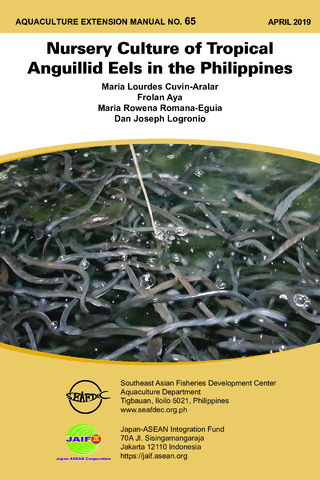
Nursery culture of tropical anguillid eels in the Philippines


Share
Description
This technical publication focused on nursery production of anguillid eels from glass eels to elver using data gathered from eel farm surveys and rearing trials conducted by SEAFDEC/AQD as part of the JAIF (Japan-ASEAN Integration Fund) project on Enhancing Sustainable Utilization and Management Scheme for Tropical Anguillid Eel Resources in Southeast Asia.
Suggested Citation
Cuvin-Aralar, M. L., Aya, F. A., Romana-Eguia, M. R., & Logronio, D. J. (2019). Nursery culture of tropical anguillid eels in the Philippines. Tigbauan, Iloilo, Philippines: Aquaculture Department, Southeast Asian Fisheries Development Center.
Type
BookISSN
0115-5369Series
Aquaculture extension manual; No. 65Collections
Related items
Showing items related by title, author, creator and subject.
-
High genetic diversity in anguillid glass eels across three Southeast Asian countries revealed through mitochondrial DNA D-loop sequences, with notes on population structure
; ; Santos, Mudjekeewis ; Romana-Eguia, Maria Rowena R. ; ; (Elsevier, 2024-09)
Understanding the genetic diversity and population structure of anguillid eels is crucial for effective management. In this study, we used the mitochondrial DNA (mtDNA) D-loop marker to identify anguillid glass eels and assessed their genetic diversity across six sampling sites spanning three Southeast Asian countries. We also examined the population structures of Anguilla marmorata and A. celebesensis. We validated nine distinct species and subspecies of anguillid eels from 465 specimens collected in Indonesia (n = 246), the Philippines (n = 119), and Vietnam (n = 100). High gene diversities were observed across the species, ranging from 0.979 (A. celebesensis) to 1.000 (A. bicolor bicolor, A. marmorata, and A. interioris). Correspondingly, nucleotide diversity values were relatively low, varying from 0.036 (A. marmorata) to 0.057 (A. interioris). A. marmorata (n = 162) displayed a broad distribution, being observed across all six sites, with a significant yet low average fixation index of 0.05755. Pairwise comparisons of FST values between Cimandiri and other locations (except for Cagayan) were relatively high and statistically significant (p < 0.01), indicating significant genetic differentiation of Cimandiri samples compared to most locations in this study. On the other hand, A. celebesensis (n = 110), exhibited a non-significant and low fixation index (0.007), indicating no genetic differentiation in samples from Poso and Poigar Rivers, Indonesia. Our findings highlight the essential need for coordinated management strategies among regions that share common stocks. Additionally, this study underscores the efficacy of the mtDNA D-loop in precisely identifying glass eel species/subspecies and elucidating the genetic diversity and population structure of tropical anguillid eels.
; Romana-Eguia, Maria Rowena R. ; ; (Elsevier, 2024-09)
Understanding the genetic diversity and population structure of anguillid eels is crucial for effective management. In this study, we used the mitochondrial DNA (mtDNA) D-loop marker to identify anguillid glass eels and assessed their genetic diversity across six sampling sites spanning three Southeast Asian countries. We also examined the population structures of Anguilla marmorata and A. celebesensis. We validated nine distinct species and subspecies of anguillid eels from 465 specimens collected in Indonesia (n = 246), the Philippines (n = 119), and Vietnam (n = 100). High gene diversities were observed across the species, ranging from 0.979 (A. celebesensis) to 1.000 (A. bicolor bicolor, A. marmorata, and A. interioris). Correspondingly, nucleotide diversity values were relatively low, varying from 0.036 (A. marmorata) to 0.057 (A. interioris). A. marmorata (n = 162) displayed a broad distribution, being observed across all six sites, with a significant yet low average fixation index of 0.05755. Pairwise comparisons of FST values between Cimandiri and other locations (except for Cagayan) were relatively high and statistically significant (p < 0.01), indicating significant genetic differentiation of Cimandiri samples compared to most locations in this study. On the other hand, A. celebesensis (n = 110), exhibited a non-significant and low fixation index (0.007), indicating no genetic differentiation in samples from Poso and Poigar Rivers, Indonesia. Our findings highlight the essential need for coordinated management strategies among regions that share common stocks. Additionally, this study underscores the efficacy of the mtDNA D-loop in precisely identifying glass eel species/subspecies and elucidating the genetic diversity and population structure of tropical anguillid eels. -
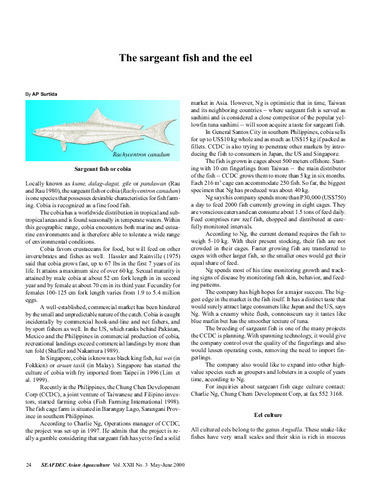
The sargeant fish and the eel
(Aquaculture Department, Southeast Asian Fisheries Development Center, 2000)The culture of sargeant fish, or cobia (Rachycentron canadum) and eel (Anguilla spp) in the Philippines is discussed. Market potentials for the cultured products are examined. -
The effects of iron compounds on the virulence of Vibrio anguillarum in Japanese eels and ayu
(Japanese Society of Fish Pathology, 1987)When Japanese eels (Anguilla japonica) were injected intramuscularly (IM) with ferric ammonium citrate (FAC) at a sublethal dose of 10 µg/g and followed by IM-injection with various doses of Vibrio anguillarum, FAC injection enhanced greatly the virulence of the pathogen to eels, lowering the LD50 value from 107.9 to 104.2 CFU/100 g. Similar effects were obtained with ferrous sulfate and ferric chloride in eels. However, such a virulence-enhancing effect of FAC was scarcely observed in ayu (Plecoglossus altivelis), which has high susceptibility to the pathogen by nature. It was also found that addition of FAC (10 µg/ml) in fish sera accelerated the bacterial growth in vitro but the effect was much greater in eel serum than in ayu serum. The results of these in vivo and in vitro experiments demonstrated that the availability of free iron in host fish would have a significant influence on the pathogenesis of V. anguillarum infection.