High genetic diversity in anguillid glass eels across three Southeast Asian countries revealed through mitochondrial DNA D-loop sequences, with notes on population structure

View/
Date
2024-09Page views
920ASFA keyword

AGROVOC keyword

Geographic names

Metadata
Show full item recordShare
Abstract
Understanding the genetic diversity and population structure of anguillid eels is crucial for effective management. In this study, we used the mitochondrial DNA (mtDNA) D-loop marker to identify anguillid glass eels and assessed their genetic diversity across six sampling sites spanning three Southeast Asian countries. We also examined the population structures of Anguilla marmorata and A. celebesensis. We validated nine distinct species and subspecies of anguillid eels from 465 specimens collected in Indonesia (n = 246), the Philippines (n = 119), and Vietnam (n = 100). High gene diversities were observed across the species, ranging from 0.979 (A. celebesensis) to 1.000 (A. bicolor bicolor, A. marmorata, and A. interioris). Correspondingly, nucleotide diversity values were relatively low, varying from 0.036 (A. marmorata) to 0.057 (A. interioris). A. marmorata (n = 162) displayed a broad distribution, being observed across all six sites, with a significant yet low average fixation index of 0.05755. Pairwise comparisons of FST values between Cimandiri and other locations (except for Cagayan) were relatively high and statistically significant (p < 0.01), indicating significant genetic differentiation of Cimandiri samples compared to most locations in this study. On the other hand, A. celebesensis (n = 110), exhibited a non-significant and low fixation index (0.007), indicating no genetic differentiation in samples from Poso and Poigar Rivers, Indonesia. Our findings highlight the essential need for coordinated management strategies among regions that share common stocks. Additionally, this study underscores the efficacy of the mtDNA D-loop in precisely identifying glass eel species/subspecies and elucidating the genetic diversity and population structure of tropical anguillid eels.
Suggested Citation
Marini, M., Pedrosa-Gerasmio, I. R., Santos, M., Romana-Eguia, M. R. R., Nguyen, B. T., & Shibuno, T. (2024). High genetic diversity in anguillid glass eels across three Southeast Asian countries revealed through mitochondrial DNA D-loop sequences, with notes on population structure. Ecological Genetics and Genomics , 32, 100276. https://doi.org/10.1016/j.egg.2024.100276
Type
ArticleISSN
2405-9854Collections
- Journal Articles [1267]
Related items
Showing items related by title, author, creator and subject.
-
Potentials and prospects of Southeast Asian eel resources for sustainable fisheries and aquaculture development
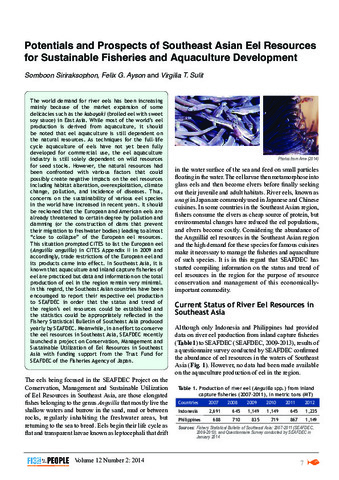
(Secretariat, Southeast Asian Fisheries Development Center, 2014)The world demand for river eels has been increasing mainly because of the market expansion of some delicacies such as the kabayaki (broiled eel with sweet soy sauce) in East Asia. While most of the world’s eel production is derived from aquaculture, it should be noted that eel aquaculture is still dependent on the natural resources. As techniques for the full-life cycle aquaculture of eels have not yet been fully developed for commercial use, the eel aquaculture industry is still solely dependent on wild resources for seed stocks. However, the natural resources had been confronted with various factors that could possibly create negative impacts on the eel resources including habitat alteration, overexploitation, climate change, pollution, and incidence of diseases. Thus, concerns on the sustainability of various eel species in the world have increased in recent years. It should be reckoned that the European and American eels are already threatened to certain degree by pollution and damming (or the construction of dams that prevent their migration to freshwater bodies) leading to almost “close to collapse” of the European eel resources. This situation prompted CITES to list the European eel (Anguilla anguilla) in CITES Appendix II in 2009 and accordingly, trade restrictions of the European eel and its products came into effect. In Southeast Asia, it is known that aquaculture and inland capture fisheries of eel are practiced but data and information on the total production of eel in the region remain very minimal. In this regard, the Southeast Asian countries have been encouraged to report their respective eel production to SEAFDEC in order that the status and trend of the region’s eel resources could be established and the statistics could be appropriately reflected in the Fishery Statistical Bulletin of Southeast Asia produced yearly by SEAFDEC. Meanwhile, in an effort to conserve the eel resources in Southeast Asia, SEAFDEC recently launched a project on Conservation, Management and Sustainable Utilization of Eel Resources in Southeast Asia with funding support from the Trust Fund for SEAFDEC of the Fisheries Agency of Japan. -
Genetic diversity, population structure and demographic history of the tropical eel Anguilla bicolor pacifica in Southeast Asia using mitochondrial DNA control region sequences
; ; ; ; ; Romana-Eguia, Maria Rowena R. ; (Elsevier, 2021-04)
The tropical catadromous eel, Anguilla bicolor pacifica, an important fishery resource in Southeast Asia, is under threat due to overexploitation (especially of its glass eel phase) and the limited information on their current genetic status which is necessary for resource management. Mitochondrial DNA (mtDNA) control region sequences, a useful marker for population genetic studies in many aquatic organisms, were used to investigate the genetic diversity, population structure and demographic history of A. bicolor pacifica in the region. A total of 151 specimens were collected from three sites in Southeast Asia, namely: Phu Yen, Vietnam (n = 48); General Santos, Philippines (n = 52); and, Palu, Indonesia (n = 51). A total of 138 haplotypes were identified using the mtDNA control region sequences. In spite of the lack of shared haplotypes, low and non-significant \(F_{ST}\) values, high haplotype diversity in concurrence with relatively low nucleotide diversity, a haplotype network with no phylogeographic structuring indicate no significant genetic population structuring among the eel samples from Vietnam, Philippines and Indonesia. Population expansion of A. bicolor pacifica was also suggested based on the results of the neutrality tests, mismatch distribution analysis and Bayesian skyline plot. Taken together, a joint management strategy for A. bicolor pacifica must involve countries in Southeast Asia particularly Vietnam, Philippines and Indonesia for its sustainable use.
; (Elsevier, 2021-04)
The tropical catadromous eel, Anguilla bicolor pacifica, an important fishery resource in Southeast Asia, is under threat due to overexploitation (especially of its glass eel phase) and the limited information on their current genetic status which is necessary for resource management. Mitochondrial DNA (mtDNA) control region sequences, a useful marker for population genetic studies in many aquatic organisms, were used to investigate the genetic diversity, population structure and demographic history of A. bicolor pacifica in the region. A total of 151 specimens were collected from three sites in Southeast Asia, namely: Phu Yen, Vietnam (n = 48); General Santos, Philippines (n = 52); and, Palu, Indonesia (n = 51). A total of 138 haplotypes were identified using the mtDNA control region sequences. In spite of the lack of shared haplotypes, low and non-significant \(F_{ST}\) values, high haplotype diversity in concurrence with relatively low nucleotide diversity, a haplotype network with no phylogeographic structuring indicate no significant genetic population structuring among the eel samples from Vietnam, Philippines and Indonesia. Population expansion of A. bicolor pacifica was also suggested based on the results of the neutrality tests, mismatch distribution analysis and Bayesian skyline plot. Taken together, a joint management strategy for A. bicolor pacifica must involve countries in Southeast Asia particularly Vietnam, Philippines and Indonesia for its sustainable use. -
Series: Aquaculture extension manual; No. 65
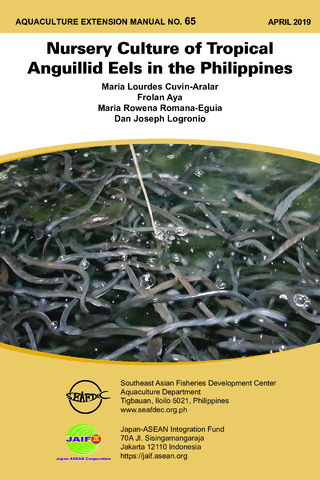
Nursery culture of tropical anguillid eels in the Philippines
; Aya, FrolanThis technical publication focused on nursery production of anguillid eels from glass eels to elver using data gathered from eel farm surveys and rearing trials conducted by SEAFDEC/AQD as part of the JAIF (Japan-ASEAN ...; Romana-Eguia, Maria Rowena R. ; (Aquaculture Department, Southeast Asian Fisheries Development Center, 2019)