The sea cucumber fishery in Palawan, Philippines

Download URL
kochi.repo.nii.ac.jpDate
2018Page views
3,441
AGROVOC keyword
Geographic names

Metadata
Show full item recordShare
Abstract
This paper presents the nature of sea cucumber fishery in Palawan, Philippines with information on gathering practices, commonly traded species and secondary accounts on wild populations. Current issues on sea cucumber fishery are also presented here along with recommended doable management measures.
Suggested Citation
Jontila, J. B. S., Monteclaro, H. M., Quinitio, G. F., Santander-de Leon, S. M., & Altamirano, J. (2018). The sea cucumber fishery in Palawan, Philippines. Kuroshio Science , 12(1), 84-88. http://hdl.handle.net/10862/3448
Type
ArticleISSN
1882-823XCollections
- Journal Articles [1266]
Related items
Showing items related by title, author, creator and subject.
-
Status of sea cucumber fishery and populations across sites with different levels of management in Palawan, Philippines
(Elsevier, 2018)This study was conducted to investigate the sea cucumber fishery and compare populations between exploited and unexploited sites. Three islands were selected, the Arrecife Island as the unexploited site and the Johnson and Green Islands representing the exploited sites. In each site, sea cucumber species richness, diversity and densities were assessed by laying as much as 15 transects (50 m × 5 m) per habitat in each island. Differences in species richness, diversity and relative densities across sites and habitats were tested using a Two-way Analysis of Variance (ANOVA) and Tukey test for post hoc comparisons. An interview with gatherers, key informants and focus group discussions were also conducted to gather information on the sea cucumber fishery and its management. Results showed that the unexploited site had a higher species richness (14 vs. 7 and 7). Relative density of species was also higher in the unexploited site at 1245 ind ha-1 while it was only 78 and 39 ind ha-1 in exploited sites (p < 0.05). Interviews and a focus group discussion revealed that national regulations on permit system and size limits were not enforced at the local level and that gatherers had low levels of awareness regarding regulations on sea cucumber harvest. Current management measures appear to be ineffective and insufficient, leaving the sea cucumbers in areas open to exploitation at risk of depletion. Given that sea cucumbers provide substantial income to local communities, the depletion of this resource could compromise the livelihood of people in island communities that rely heavily on marine resources for living. Thus, this study highlights the need to review national policies on sea cucumber fishery and place the management at the local level. -
Series: ACIAR Technical Report; No. 97
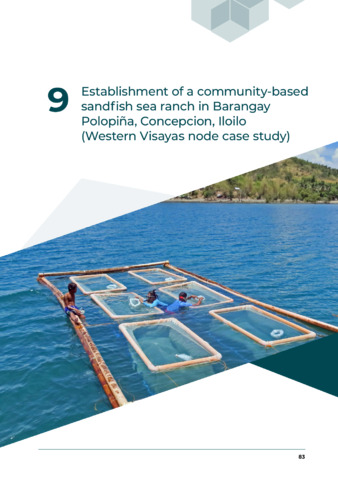
Establishment of a community-based sandfish sea ranch in Barangay Polopiña, Concepcion, Iloilo (Western Visayas node case study)
Altamirano, Jon ; Suyo, Jee Grace ; Baylon, Roselyn ; (Australian Centre for International Agricultural Research, 2022)
-
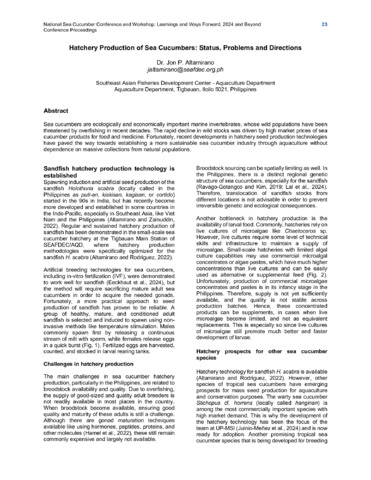
Hatchery production of sea cucumbers: Status, problems and directions
Altamirano, Jon (Mindanao State University at Naawan, 2025)
Sea cucumbers are ecologically and economically important marine invertebrates, whose wild populations have been threatened by overfishing in recent decades. The rapid decline in wild stocks was driven by high market prices of sea cucumber products for food and medicine. Fortunately, recent developments in hatchery seed production technologies have paved the way towards establishing a more sustainable sea cucumber industry through aquaculture without dependence on massive collections from natural populations.