In observance of the Lenten season, please be advised of the following adjustments to our repository services:
- Effective Date: Afternoon of April 1, 2026
- Service Resumption: Monday, April 6, 2026
Our repository remains online for browsing; however, "Request a Copy" responses will be paused starting April 1, 2026 afternoon. Standard processing and responses will resume on April 6, 2026. Thank you for your patience!
A review of reported seaweed diseases and pests in aquaculture in Asia

Download URL
onlinelibrary.wiley.comDate
2020-08Page views
1,651ASFA keyword

AGROVOC keyword
Taxonomic term

Geographic names

Metadata
Show full item recordShare
Abstract
Seaweeds have been used as a food for centuries in Asia and are increasingly exploited as a source for dietary supplements, animal feed, chemicals, and biofuels. In recent years, there has been an increase in the prevalence of diseases and pests in these aquaculture crops, with a subsequent reduction in their quantity and commercial value. In this article, we review diseases that have been reported in the scientific literature for species of red and brown seaweeds. We have focused on the major seaweed crops grown in Asia, where much of this production is centered. We also provide information on disease management and biosecurity and some observations on future directions.
Suggested Citation
Ward, G., Faisan, J. P., Jr., Cottier‐Cook, E. J., Gachon, C., Hurtado, A. Q., Lim, P. E., Matoju, I., Msuya, F. E., Bass, D., & Brodie, J. (2020). A review of reported seaweed diseases and pests in aquaculture in Asia. Journal of the World Aquaculture Society , 51(4), 815-828. https://doi.org/10.1111/jwas.12649
Type
ArticleISSN
0893-8849; 1749-7345Collections
- Journal Articles [1267]

Except where otherwise noted, this item's license is described as http://creativecommons.org/licenses/by/4.0/
Related items
Showing items related by title, author, creator and subject.
-
Research on seaweeds and mollusks
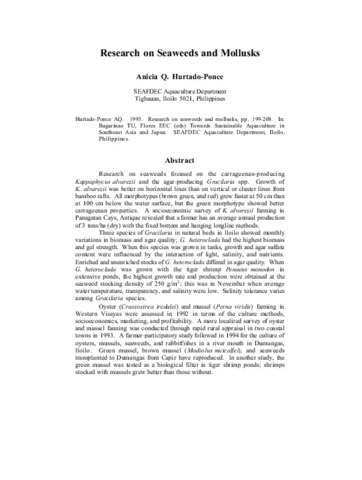
(Aquaculture Department, Southeast Asian Fisheries Development Center, 1995)Research on seaweeds focused on the carrageenan-producing Kappaphycus alvarezii and the agar-producing Gracilaria spp. Growth of K. alvarezii was better on horizontal lines than on vertical or cluster lines from bamboo rafts. All morphotypes (brown green, and red) grew faster at 50 cm than at 100 cm below the water surface, but the green morphotype showed better carrageenan properties. A socioeconomic survey of K. alvarezii farming in Panagatan Cays, Antique revealed that a farmer has an average annual production of 3 tons/ha (dry) with the fixed bottom and hanging longline methods. Three species of Gracilaria in natural beds in lloilo showed monthly variations in biomass and agar quality; G. heteroclada had the highest biomass and gel strength. When this species was grown in tanks, growth and agar sulfate content were influenced by the interaction of light, salinity, and nutrients. Enriched and unenriched stocks of G. heteroclada differed in agar quality. When G. heteroclada was grown with the tiger shrimp Penaeus monodon in extensive ponds, the highest growth rate and production were obtained at the seaweed stocking density of 250 g/m2; this was in November when average water temperature, transparency, and salinity were low. Salinity tolerance varies among Gracilaria species.Oyster (Crassostrea iredalei) and mussel (Perna viridis) farming in Western Visayas were assessed in 1992 in terms of the culture methods, socioeconomics, marketing, and profitability. A more localized survey of oyster and mussel fanning was conducted through rapid rural appraisal in two coastal towns in 1993. A farmer-participatory study followed in 1994 for the culture of oysters, mussels, seaweeds, and rabbitfishes in a river mouth in Dumangas, lloilo. Green mussel, brown mussel (Modiolus metcalfei), and seaweeds transplanted to Dumangas from Capiz have reproduced. In another study, the green mussel was tested as a biological filter in tiger shrimp ponds; shrimps stocked with mussels grew better than those without. A nationwide survey on the Placuna placenta fishery in 1993 showed 27 remaining 'kapis' beds; many others have been depleted due to excessive gathering, pollution, siltation, and trawling. Broodstocks are being developed to produce 'kapis' seed for grow-out and restocking. For the first time at AQD, adult donkey-ear abalone Haliotis asinina from the wild spawned naturally in laboratory tanks. Juvenile abalones can be successfully grown on Gracilaria or abalone diet. -
Culture and use of algae in Southeast Asia. Proceedings of the Symposium on Culture and Utilization of Algae in Southeast Asia, 8-11 December 1981, Tigbauan, Iloilo, Philippines
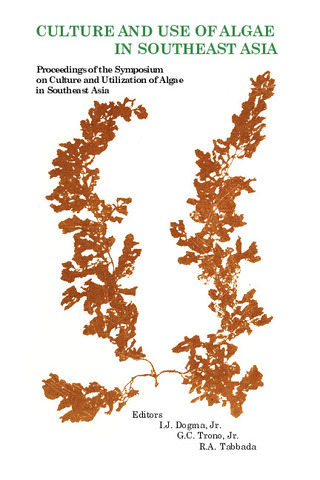
(Aquaculture Department, Southeast Asian Fisheries Development Center, 1990)Abstracts of the 13 papers presented at the symposium are cited individually. A variety of topics were covered, including the culture of micro and macroalgae, the processing of algal products and their utilization in industry as natural feed for aquaculture animals, the status of seaweed resources and their production, and the biology and use of algal populations as an indicator of the state of the aquatic environment. -
Comparative analysis of the temporal abundance of the epiphytic pest, Melanothamnus thailandicus, affecting farmed Kappaphycus striatus: Visual and molecular detection approaches
Faisan, Jr., Joseph ; Sibonga, Rema ; Luhan, Maria Rovilla ; Ferriols, Victor Marco Emmanuel ; Mateo, Jonalyn ; Brakel, Janina ; Brodie, Juliet ; Ward, Georgia ; ; ; Stentiford, Grant ; Gachon, Claire ; Hurtado, Anicia (Springer, 2025-09-02)
Kappaphycus striatus is a widely cultivated red eucheumatoid seaweed in Southeast Asia. However, infestations of epiphytic filamentous algae (EFA) have become a significant challenge, reducing biomass yields during harvest and resulting in income loss for farmers. This study evaluated and identified the EFA affecting farmed K. striatus in northern Iloilo, Philippines. Bi-monthly collections of representative individuals from a single site in a shallow water area were conducted for nine months (June 2019‒February 2020). Seaweed samples from different time points, including both visibly healthy and infested algal thalli, were further analyzed using molecular techniques to assess the effectiveness of visual examination in detecting these epiphytes. Visually, red filamentous epiphytic pests were observed during the rainy months, particularly between September and December. In K. striatus showing clear signs of infestation, these appeared as “goosebump-like” structures with epiphytic filaments protruding from the host. Molecular analysis revealed that this EFA was present in different regions of the seaweed thallus. Interestingly, the target epiphyte was also detected in thallus tissues that appeared visually healthy. PCR detection of EFA yielded higher results (25.7%) than visual examination (20.0%) (p < 0.001). Phylogenetic analysis identified the filamentous epiphyte as Melanothamnus thailandicus‒ a species not previously recorded affecting farmed eucheumatoid seaweed in the Philippines. These findings suggest that molecular identification of epiphytes is more reliable than visual inspection. Therefore, it is recommended that molecular detection methods be incorporated into biosecurity protocols, farm management practices, and seedling movement to prevent the spread and unintentional introduction of epiphytic pests in seaweed farming areas.
; Sibonga, Rema ; Luhan, Maria Rovilla ; Ferriols, Victor Marco Emmanuel ; Mateo, Jonalyn ; Brakel, Janina ; Brodie, Juliet ; Ward, Georgia ; ; ; Stentiford, Grant ; Gachon, Claire ; Hurtado, Anicia (Springer, 2025-09-02)
Kappaphycus striatus is a widely cultivated red eucheumatoid seaweed in Southeast Asia. However, infestations of epiphytic filamentous algae (EFA) have become a significant challenge, reducing biomass yields during harvest and resulting in income loss for farmers. This study evaluated and identified the EFA affecting farmed K. striatus in northern Iloilo, Philippines. Bi-monthly collections of representative individuals from a single site in a shallow water area were conducted for nine months (June 2019‒February 2020). Seaweed samples from different time points, including both visibly healthy and infested algal thalli, were further analyzed using molecular techniques to assess the effectiveness of visual examination in detecting these epiphytes. Visually, red filamentous epiphytic pests were observed during the rainy months, particularly between September and December. In K. striatus showing clear signs of infestation, these appeared as “goosebump-like” structures with epiphytic filaments protruding from the host. Molecular analysis revealed that this EFA was present in different regions of the seaweed thallus. Interestingly, the target epiphyte was also detected in thallus tissues that appeared visually healthy. PCR detection of EFA yielded higher results (25.7%) than visual examination (20.0%) (p < 0.001). Phylogenetic analysis identified the filamentous epiphyte as Melanothamnus thailandicus‒ a species not previously recorded affecting farmed eucheumatoid seaweed in the Philippines. These findings suggest that molecular identification of epiphytes is more reliable than visual inspection. Therefore, it is recommended that molecular detection methods be incorporated into biosecurity protocols, farm management practices, and seedling movement to prevent the spread and unintentional introduction of epiphytic pests in seaweed farming areas.