A process of culturing mud polychaete Marphysa iloiloensis
View/

Downloads: 56
Downloads: 70
Downloads: 70
Downloads: 57
Downloads: 259
Date
2021-09-20Inventor
Mandario, Mary Anne 
Page views
1,097ASFA keyword

AGROVOC keyword
Taxonomic term

Geographic names

Metadata
Show full item recordShare
Abstract
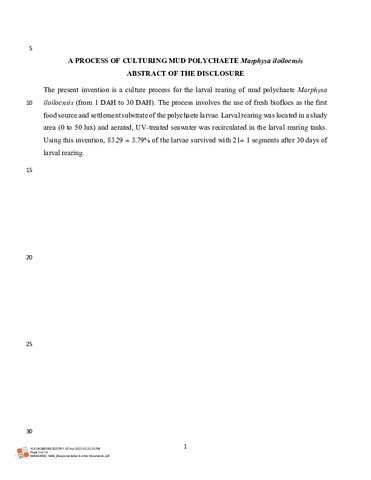
The present invention is a culture process for the larval rearing of mud polychaete Marphysa iloiloensis (from 1 DAH to 30 DAH). The process involves the use of fresh bioflocs as the first food source and settlement substrate of the polychaete larvae. Larval rearing was located in a shady area (0 to 50 lux) and aerated, UV-treated seawater was recirculated in the larval rearing tanks. Using this invention, 83.29 ± 3.79% of the larvae survived with 21± 1 segments after 30 days of larval rearing.
Keywords
Marphysa iloiloensisSuggested Citation
Mandario, M. A. E. (2021). A process of culturing mud polychaete Marphysa iloiloensis (Intellectual Property Office of the Philippines Patent PH12020050064). https://wipopublish.ipophil.gov.ph/wopublish-search/public/detail/patents?id=PH12020050064
Type
PatentCollections
- Patents [5]
Related items
Showing items related by title, author, creator and subject.
-
A new species of the sanguinea-group Quatrefages, 1866 (Annelida: Eunicidae: Marphysa) from the Philippines
; Mandario, Mary Anne; ; ; ; (Magnolia Press, 2019-09-24)
A new species of the Marphysa sanguinea group, M. iloiloensis n. sp. (Annelida: Eunicida: Eunicidae), is described from the Marine Annelids Hatchery of the Southeast Asian Fisheries Development Center, Aquaculture Department (SEAFDEC- AQD), Iloilo Province, Philippines. It represents the first record of this group in the Philippines. The new species is most similar morphologically to M. hongkongensa Wang, Zhang & Qiu, 2018, but can be distinguished from it by having fewer branchial filaments, a pair of faint eyes (absent in M. hongkongensa), and in slight differences in jaw morphology and chaetation. The embryos of the new species develop inside a jelly cocoon attached to the entrance of the adult burrow; this is the first time that egg-containing cocoons have been found in any species of the sanguinea-group. Phylogenetic analysis based on the mitochondrial gene cytochrome c oxidase subunit I (COI) revealed that Marphysa iloiloensis n. sp. is genetically distinct from all other analysed Marphysa species and forms a sister group to M. hongkongensa. A revised identification key to members of the sanguinea-group in Southeast Asia is provided. -
Survival, growth and biomass of mud polychaete Marphysa iloiloensis (Annelida: Eunicidae) under different culture techniques
Mandario, Mary Anne (John Wiley & Sons, Ltd, 2020-04-20)
Polychaetes are commercially exploited as fishing bait and supplemental diet to crustacean and finfish broodstock. However, scarcity of supply and biosecurity issues limits its use. Polychaete aquaculture has become the best alternative to wild resources. In this study, two different culture techniques (1‐sediment tank throughout the culture period and 2‐nursery tank with bioflocs for 30 days; thereafter, juveniles were transferred to sediment tank until harvest) using two diets [bioflocs (BF) and feed mill sweepings (FS)] were tested to determine the survival, growth and biomass of polychaete Marphysa iloiloensis (Glasby et al., Zootaxa, 2019, 4674) in the grow‐out. The 180‐day trial was conducted in 16 tanks (0.20 m2) stocked with 5,066 ± 575 M. iloiloensis trochophore larvae/tank which were assigned randomly into four culture treatments with four replicates each. The treatments were labelled as: (a) BFS – fed BF in sediment tank for 180 days; (b) BF + BFS – fed BF in nursery tank for 30 days, juveniles were transferred in sediment tank and fed BF for another 150 days; (c) FSS – fed FS in sediment tank for 180 days; and (d) BF + FSS – fed BF in nursery tank for 30 days, juveniles are transferred in sediment tank and fed FS for another 150 days. Results showed that polychaetes in BF + FSS had significantly higher survival than BFS. Polychaetes in both BF + FSS and FSS had significantly higher body weight than BF + BFS and BFS, while biomass in BF + FSS (175.73 ± 42.25 g/tank) was significantly higher compared to other treatments (p < .05). Polychaetes fed with FS had 61%–64% protein and 12%–13% fat, while those fed with BF exclusively had 66%–70% protein and 3.50%–4.50% fat. The findings indicate that FS whether or not BF is included in the diet can improve both survival and growth of polychaetes but significantly higher biomass can be achieved with the combination of BF and FS. Additionally, polychaetes in BF + FSS contained 64% protein and 13% fat. Therefore, BF can be used as an alternative diet to FS in the early life stages of M. iloiloensis and nursery rearing using BF is imperative to increase its biomass in the grow‐out production. -
Effects of feeding rate and sediment depth on the survival, growth performance, and biomass of mud polychaete Marphysa iloiloensis from early juvenile to adult in grow-out tanks
Mandario, Mary Anne; ; (Elsevier, 2022-02-15)
Polychaete aquaculture has progressed in some countries to meet the high demand of fish bait and aquaculture industries. However, knowledge on the aquaculture requirements of polychaetes in the grow-out is still scarce. The present study aimed to determine the optimal feeding rate (FR) and sediment depth (SD) for the grow-out culture of mud polychaete Marphysa iloiloensis from early juvenile to adult stage. The effects of two FRs (50 and 100 g m−2) with three different levels of SD (2, 3, and 5 cm) on M. iloiloensis survival, growth performance, and biomass were evaluated. The study was performed in a 2 × 3 factorial experiment using completely randomized design with four replicates per treatment that lasted 120 days. Early juveniles (30 days old) were stocked in glass tanks at 1000 individuals m−2 and grown for 120 days (herein refer as 'adult', with musculature and capable of reproduction). Regardless of FR, M. iloiloensis had the highest survival of 45 ± 2% in 5 cm SD but statistically comparable to 3 cm SD (34 ± 5%), while survival was significantly lowest in 7 cm SD (26 ± 3%). The levels of nitrite (NO2) and total ammonia nitrogen (TAN) was significantly higher in the rearing water of 100 g m−2 FR than in 50 g m−2 FR. Higher FR resulted to poor water quality and appeared to contribute to the low M. iloiloensis survival in 100 g m−2 FR. Growth performance was similar among treatments. There was a significant interaction between FR and SD on M. iloiloensis biomass (p < 0.05). In 50 g m−2 FR, no difference was observed in the different levels of SD while in 100 g m−2 FR, biomass was significantly higher in 5 cm SD than in 7 cm SD (p < 0.05). M. iloiloensis biomass in 50 g m−2 FR was higher compared to 100 g m−2 FR, regardless of the SD. Overall, the culture of M. iloiloensis using 50 g m−2 FR in 3–5 cm SD showed the best survival and biomass. Based on these findings, it is recommended that the grow-out culture of M. iloiloensis from early juvenile to adult should follow the 50 g m−2 FR and should be done in tanks with 3–5 cm SD to improve production.