LHRHa and pimozide-induced breeding in the catfish, Clarias macrocephalus (Gunther).

Share
Abstract
Clarias macrocephalus is endemaic yet dwinding freshwater foodfish in the Philippines. Induced breeding protocol was developed after a series of studies which determined the appropriate egg size, proper time of stripping females, effective dose combination of luteinizing hormone-releasing hormone analogue (LHRHa) and pimozide (PIM), and their effects on egg quality. Based on its similar osmotic pressure with catfish plasma, eggs were fixed in 1% phosphate-bufferedd formalin. Catfish eggs with a mean diameter of 1.40 - 1.60 mm were responsive to hormonal treatment and increased to 1.50 - 1.70 mm at ovulation. Oocyte maturation, indicated by eggs in the germinal vesicle breadown (GVBD) stage, was observed at least 13 h pst-injection, followed by ovulation 4 h thereafter. Techniques developed in these studies showed a simsle, convenient, and effective way to induce spawning of C. macrocephalus. A simultaneous injetion of 0.05 ųg LHRHa + 1 ųg PIM/g BW at 1800 - 1900 h, followed by stripping at 16 - 20 h post-injection has consistently resulted in 100% ovulation, high fertilization and hatching rates.
Type
Conference paperCollections
- Conference Proceedings [300]
Related items
Showing items related by title, author, creator and subject.
-
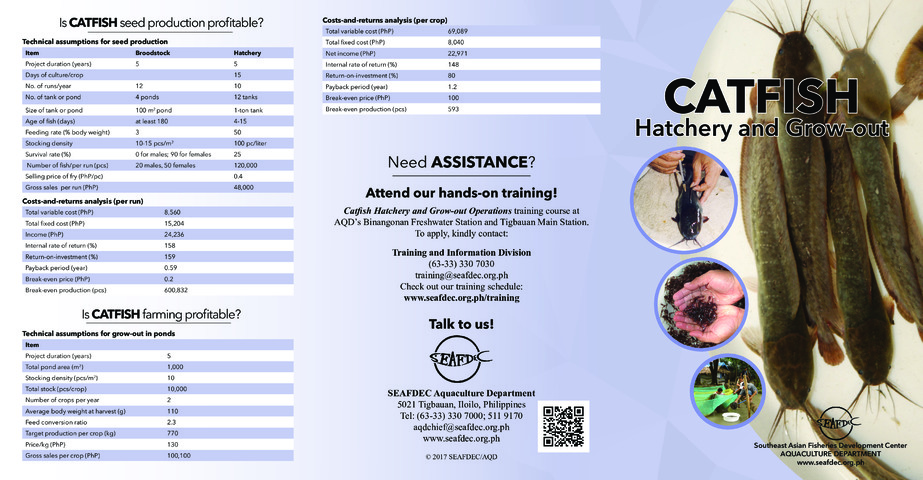
Catfish hatchery and grow-out
(Aquaculture Department, Southeast Asian Fisheries Development Center, 2017) -
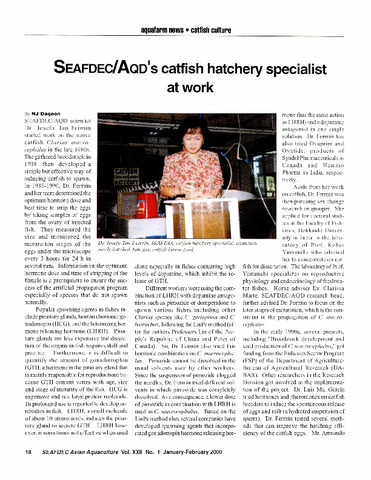
SEAFDEC/AQD's catfish hatchery specialist at work
(Aquaculture Department, Southeast Asian Fisheries Development Center, 2000) -
Aeromonas hydrophila in the epizootic ulcerative syndrome (EUS) of snakehead, Ophicephalus striatus, and catfish, Clarias batrachus: quantitative estimation in natural infection and experimental induction of dermo-muscular necrotic lesion
; ; Tendencia, Eleonor (1992)
Snakehead (Ophicephalus striatus) and catfish (Clarias batraclus) with the Epizootic Ulcerative Syndrome (EUS) were sampled for bacteria. Total bacterial counts of skin and muscle/dermal lesions revealed mean colony forming units (CFU) per gram tissue of 1.22 x 10³, 1.40 x 10⁵, 5.31 x 195 and 1.14 x 10⁷ in apparently normal, slightly lesioned, moderately lesioned and severely lesioned snakehead samples, respectively. In catfish, mean CFU per gram tissue were 4.30 x 10⁴ and 2.00 x 10⁵ in apparently normal and slightly lesioned specimens, respectively. Kidney samples likewise revealed the presence of bacteria. Bacteria isolated on trypticase soy agar and Rimler-Shotts medium were predominantly Aeromonas hydrophila occurring in 90% of snakeheads and in 33% of catfish specimens. Infection experiments of A. hydrophila injected intramuscularly into healthy snakehead and catfish induced dermo-muscular necrotic lesions. A dose of at least 106 cells of A. hydrophila was required to induce EUS-like lesions in snakehead and catfish at 21-25 degree C in 24-96 h.
(1992)
Snakehead (Ophicephalus striatus) and catfish (Clarias batraclus) with the Epizootic Ulcerative Syndrome (EUS) were sampled for bacteria. Total bacterial counts of skin and muscle/dermal lesions revealed mean colony forming units (CFU) per gram tissue of 1.22 x 10³, 1.40 x 10⁵, 5.31 x 195 and 1.14 x 10⁷ in apparently normal, slightly lesioned, moderately lesioned and severely lesioned snakehead samples, respectively. In catfish, mean CFU per gram tissue were 4.30 x 10⁴ and 2.00 x 10⁵ in apparently normal and slightly lesioned specimens, respectively. Kidney samples likewise revealed the presence of bacteria. Bacteria isolated on trypticase soy agar and Rimler-Shotts medium were predominantly Aeromonas hydrophila occurring in 90% of snakeheads and in 33% of catfish specimens. Infection experiments of A. hydrophila injected intramuscularly into healthy snakehead and catfish induced dermo-muscular necrotic lesions. A dose of at least 106 cells of A. hydrophila was required to induce EUS-like lesions in snakehead and catfish at 21-25 degree C in 24-96 h.