Development of hatchery techniques for the mud crab Scylla serrata (Forskål): Comparison of feeding schemes

View/
Date
1999Author
Page views
5,277ASFA keyword

AGROVOC keyword
Taxonomic term

Metadata
Show full item recordShare
Abstract
Scylla serrata larvae were reared in 3 L plastic containers and fed various amounts of artificial diets (AD) with or without natural food (NF: Brachionus rotundiformis and newly-hatched Artemia). The amounts of AD fed alone to zoea in treatments (T) 1 to 4 were as follows: 1) 2.0 mg/L/day + 0.25 mg/L/day increment/substage; 2) 2.0 mg/L/day + 0.5 mg/L/day increment/ substage; 3) 4.0 mg/L/day + 0.5 mg/L/day increment/substage; 4) 4.0 mg/L/day + 1.0 mg/L/day increment/ substage. NF were given in addition to the respective amounts of artificial diet in T5, T6, T7 and T8. T9 served as the control (NF only). Based on three experimental runs, only larvae in T5, T6, and T9 survived until the megalopa stage. Thus, only these three treatments were compared in succeeding experiments using a commercial shrimp diet in 250 L fibreglass tanks. Of the three runs conducted using a commercial diet, two runs showed significant differences (P<0.05) in survival. T5 gave higher survival (3.71% and 1.33%) than T9 (1.84% and 0.45%) and T6 (1.37% and 0.45%). Population development index did not differ among treatments in three runs.
Suggested Citation
Quinitio, E. T., Parado-Estepa, F., & Alava, V. (1999). Development of hatchery techniques for the mud crab Scylla serrata (Forskål): Comparison of feeding schemes. In C. P. Keenan & A. Blackshaw (Eds.), Mud Crab Aquaculture and Biology. Proceedings of an international scientific forum held in Darwin, Australia, 21–24 April 1997 (pp. 125-130). Canberra: Australian Centre for International Agricultural Research.
Type
Conference paperCollections
- Conference Proceedings [300]
Related items
Showing items related by title, author, creator and subject.
-
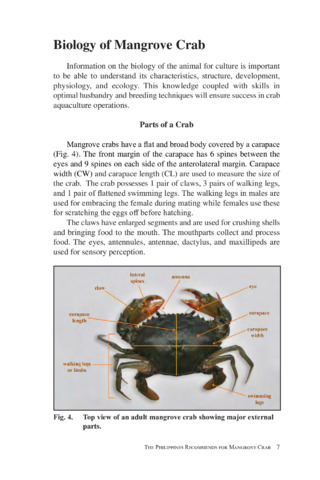
[The Philippines recommends for mangrove crab:] Biology of mangrove crab
(DOST-PCAARRD, 2021) -
Larval rearing of mud crab (Scylla): What lies ahead
; ; Quinitio, Emilia T. ; ; ; ; ; ; ; (Elsevier, 2018)
The increasing global demand for mud crabs (genus Scylla) and threats to the wild populations highlight the urgency of fully rearing them in captivity. Despite considerable progress in mud crab production, most crab farms still rely heavily on wild-caught crablets and juveniles while the low and inconsistent success rates of larviculture remain as the main bottleneck impeding the development of mud crab aquaculture. Over the years, numerous studies have been conducted to determine the optimum larval rearing parameters, the ontogenic changes in digestive function and feeding behaviour, and the diets for different larval stages. These data, however, are dispersed and not summarised to inform culture practices. This review provides an update on the current progresses and to pinpoint the gaps in knowledge regarding mud crab larval rearing. We include all four mud crab species under the genus Scylla, i.e. Scylla serrata, Scylla olivacea, Scylla tranquebarica and Scylla paramamosain. Knowledge compiled in this review serves as an important guideline for prospective mud crab larviculture. Future research should gear towards filling in the gaps in our knowledge to advance mud crab larval rearing, thus fully incorporating mud crab into the aquaculture sector.
; ; ; ; ; ; ; (Elsevier, 2018)
The increasing global demand for mud crabs (genus Scylla) and threats to the wild populations highlight the urgency of fully rearing them in captivity. Despite considerable progress in mud crab production, most crab farms still rely heavily on wild-caught crablets and juveniles while the low and inconsistent success rates of larviculture remain as the main bottleneck impeding the development of mud crab aquaculture. Over the years, numerous studies have been conducted to determine the optimum larval rearing parameters, the ontogenic changes in digestive function and feeding behaviour, and the diets for different larval stages. These data, however, are dispersed and not summarised to inform culture practices. This review provides an update on the current progresses and to pinpoint the gaps in knowledge regarding mud crab larval rearing. We include all four mud crab species under the genus Scylla, i.e. Scylla serrata, Scylla olivacea, Scylla tranquebarica and Scylla paramamosain. Knowledge compiled in this review serves as an important guideline for prospective mud crab larviculture. Future research should gear towards filling in the gaps in our knowledge to advance mud crab larval rearing, thus fully incorporating mud crab into the aquaculture sector. -
Development of protocol for the production of hatchery-reared mud crab Scylla serrata juveniles for soft-shell crab farming
Quinitio, Emilia T.; ; (Aquaculture Department, Southeast Asian Fisheries Development Center, 2017)
Development of economically viable techniques for growing hatchery-reared juvenile crabs to suitable sizes will address the problem on the source of seed stocks for soft-shell crab farming. This paper reports the production of hatchery-reared mud crab Scylla serrata from juveniles in the nursery to 73-106 g body weight (BW) crabs in the grow-out pond for the individual system soft-shell crab farming. Likewise, the performance of hatchery-reared S. serrata, and wild S. tranquebarica and S. olivacea juveniles was determined in the soft-shell crab production set-up. The BW increased from 1.8-1.9 g to 78-113.7 g when stocked at 0.5 ind m-2 and from 1.6-2.3 g to 73-106.7 g at 1.0 ind m-2 after 75 days. Growth rates at both stocking densities were comparable. However, survival was significantly higher (P<0.05) in lower (63.6~c1.01%) than in higher (35.6~c3.34%) stocking density. Male S. serrata (46.0 ~c 1.75%) had significantly higher BW increase than females (39.4 ~c 2.05%). Crabs stocked at sizes of 51-60 g showed significantly greater percent increase in BW (43.26~c 0.98%) compared with those at 61-70 g (40.98~c1.33%), 71-80 g (38.55~c 1.04%), 81-90 g (36.34 ~c 1.27%) and 91-100 g (38.52 ~c 1.67%). Among the three species, hatchery-reared S. serrata (42.14 ~c 1.34%) had significantly higher mean percent BW increase compared with S. olivacea (38.23 ~c 0.49%) and S. tranquebarica (36.16 ~c 0.78%). S. serrata had significantly shorter mean culture period (24.11 ~c 0.95 days) than S. tranquebarica (28.48 ~c 0.54 days) and S. olivacea (28.75 ~c 0.34 days).