Illuminated-cage nursery of the Asian sea bass, Lates calcarifer Bloch, (Centropomidae): effects of initial body size and stocking density
ดู/
วันที่
2000Page views
2,282ASFA keyword

AGROVOC keyword
Taxonomic term

เมตาดาต้า
แสดงระเบียนรายการเต็มShare
นามธรรม
This study was conducted to determine the appropriate initial body size and the corresponding stocking density of sea bass, Lates calcarifer, during nursery rearing in illuminated cages. Hatchery-produced sea bass fry of different initial sizes of 7.2 (day 15), 13.2 (day 22), and 15.2 mm (day 29) were stocked at densities between 300 and 1,500 m-3 in decreasing order with fish size. Nylon net cages (1x1x1 m) set in a protected sea cove area were individually lit at 300 lux using incandescent bulb placed at 1 m above water surface. Artificial lights attract wild zooplankton that served as prey to young sea bass. After 42 days of culture 22-day old sea bass fry with 13.2 mm TL initial size and stocked at 400 m-3 showed the highest growth (35.3 mm TL, 535.7 mg BW) and survival rates (64.4%). At a stocking density of 800 m-3, the survival rate was the second highest at 43%. Although day 15-fry at 7.2 mm TL initial size showed higher specific growth rates (11 % day-1) and size at harvest (29-31 mm TL, 346.2-374.4 mg BW), survival rates (11-15 %) were lower than the day 22- and 29-fry (30-64%). Calanoid copepods of the genus Calanus, Paracalanus and Acartia dominated the diet (81-90%) of sea bass at different size groups. Percentage number of shooters ranged from 0.5-1.4% of total stocks and were not significantly different among treatments. The present results indicate that sea bass should spend 21 days in the hatchery prior to nursery rearing in illuminated sea cages. Sea cages are inexpensive and more cost-effective than ordinary cage or earthen pond for sea bass fingerling production.
การอ้างอิง
Fermin, A. C. (2000). Illuminated-cage nursery of the Asian sea bass, Lates calcarifer Bloch, (Centropomidae): effects of initial body size and stocking density. In I. C. Liao & C. K. Lin (Eds.), Cage Aquaculture in Asia: Proceedings of the First International Symposium on Cage Aquaculture in Asia (pp. 267-272). Manila, Philippines: Asian Fisheries Society; Bangkok, Thailand: World Aquaculture Society - Southeast Asian Chapter.
Type
Conference paperคอลเลกชัน
- Conference Proceedings [300]
Related items
Showing items related by title, author, creator and subject.
-
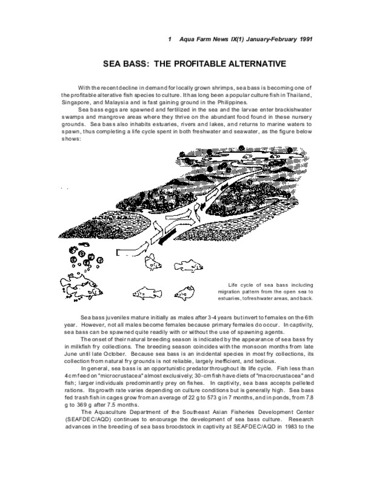
Sea bass: The profitable alternative
(Aquaculture Department, Southeast Asian Fisheries Development Center, 1991) -
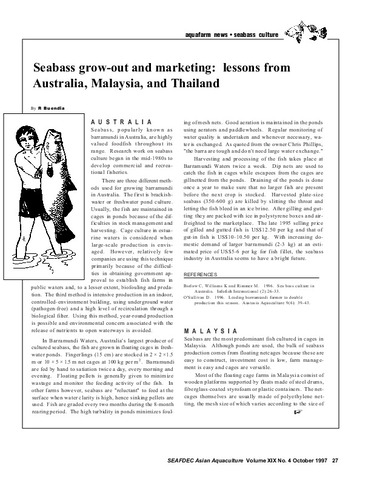
Seabass grow-out and marketing: lessons from Australia, Malaysia, and Thailand
(Aquaculture Department, Southeast Asian Fisheries Development Center, 1997) -
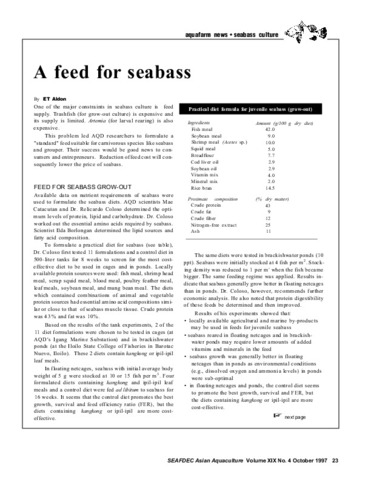
A feed for seabass
(Aquaculture Department, Southeast Asian Fisheries Development Center, 1997)One of the major constraints in seabass (Lates calcarifer) culture is feed supply. Details are given of work conducted at AQD regarding the formulation of a 'standard' feed suitable for carnivorous species like the seabass ...