Grouper research at the Southeast Asian Fisheries Development Center Aquaculture Department

Share
Abstract
This paper provides information on grouper research activities that have been carried out in SEAFDEC AQD. It covers various aspects such as broodstock management, seed production, nursery and grow-out culture techniques.
Suggested Citation
Marte, C. L. (2002). Grouper research at the Southeast Asian Fisheries Development Center Aquaculture Department. In Asia-Pacific Economic Cooperation & Network of Aquaculture Centres in Asia-Pacific (Eds.), Report of the APEC/NACA Cooperative Grouper Aquaculture Workshop, Hat Yai, Thailand 7-9 April 1999 (pp. 143-151). Bangkok, Thailand: Network of Aquaculture Centres in Asia-Pacific.
Type
Conference paperCollections
- Conference Proceedings [300]
Related items
Showing items related by title, author, creator and subject.
-
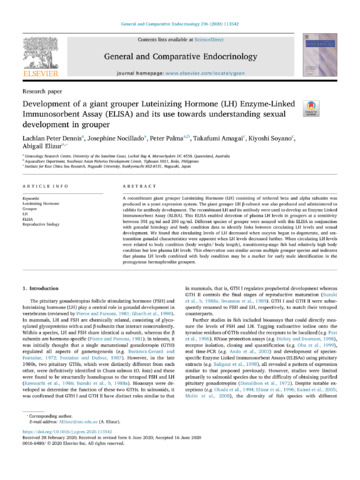
Development of a giant grouper Luteinizing Hormone (LH) Enzyme-Linked Immunosorbent Assay (ELISA) and its use towards understanding sexual development in grouper
; ; Palma, Peter ; ; ; (Elsevier, 2020-07-13)
A recombinant giant grouper Luteinizing Hormone (LH) consisting of tethered beta and alpha subunits was produced in a yeast expression system. The giant grouper LH β-subunit was also produced and administered to rabbits for antibody development. The recombinant LH and its antibody were used to develop an Enzyme Linked Immunosorbent Assay (ELISA). This ELISA enabled detection of plasma LH levels in groupers at a sensitivity between 391 pg/ml and 200 ng/ml. Different species of grouper were assayed with this ELISA in conjunction with gonadal histology and body condition data to identify links between circulating LH levels and sexual development. We found that circulating levels of LH decreased when oocytes began to degenerate, and sex-transition gonadal characteristics were apparent when LH levels decreased further. When circulating LH levels were related to body condition (body weight/ body length), transitioning-stage fish had relatively high body condition but low plasma LH levels. This observation was similar across multiple grouper species and indicates that plasma LH levels combined with body condition may be a marker for early male identification in the protogynous hermaphrodite groupers.
; ; ; (Elsevier, 2020-07-13)
A recombinant giant grouper Luteinizing Hormone (LH) consisting of tethered beta and alpha subunits was produced in a yeast expression system. The giant grouper LH β-subunit was also produced and administered to rabbits for antibody development. The recombinant LH and its antibody were used to develop an Enzyme Linked Immunosorbent Assay (ELISA). This ELISA enabled detection of plasma LH levels in groupers at a sensitivity between 391 pg/ml and 200 ng/ml. Different species of grouper were assayed with this ELISA in conjunction with gonadal histology and body condition data to identify links between circulating LH levels and sexual development. We found that circulating levels of LH decreased when oocytes began to degenerate, and sex-transition gonadal characteristics were apparent when LH levels decreased further. When circulating LH levels were related to body condition (body weight/ body length), transitioning-stage fish had relatively high body condition but low plasma LH levels. This observation was similar across multiple grouper species and indicates that plasma LH levels combined with body condition may be a marker for early male identification in the protogynous hermaphrodite groupers. -
Series: ACIAR Monograph 110
Localisation of enzymes in the digestive system during early development of the grouper (Epinephelus coioides)
(Australian Centre for International Agricultural Research, 2004)This study was undertaken to investigate the occurrence of some digestive enzymes in the gastrointestinal tract during early development in the grouper. This work was conducted to provide information on formulating an appropriate feeding scheme and an artificial diet for the early development of the grouper, Epinephelus coioides. Larvae of E. coioides were reared in 5 tonne rectangular concrete tanks. The digestive enzymes localized were acid phosphatase (ACP), alkaline phosphatase (ALP), nonspecific esterase (NSE), aminopeptidase (AMP), trypsin (TRP), maltase (MAL) and lipase (LIP). Weak enzyme activity occurred during the yolk sac stage. High AMP activity started at day 14 prior to Artemia feeding at day 16. Fluctuations in TRP activity might be related to stomach formation. Occurrence of MAL during early development demonstrated a capacity to digest carbohydrates. An increase in LIP activity coincided with the occurrence of gastric glands. Insignificant changes in digestive enzymes were observed in the metamorphosing grouper larvae from day 40 to 60. -
Growth and yield of the grouper Epinephelus coioides fed 'trash fish' at different rates and frequencies in floating net cages
(Bureau of Agricultural Research, Department of Agriculture, 2007)The effects of various feeding rates and frequencies on the growth and survival of orangespotted grouper Epinephelus coides were determined in floating net cages in Tiniguiban Cove, Puerto Princesa, Palawan. Juveniles (average weight 60 g) were stocked in 2 m x 2 m x 1.5 m cages at a density of 10/m3. The experiment tested six treatments: 10% of body weight (BW) daily; 5% BW daily; ad libitum daily; 10% BW every other day; 5% BW every other day; and ad libitum every other day. After five months, the fish fed at 10% daily had 100% survival and the highest weight gain (520 g), growth rate (3.5 g/d), net production (31.44 kg), and gross income (P5,463). However, returns were negative in all treatments because of either too high feed consumption and poor conversion or low net production.