SEAFDEC/AQDINSTITUTIONAL REPOSITORY
    • English
    • 日本語
    • ไทย
    • Bahasa Indonesia
  • ไทย 
    • English
    • 日本語
    • ไทย
    • Bahasa Indonesia
  • เข้าสู่ระบบ
ดูรายการ 
  •   SAIR บ้าน
  • 01 SEAFDEC/AQD Publications
  • Conference Proceedings
  • Feeds for Small-scale Aquaculture
  • ดูรายการ
  •   SAIR บ้าน
  • 01 SEAFDEC/AQD Publications
  • Conference Proceedings
  • Feeds for Small-scale Aquaculture
  • ดูรายการ
JavaScript is disabled for your browser. Some features of this site may not work without it.

Kappaphycus and Gracilariopsis meal as binders for diets of tiger shrimp
  • Global styles
  • MLA
  • Vancouver
  • Elsevier - Harvard
  • APA
  • Help
Thumbnail
ดู/เปิด
ffssa_p120.pdf (373.4Kb) Open Access
Downloads: 1,702
วันที่
1996
ผู้เขียน
Peñaflorida, Veronica
Golez, Nelson
Page views
4,255
ASFA keyword
artificial feeding ASFA
diet ASFA
food additives ASFA
rearing techniques ASFA
seaweeds ASFA
shrimp culture ASFA
AGROVOC keyword
Gracilaria heteroclada
Kappaphycus alvarezii AGROVOC
Penaeus monodon AGROVOC
Taxonomic term
Penaeus monodon GBIF
เมตาดาต้า
แสดงระเบียนรายการเต็ม

Share 
 
นามธรรม
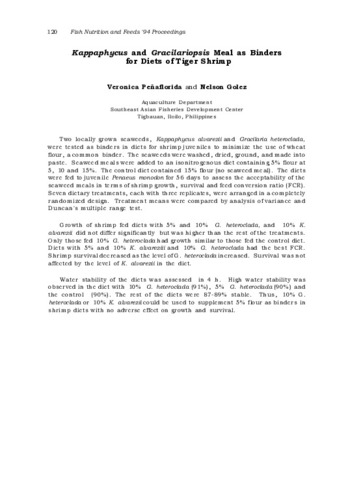
Two locally grown seaweeds, Kappaphycus alvarezii and Gracilaria heteroclada, were tested as binders in diets for shrimp juveniles to minimize the use of wheat flour, a common binder. The seaweeds were washed, dried, ground, and made into paste. Seaweed meals were added to an isonitrogenous diet containing 5% flour at 5, 10 and 15%. The control diet contained 15% flour (no seaweed meal). The diets were fed to juvenile Penaeus monodon for 56 days to assess the acceptability of the seaweed meals in terms of shrimp growth, survival and feed conversion ratio (FCR). Seven dietary treatments, each with three replicates, were arranged in a completely randomized design. Treatment means were compared by analysis of variance and Duncan's multiple range test.Growth of shrimp fed diets with 5% and 10% G. heteroclada, and 10% K. alvarezii did not differ significantly but was higher than the rest of the treatments. Only those fed 10% G. heteroclada had growth similar to those fed the control diet. Diets with 5% and 10% K. alvareziii and 10% G. heteroclada had the best FCR. Shrimp survival decreased as the level of G. heteroclada increased. Survival was not affected by the level of K. alvarezii in the diet.Water stability of the diets was assessed in 4 h. High water stability was observed in the diet with 10% G. heteroclada (91%), 5% G. heteroclada (90%) and the control (90%). The rest of the diets were 87-89% stable. Thus, 10% G. heteroclada or 10% K. alvarezii could be used to supplement 5% flour as binders in shrimp diets with no adverse effect on growth and survival.
Description
Abstract only
URI
http://hdl.handle.net/10862/552
Type
Conference paper
คอลเลกชัน
  • Feeds for Small-scale Aquaculture [23]


© SEAFDEC/AQD  2025
ส่งความคิดเห็น | Subscribe


หมวด

ทั้งหมดของ SAIRชุมชนและคอลเล็กชันตามวันที่ออกผู้เขียนชื่อเรื่องอาสาสมัครคอลเลกชันนี้ตามวันที่ออกผู้เขียนชื่อเรื่องอาสาสมัคร

บัญชีของฉัน

เข้าสู่ระบบRegister

Statistics

View Usage Statistics

© SEAFDEC/AQD  2025
ส่งความคิดเห็น | Subscribe


Export citations

Export the current results of the search query as a citation list. Select one of the available citation styles, or add a new one using the "Citations format" option present in the "My account" section.

The list of citations that can be exported is limited to items.

Export citations

Export the current item as a citation. Select one of the available citation styles, or add a new one using the "Citations format" option present in the "My account" section.

Export Citations

DOCUMENT REQUEST NOT AVAILABLE

This publication is still available (in PRINT) and for sale at AQD bookstore. The library is currently restricted to send PDF of publications that are still for sale.

You may contact bookstore@seafdec.org.ph or visit AQD bookstore for orders.

FILE UNDER EMBARGO

This file associated with this publication is currently under embargo. This will be available for download after the embargo date.