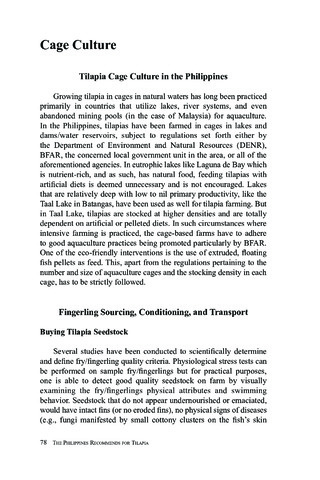
[The Philippines recommends for tilapia:] Cage culture
 AQD Access

Share
Suggested Citation
The Tilapia Technical Committee 2017. (2018). Cage culture. In The Philippines recommends for tilapia (pp. 78-103). Los Baños, Laguna, Philippines: DOST-PCAARRD.
Type
Book chapterISSN
0115-7833Koleksi
Related items
Showing items related by title, author, creator and subject.
-
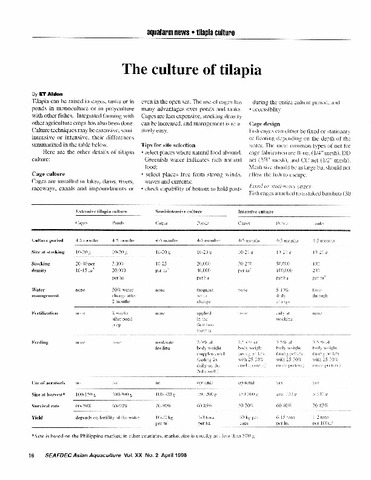
The culture of tilapia
(Aquaculture Department, Southeast Asian Fisheries Development Center, 1998) -
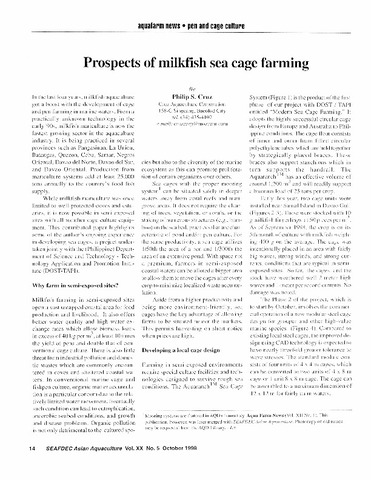
Prospects of milkfish sea cage farming
(Aquaculture Department, Southeast Asian Fisheries Development Center, 1998) -
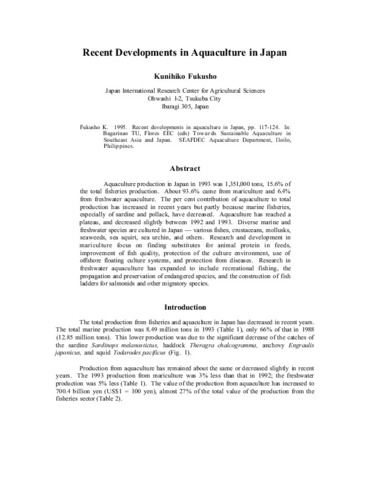
Recent developments in aquaculture in Japan
(Aquaculture Department, Southeast Asian Fisheries Development Center, 1995)Aquaculture production in Japan in 1993 was 1,351,000 tons, 15.6% of the total fisheries production. About 93.6% came from mariculture and 6.4% from freshwater aquaculture. The per cent contribution of aquaculture to total production has increased in recent years but partly because marine fisheries,especially of sardine and pollack, have decreased. Aquaculture has reached a plateau, and decreased slightly between 1992 and 1993. Diverse marine and freshwater species are cultured in Japan — various fishes, crustaceans, mollusks, seaweeds, sea squirt, sea urchin, and others. Research and development in mariculture focus on finding substitutes for animal protein in feeds, improvement of fish quality, protection of the culture environment, use of offshore floating culture systems, and protection from diseases. Research in freshwater aquaculture has expanded to include recreational fishing, the propagation and preservation of endangered species, and the construction of fish ladders for salmonids and other migratory species.