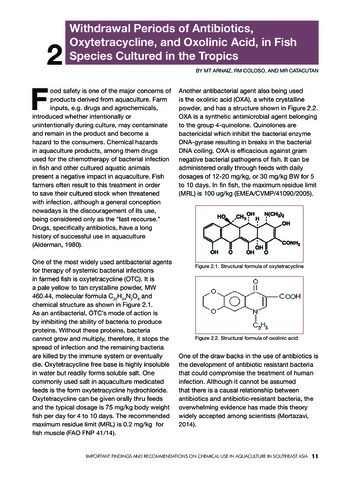
Withdrawal periods of antibiotics, oxytetracycline, and oxolinic acid, in fish species cultured in the tropics


Share
Abstract
Food safety is one of the major concerns of products derived from aquaculture. Farm inputs, e.g. drugs and agrochemicals, introduced whether intentionally or unintentionally during culture, may contaminate and remain in the product and become a hazard to the consumers. Chemical hazards in aquaculture products, among them drugs used for the chemotherapy of bacterial infection in fish and other cultured aquatic animals present a negative impact in aquaculture. Fish farmers often result to this treatment in order to save their cultured stock when threatened with infection, although a general conception nowadays is the discouragement of its use, being considered only as the “last recourse.” Drugs, specifically antibiotics, have a long history of successful use in aquaculture (Alderman, 1980).
Suggested Citation
Arnaiz, M. T., Coloso, R. M., & Catacutan, M. R. (2015). Withdrawal periods of antibiotics, oxytetracycline, and oxolinic acid, in fish species cultured in the tropics. In Important Findings and Recommendations on Chemical Use in Aquaculture in Southeast Asia (pp. 11–15). Aquaculture Department, Southeast Asian Fisheries Development Center.
Type
Book chapterISBN
9789719931034Related items
Showing items related by title, author, creator and subject.
-
Resistance to antibiotics of Vibrio spp. and Aeromonas spp. isolated from fish and shrimp tissues and rearing water in Panay island, Philippines
(University of the Philippines Visayas, 1998)A survey on the resistance patterns to selected antibiotics of bacterial pathogens of fish and shrimps in Panay Island, Philippines was conducted. One hundred and sixteen (116) bacterial isolates were collected from fish (Chanos chanos, Epinephelus sp. and Lates calcarifer) and shrimp (Penaeus monodon and P. indicus) tissues and rearing water. Among these isolates, only seven were identified as Aeromonas spp., the rest (109 isolates) were Vibrio spp., 42% of which were luminous Vibrio. Results of the sensitivity tests showed that all Aeromonas spp. isolates were resistant to streptomycin, oxytetracycline, and trimethoprim/sulphamethoxazole. Most of the Vibrio spp. isolates (94.5%) were resistant to streptomycin. Multiple resistance to two or more antibiotics was observed in 17 isolates of Vibrio spp. and all isolates of Aeromonas spp. -
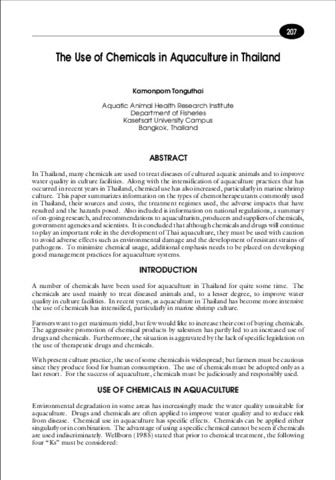
The use of chemicals in aquaculture in Thailand
(Aquaculture Department, Southeast Asian Fisheries Development Center, 2000)In Thailand, many chemicals are used to treat diseases of cultured aquatic animals and to improve water quality in culture facilities. Along with the intensification of aquaculture practices that has occurred in recent years in Thailand, chemical use has also increased, particularly in marine shrimp culture. This paper summarizes information on the types of chemotherapeutants commonly used in Thailand, their sources and costs, the treatment regimes used, the adverse impacts that have resulted and the hazards posed. Also included is information on national regulations, a summary of on-going research, and recommendations to aquaculturists, producers and suppliers of chemicals, government agencies and scientists. It is concluded that although chemicals and drugs will continue to play an important role in the development of Thai aquaculture, they must be used with caution to avoid adverse effects such as environmental damage and the development of resistant strains of pathogens. To minimize chemical usage, additional emphasis needs to be placed on developing good management practices for aquaculture systems. -
Changes induced in the gills of milkfish (Chanos chanos Forsskål) fingerlings after acute exposure to nifurpirinol (Furanace; P-7138)
(Springer Verlag, 1995)The need for a chemotherapeutant used specifically for fish disease became increasingly apparent with intensive fish culture practices, and with the possibility of bacterial resistance against drugs used for human and animal medicine (Austin 1985). With this in mind, Nifurpirinol (trade name Furanace; P-7138) was developed by the Dainippon Pharmaceutical Co., Ltd., Japan, and is currently manufactured in the United States as Prefuran. Studies have proven that the drug is effective against bacterial and fungal pathogens in a wide variety of aquatic animals. Most of the Nifurpirinol studies done in the past have dealt on its antimicrobial activity, tissue uptake, and effective treatment levels ranging from 0.5-2.5 mg/L. The 96-hr median lethal concentration (LC50) to channel catfish (Ictalurus punctatus Rafinesque) has also been determined at 0.945-1.90 mg/L, and at 1.70 mg/L for milkfish, Chanos chanos Forsskaal. However, there have only been two studies that have examined the histological effects on treated fish. Histopathologically, Mitchell et al. (1978) found hypertrophy and hyperplasia of the lamellar epithelium in channel catfish gills exposed to 0.5 mg/L for 4 d or longer at 24 plus or minus 2 degree C, while Amend and Ross (1970) working at 21 plus or minus 1 degree C observed no apparent changes in the gills of coho salmon (Oncorhynchus kisutch) exposed intermittently to 1 mg/L of Nifurpirinol. This paper describes the histological changes observed in the gills of milkfish fingerlings used in static, 96-hr Nifurpirinol toxicity tests. Milkfish was used because of its economic importance as a widely cultured food fish in Asia. The gills were chosen as target organs.