Endocrine changes associated with overripening of ovulated eggs in goldfish, Carassius auratus L.


Share
Abstract
Changes in steroid hormone levels in the serum and ovarian fluid were studied during overripening in goldfish. Ovulated eggs retained in the ovarian cavity become overripe at around 12 h after ovulation and completely overripe 24 h after. Blood and ovarian fluid were taken at 0, 3, 6, 12, 18, and 24 h after ovulation. Estradiol-17ß (E 2) , testosterone (T), progesterone (P) and 17α,20ß-dihydroxy-4-pregnen-3-one (17α,20ß-P) in the serum were extracted directly with a solvent while those in the ovarian fluid were separated by HPLC before radioimmunoassay. Both serum and ovarian fluid P showed a highly significant decline at 18 h with a further decline at 24 h; P levels were higher in the ovarian fluid. Serum 17α,20ß-P showed a progressive and more rapid decline, decreasing significantly at 12 h with further decreases at 18 h and 24 h; the level was five-fold lower at 24 h compared to the 0 h level. Serum T increased significantly at 3 h which was maintained until 18 h, when it declined to 0 h level. No significant changes in E2 were observed in the serum, except for a significant difference between 6 and 24 h. There were no significant changes in E2, T and 17α,20ß-P in the ovarian fluid. Of the four steroids measured, only 17α,20ß-P and P showed changes which bear some correlation with the time course of overripening. The declines in the mean ratios of 17α,20ß-P/E2 in the serum and P/E2 in the ovarian fluid also appeared to have a good correlation with the time course of overripening. The postovulatory follicles (POFs) showed degenerative features which likewise correspond to the decline in P and 17α,20ß-P.
Suggested Citation
Formacion, M. J., & Lam, T. J. (1996). Endocrine changes associated with overripening of ovulated eggs in goldfish, Carassius auratus L. In C. L. Marte, G. F. Quinitio, & A. C. Emata (Eds.), Proceedings of the Seminar-Workshop on Breeding and Seed Production of Cultured Finfishes in the Philippines, Tigbauan, Iloilo, Philippines, 4-5 May 1993 (pp. 89-96). Tigbauan, Iloilo, Philippines: Aquaculture Department, Southeast Asian Fisheries Development Center.
Type
Conference paperISBN
9718511326Related items
Showing items related by title, author, creator and subject.
-
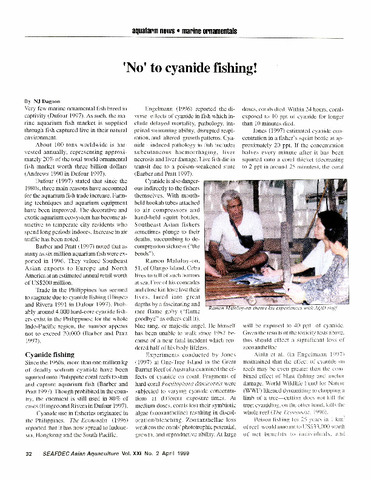
'No' to cyanide fishing!
(Aquaculture Department, Southeast Asian Fisheries Development Center, 1999) -
The Philippine industry: Marine tropical fish
(Aquaculture Department, Southeast Asian Fisheries Development Center, 1992) -
CRM in the Philippines: Lessons learned
(Aquaculture Department, Southeast Asian Fisheries Development Center, 1996)Philippine coastal communities can become capable fishery resource managers and that their management practices can become largely self-sustaining if the project approach focuses on assisting fishermen to learn how to help themselves. Community organization is an essential part of the process and should not be viewed as an end product in itself. There are also no quick fixes, and projects require a complex array of activities if large numbers of coastal residents are to be assisted. In some of these projects, the control of illegal fishing combined with limiting of commercial fishing to offshore areas and good coastal habitat management resulted in a doubling of daily fish catch and income for small-scale fishermen. However, even with the best of management, the total fishery harvest is limited and further increases in individual fishing income can only come from reducing total fishing effort. This will require a system of control on access to the resource to limit the number and kind of fishing gears and to divide the resource equitably. Assisting coastal communities to devise and implement realistic equitable access controls is the major challenge facing coastal resource co-management.