Detection of pesticide residues in Philippine aquaculture products
 AQD Access

Share
Abstract
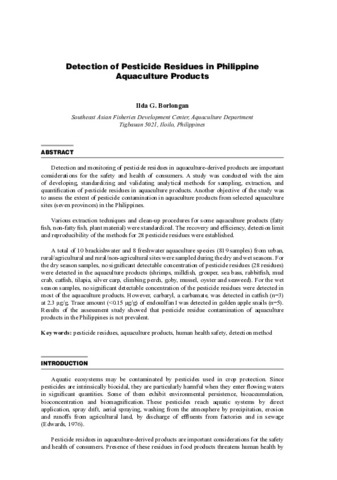
Detection and monitoring of pesticide residues in aquaculture-derived products are important considerations for the safety and health of consumers. A study was conducted with the aim of developing, standardizing and validating analytical methods for sampling, extraction, and quantification of pesticide residues in aquaculture products. Another objective of the study was to assess the extent of pesticide contamination in aquaculture products from selected aquaculture sites (seven provinces) in the Philippines.
Various extraction techniques and clean-up procedures for some aquaculture products (fatty fish, non-fatty fish, plant material) were standardized. The recovery and efficiency, detection limit and reproducibility of the methods for 28 pesticide residues were established.
A total of 10 brackishwater and 8 freshwater aquaculture species (819 samples) from urban, rural/agricultural and rural/non-agricultural sites were sampled during the dry and wet seasons. For the dry season samples, no significant detectable concentration of pesticide residues (28 residues) were detected in the aquaculture products (shrimps, milkfish, grouper, sea bass, rabbitfish, mud crab, catfish, tilapia, silver carp, climbing perch, goby, mussel, oyster and seaweed). For the wet season samples, no significant detectable concentration of the pesticide residues were detected in most of the aquaculture products. However, carbaryl, a carbamate, was detected in catfish (n=3) at 2.3 μg/g. Trace amount (<0.15 μg/g) of endosulfan I was detected in golden apple snails (n=5). Results of the assessment study showed that pesticide residue contamination of aquaculture products in the Philippines is not prevalent.
Suggested Citation
Borlongan, I. G. (2005). Detection of pesticide residues in Philippine aquaculture products. In K. Nagasawa (Ed.), Recent Advances in Diagnosis and Prevention of Fish and Shrimp Diseases in Southeast Asia (pp. 329–335). Tigbauan, Iloilo, Philippines: Aquaculture Department, Southeast Asian Fisheries Development Center.
Type
Book chapterISBN
9718511732Related items
Showing items related by title, author, creator and subject.
-
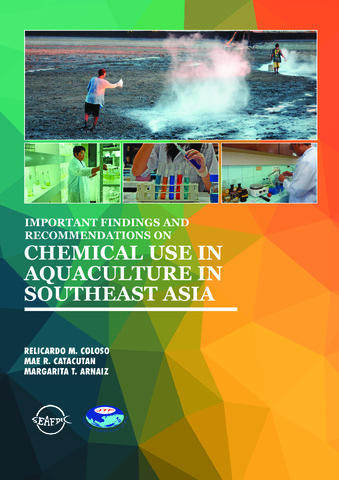
Important findings and recommendations on chemical use in aquaculture in Southeast Asia
(Aquaculture Department, Southeast Asian Fisheries Development Center, 2015)Under the program of Fisheries Consultative Group of the ASEAN (Association of South-East Asian Nations) - SEAFDEC (Southeast Asian Fisheries Development Center) Strategic Partnership Mechanism, a research project entitled “Food Safety of Aquaculture Products in Southeast Asia” was implemented by SEAFDEC/AQD (Aquaculture Department of SEAFDEC) from 2010 to 2014 with the financial support of the Government of Japan Trust Fund V (GOJ-TF5). The objectives of the project were to 1) contribute to the establishment of guidelines on the production of safe aquaculture products; 2) determine the presence and levels of commonly used chemicals in aquaculture in aquaculture products; 3) compile and disseminate SEAFDEC guidelines on the use of antibiotics and chemicals in aquaculture; and 4) implement training course/workshop to promote food safety awareness in the ASEAN region. Along with the said objectives, research activities, particularly focusing both on withdrawal periods of antibiotics often used in aquaculture and on surveillance of chemical contaminants in aquaculture products and feeds, were implemented (in 2010-2014). In addition, knowledge and technologies on food safety of aquaculture products were disseminated to local and national government staff, practitioners, stakeholders, etc. through an international seminar (in January 2011) and an international training course (in November 2013). Furthermore, AQD organized The International Workshop on Food Safety of Aquaculture Products in the Southeast Asia – Challenges in Sustaining the Food Safety of Aquaculture Products in May 2013 to promote and influence the regional initiatives in securing wholesome and safe aquaculture commodities in the ASEAN region. The publication of this volume consolidates the activities of the project which AQD has pursued during the period of the GOJ-TF5. Although the title of this volume does not include the word “guideline,” this volume surely includes and refers to the ASEAN guidelines recently published with the title of Guidelines for the Use of Chemicals in Aquaculture and Measures to Eliminate the Use of Harmful Chemicals courtesy of the ASEAN secretariat based on the understanding of the collaboration between ASEAN-SEAFDEC, as well as the basic and new findings of AQD scientists accomplished through the research activities, which were not covered by the ASEAN guidelines. Although the food safety of aquaculture products would be strictly required in the ASEAN region in the future, this volume will make a great contribution to the requirement. -
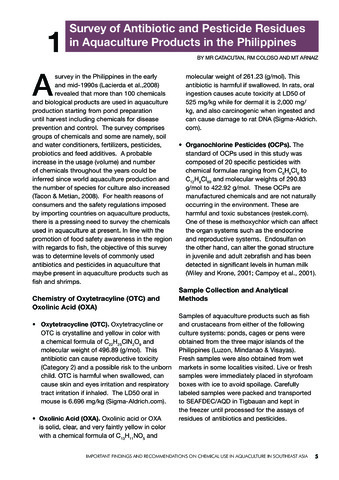
Survey of antibiotic and pesticide residues in aquaculture products in the Philippines
(Aquaculture Department, Southeast Asian Fisheries Development Center, 2015)A survey in the Philippines in the early and mid-1990s (Lacierda et al.,2008) revealed that more than 100 chemicals and biological products are used in aquaculture production starting from pond preparation until harvest including chemicals for disease prevention and control. The survey comprises groups of chemicals and some are namely, soil and water conditioners, fertilizers, pesticides, probiotics and feed additives. A probable increase in the usage (volume) and number of chemicals throughout the years could be inferred since world aquaculture production and the number of species for culture also increased (Tacon & Metian, 2008). For health reasons of consumers and the safety regulations imposed by importing countries on aquaculture products, there is a pressing need to survey the chemicals used in aquaculture at present. In line with the promotion of food safety awareness in the region with regards to fish, the objective of this survey was to determine levels of commonly used antibiotics and pesticides in aquaculture that maybe present in aquaculture products such as fish and shrimps. -
Seasonal growth, carrageenan properties, and resistance to disease and epiphytic pests between Kappaphycus alvarezii (Rhodophyta) var. tambalang (brown) tissue-cultured and farm-sourced seaweeds
Faisan, Jr., Joseph ; ; ; ; ; (Springer, 2024-01-08)
Growth performance (specific growth rate [SGR] and biomass yield), carrageenan properties (yield, viscosity, and gel strength), and disease and pest incidence were compared between Kappaphycus alvarezii var. tambalang (brown) tissue-cultured (TC) plantlets and farm-sourced (FS) seedlings. Seedlings used in the trials were propagules (4‒19 g pieces) and these were deployed on lines in sea cages over three separate runs of 60 days. The highest growth rate was recorded in TC plantlets and the SGRs were significantly higher (1.5‒6.5x) in TC than FS after Day of Culture (DOC) 15 (i.e., measurements taken every 15 days in each cycle). The carrageenan properties did not differ between treatments, with the exception of viscosity at DOC 45, where TC was higher than FS. “Ice-ice” disease (IID) was observed in both FS and TC in May‒June and August‒October at DOC 45 to 60, coinciding with changes in environmental conditions (i.e., dry‒wet and wet seasons). IID in FS had a moderate to very high incidence (31.2‒86.2%), while TC IID had a lower range of incidence (12.8‒60.6%). On the other hand, epiphytic filamentous algae (EFA) were observed only in August‒October with a low incidence (≤25%). However, EFA appeared earlier in FS than in TC. Taken together, these results highlight that tissue-cultured seaweeds had higher growth performance without compromising carrageenan quality and may be more resistant to health problems than farm-sourced seedlings. Studies should now assess the long-term viability of using tissue-cultured seaweeds over farm-sourced seedlings scaling to allow testing in standard farm settings, including the size of the initial seed.
; ; ; ; ; (Springer, 2024-01-08)
Growth performance (specific growth rate [SGR] and biomass yield), carrageenan properties (yield, viscosity, and gel strength), and disease and pest incidence were compared between Kappaphycus alvarezii var. tambalang (brown) tissue-cultured (TC) plantlets and farm-sourced (FS) seedlings. Seedlings used in the trials were propagules (4‒19 g pieces) and these were deployed on lines in sea cages over three separate runs of 60 days. The highest growth rate was recorded in TC plantlets and the SGRs were significantly higher (1.5‒6.5x) in TC than FS after Day of Culture (DOC) 15 (i.e., measurements taken every 15 days in each cycle). The carrageenan properties did not differ between treatments, with the exception of viscosity at DOC 45, where TC was higher than FS. “Ice-ice” disease (IID) was observed in both FS and TC in May‒June and August‒October at DOC 45 to 60, coinciding with changes in environmental conditions (i.e., dry‒wet and wet seasons). IID in FS had a moderate to very high incidence (31.2‒86.2%), while TC IID had a lower range of incidence (12.8‒60.6%). On the other hand, epiphytic filamentous algae (EFA) were observed only in August‒October with a low incidence (≤25%). However, EFA appeared earlier in FS than in TC. Taken together, these results highlight that tissue-cultured seaweeds had higher growth performance without compromising carrageenan quality and may be more resistant to health problems than farm-sourced seedlings. Studies should now assess the long-term viability of using tissue-cultured seaweeds over farm-sourced seedlings scaling to allow testing in standard farm settings, including the size of the initial seed.