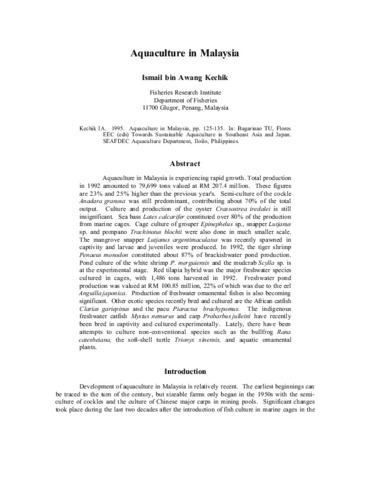
Hatchery and pond culture of Macrobrachium rosenbergii in northern Mindanao


Share
Abstract
The history of M. rosenbergii hatchery operations in Northern Mindanao can be traced from minor activities in different locations by several institutions. Earlier attempts to produce freshwater prawn postlarvae in hatcheries by Mindanao State University (MSU) faculty/researchers were conducted in the MSU-Marawi College of Fisheries (COF) and in commercial hatchery facilities for the tiger shrimp at MSU-Naawan.
Early efforts to produce freshwater prawn seedstock were done by an MSU-Marawi COF faculty member and his staff in the 1970s. Breeders were collected from Kapay, 30 m from the oceanic waters of Iligan Bay. However the group failed to rear larvae successfully to the postlarval stage. In Naawan, several larval rearing trials were conducted in the late 1970s and early 1980s as part of a project that included a study on the biology and ecology of the species in known prawn spawning grounds in Tambulig and Siay, Zamboanga del Sur. Live berried females from the two study sites were transported to Naawan and held in tanks until hatchlings were obtained. Larvae were reared in brackish and greenwater medium and fed Brachionus, Artemia and strained fish flesh. Unfortunately, not one larval rearing trial was successful.
Hatchery trials were also conducted in 1994 at the Multi-species Hatchery of the Dipolog School of Fisheries in Zamboanga del Norte. Few postlarvae were produced within one year and eventually the school discontinued the activity.
Suggested Citation
Dejarme, H. E. (2007). Hatchery and pond culture of Macrobrachium rosenbergii in northern Mindanao. In M. R. R. Eguia & M. L. C. Aralar (Comps.), Recent developments in the genetic improvement of the giant freshwater prawn (Macrobrachium sp.) (pp. 65–66). Tigbauan, Iloilo, Philippines: Aquaculture Department, Southeast Asian Fisheries Development Center.
Type
Book chapterISBN
9789718511848Related items
Showing items related by title, author, creator and subject.
-
Aquaculture industry profile and trends
(University of the Philippines Aquaculture Society, Inc., 2001) -
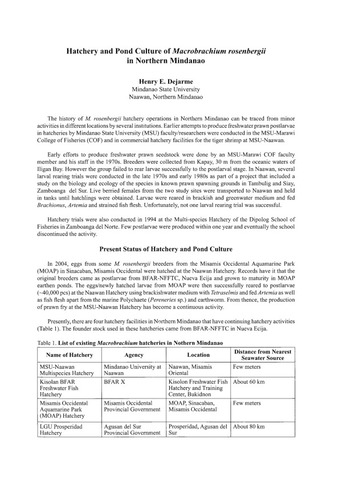
Aquaculture in Malaysia
(Aquaculture Department, Southeast Asian Fisheries Development Center, 1995)Aquaculture in Malaysia is experiencing rapid growth. Total production in 1992 amounted to 79,699 tons valued at RM 207.4 million. These figures are 23% and 25% higher than the previous year's. Semi-culture of the cockle Anadara granosa was still predominant, contributing about 70% of the total output. Culture and production of the oyster Crassostrea iredalei is still insignificant. Sea bass Lates calcarifer constituted over 80% of the production from marine cages. Cage culture of grouper Epinephelus sp., snapper Lutjanus sp. and pompano Trachinotus blochii were also done in much smaller scale. The mangrove snapper Lutjanus argentimaculatus was recently spawned in captivity and larvae and juveniles were produced. In 1992, the tiger shrimp Penaeus monodon constituted about 87% of brackishwater pond production. Pond culture of the white shrimp P. merguiensis and the mudcrab Scylla sp. is at the experimental stage. Red tilapia hybrid was the major freshwater species cultured in cages, with 1,486 tons harvested in 1992. Freshwater pond production was valued at RM 100.85 million, 22% of which was due to the eel Anguilla japonica. Production of freshwater ornamental fishes is also becoming significant. Other exotic species recently bred and cultured are the African catfish Clarias gariepinus and the pacu Piaractus brachypomus. The indigenous freshwater catfish Mystus nemurus and carp Probarbus julleini have recently been bred in captivity and cultured experimentally. Lately, there have been attempts to culture non-conventional species such as the bullfrog Rana catesbeiana, the soft-shell turtle Trionyx sinensis, and aquatic ornamental plants. -
Coastal aquaculture in Thailand
(Aquaculture Department, Southeast Asian Fisheries Development Center, 1995)Coastal aquaculture in Thailand has expanded rapidly in both area and production in the last decade. The important cultured species are the shrimps (Penaeus monodon and P. merguiensis), sea bass Lates calcarifer, groupers Epinephelus malabaricus and E. tauvina, green mussel Perna viridis, horse mussel Modiolus senhausenii, blood cockles Anadara granosa and A. nodifera and the oysters Crassostrea belcheri, C. lugubris and Saccostrea commercialis. The total production from coastal aquaculture in 1991 was 230,444 tons, consisting of 70.3% shrimp, 28.8% mollusks, and 0.9% fishes. The seaweeds Gracilaria spp., pearl oysters, scallops, and abalones are cultured on a pilot scale in some places. Hatchery technologies have recently been developed for groupers, oysters, scallops, and abalones. Expanded aquaculture has had some adverse effects on the environment and has also suffered from the environmental changes and conflicts due to other sectors using the same water and other resources.