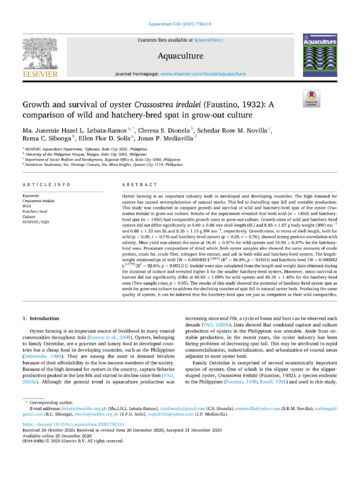
Growth and survival of oyster Crassostrea iredalei (Faustino, 1932): A comparison of wild and hatchery-bred spat in grow-out culture
View/
Date
2021-03-15Page views
2,791ASFA keyword

AGROVOC keyword
Taxonomic term

Metadata
Perlihat publikasi penuhShare
Abstract
Oyster farming is an important industry both in developed and developing countries. The high demand for oysters has caused overexploitation of natural stocks. This led to dwindling spat fall and unstable production. This study was conducted to compare growth and survival of wild and hatchery-bred spat of the oyster Crassostrea iredalei in grow-out culture. Results of the experiment revealed that both wild (n = 1450) and hatchery-bred spat (n = 1450) had comparable growth rates in grow-out culture. Growth rates of wild and hatchery-bred oysters did not differ significantly at 5.69 ± 0.88 mm shell length (SL) and 8.85 ± 1.07 g body weight (BW) mo−1 and 6.88 ± 1.33 mm SL and 8.26 ± 1.15 g BW mo−1, respectively. Growth rates, in terms of shell length, both for wild (p < 0.05, r = 0.74) and hatchery-bred oysters (p < 0.05, r = 0.76), showed strong positive correlation with salinity. Meat yield was almost the same at 16.41 ± 0.57% for wild oysters and 15.59 ± 0.37% for the hatchery-bred ones. Proximate composition of dried whole flesh oyster samples also showed the same amounts of crude protein, crude fat, crude fiber, nitrogen free extract, and ash in both wild and hatchery-bred oysters. The length-weight relationships of wild [W = 0.000492 L2.6512 (R2 = 86.8%, p < 0.001)] and hatchery-bred [W = 0.000052 L3.1779 (R2 = 92.6%, p < 0.001)] C. iredalei were also calculated from the length and weight data obtained during the duration of culture and revealed higher b for the smaller hatchery-bred oysters. Moreover, mean survival at harvest did not significantly differ at 85.03 ± 1.09% for wild oysters and 85.31 ± 1.40% for the hatchery-bred ones (Two-sample t-test, p > 0.05). The results of this study showed the potential of hatchery-bred oyster spat as seeds for grow-out culture to address the declining number of spat fall in natural oyster beds. Producing the same quality of oysters, it can be inferred that the hatchery-bred spat are just as competent as their wild conspecifics.
Suggested Citation
Lebata-Ramos, M. J. H., Dionela, C. S., Novilla, S. R. M., Sibonga, R., Solis, E. F. D., & Mediavilla, J. P. (2021). Growth and survival of oyster Crassostrea iredalei (Faustino, 1932): A comparison of wild and hatchery-bred spat in grow-out culture. Aquaculture , 534, 736310. https://doi.org/10.1016/j.aquaculture.2020.736310
Type
ArticleISSN
0044-8486Koleksi
- Journal Articles [1262]
Related items
Showing items related by title, author, creator and subject.
-
Wise use of important mollusc species in mangrove areas: Malaysia
(Aquaculture Department, Southeast Asian Fisheries Development Center, 2000)For centuries, several edible mollusc species are being collected for food by coastal communities from these mangrove ecosystems. The most common molluscs collected are cockles, various species of oysters, clams and ... -
A method of culturing/ growing high-quality edible oysters (Crassostrea spp. and Magallana bilineata)
(Intellectual Property Office of the Philippines, 2024-11-18)This utility model discloses a process of culturing/ growing high-quality edible oysters (Crassostrea spp. and Magallana bilineata) comprising the steps: selecting grow-out culture sites, deploying substrates ... -
Molluscan aquaculture in the Philippines: A review
Lebata-Ramos, Ma. Junemie Hazel (Springer, 2023-04-25)
Molluscs are among the most valuable resources of the Philippines, an archipelagic country of 7,107 islands bounded by 36,000 km of coastline and 26.6 million ha of coastal waters. In 2020, production from mussels and ...
(Springer, 2023-04-25)
Molluscs are among the most valuable resources of the Philippines, an archipelagic country of 7,107 islands bounded by 36,000 km of coastline and 26.6 million ha of coastal waters. In 2020, production from mussels and ...