The synergistic impacts of anthropogenic stressors and COVID-19 on aquaculture: A current global perspective

Download URL
www.tandfonline.comDate
2022-01-02Page views
5,070ASFA keyword

Metadata
Show full item recordShare
Abstract
The rapid, global spread of COVID-19, and the measures intended to limit or slow its propagation, are having major impacts on diverse sectors of society. Notably, these impacts are occurring in the context of other anthropogenic-driven threats including global climate change. Both anthropogenic stressors and the COVID-19 pandemic represent significant economic challenges to aquaculture systems across the globe, threatening the supply chain of one of the most important sources of animal protein, with potential disproportionate impacts on vulnerable communities. A web survey was conducted in 47 countries in the midst of the COVID-19 pandemic to assess how aquaculture activities have been affected by the pandemic, and to explore how these impacts compare to those from climate change. A positive correlation between the effects of the two categories of drivers was detected, but analysis suggests that the pandemic and the anthropogenic stressors affect different parts of the supply chain. The immediate measurable reported losses varied with aquaculture typology (land vs. marine, and intensive vs. extensive). A comparably lower impact on farmers reporting the use of integrated multitrophic aquaculture (IMTA) methods suggests that IMTA might enhance resilience to multiple stressors by providing different market options under the COVID-19 pandemic. Results emphasize the importance of assessing detrimental effects of COVID-19 under a multiple stressor lens, focusing on areas that have already locally experienced economic loss due to anthropogenic stressors in the last decade. Holistic policies that simultaneously address other ongoing anthropogenic stressors, rather than focusing solely on the acute impacts of COVID-19, are needed to maximize the long-term resilience of the aquaculture sector.
Contributes to SDGs


Description
Suggested Citation
Sarà, G., Mangano, M. C., Berlino, M., Corbari, L., Lucchese, M., Milisenda, G., Terzo, S. M. C., Azaza, M. S., Babarro, J., Bakiu, R., Broitman, B., Buschmann, A., Christofoletti, R., Deidun, A., Dong, Y., Galdies, J., Glamuzina, B., Luthman, O., Makridis, P., ... & Helmuth, B. (2022). The synergistic impacts of anthropogenic stressors and COVID-19 on aquaculture: A current global perspective. Reviews in Fisheries Science & Aquaculture , 30(1), 123-135. https://doi.org/10.1080/23308249.2021.1876633
Type
ArticleISSN
2330-8249; 2330-8257Collections
- Journal Articles [1266]

Except where otherwise noted, this item's license is described as Attribution-NonCommercial-NoDerivatives 4.0 International
Related items
Showing items related by title, author, creator and subject.
-
Effects of CO2-induced ocean environmental changes on marine life: implications for aquaculture
(Aquaculture Department, Southeast Asian Fisheries Development Center, 2011)The world's oceans are becoming warmer and acidic. The atmospheric carbon dioxide concentration has increased from 280 ppm at pre-industrial revolution to above 380 ppm today. The 4th IPCC report predicts that it will range from 540 to nearly 1,000 ppm by the end of the century. The increased CO2 not only warms surface seawater, but also acidifies it (usually termed as ocean acidification) by diffusing across the ocean surface and forming carbonic acid. Our knowledge is still scarce as to how these ocean environmental changes will affect marine life. The early studies on the impact of ocean acidification focused on corals aiming to clarify effects of high-CO2 seawater on their calcification processes. However, more recent studies have revealed that in fact ocean acidification, either alone or coupled with warming, could have detrimental impacts on a variety of biological processes in different taxa. We have shown that early development of marine bivalves (oysters and mussels) could be severely disrupted under elevated CO2 conditions (ca. 2,000 ppm). When a marine shrimp was exposed to seawater equilibrated with air containing 1,000 ppm CO2 for 30 weeks, survival was only 55% as compared with 90% in the control. Gonad maturation of a sea urchin was delayed by one month under the same CO2 conditions at ambient temperature, but when accompanied with increased temperature of 2 degree C above ambient, gonad maturation was not only delayed but also significantly suppressed; the number of eggs in the ovary was reduced to only 20% of the control. It has been shown that tropical animals already live near their thermal tolerant maxima, and therefore even small increases of environmental temperature could reduce their environmental fitness. These recent findings bear significant implication in aquaculture and fisheries production, in particular, in tropical countries. This paper will summarize recent data on these topics and discuss possible adaptation measures. -
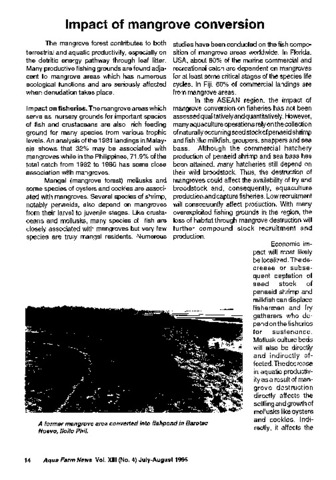
Impacts of mangrove conversion
(Aquaculture Department, Southeast Asian Fisheries Development Center, 1995)The article presents the impact of mangrove conversion on fisheries and on coastal areas. The mangrove areas which serve as nursery grounds for important species of fish and crustaceans are also rich feeding ground for many species from various trophic levels. Thus, the destruction of mangroves could affect the availability of fry and broodstock and, consequently, aquaculture production and fisheries. While in coastal areas, the destruction of mangroves increased the risk of coastal erosion from storm surges and winds, accelerates the erosion of riverbanks, exposes acid sulfate soils, leading to poor production and mass mortality of stocks, and affects the freshwater supply through salt intrusion upstream among others. -
Development and conservation of Philippine mangroves: institutional issues
Primavera, Jurgenne (Elsevier, 2000)
The decline of Philippine mangroves from half a million hectares in 1918 to only 120 000 ha in 1994 may be traced to local exploitation for fuelwood and conversion to agriculture, salt beds, industry and settlements. But brackishwater pond culture, whose history is intertwined with that of mangroves, remains the major cause of loss. The paper discusses the institutional issues — aquaculture as development strategy, low economic rent of mangroves, overlapping bureaucracy and conflicting policies, corruption, weak law enforcement and lack of political will — relevant to this decline. Recommended policies are based on these institutional factors and the experiences in mangrove rehabilitation including community-based efforts and government programs such as the 1984 Central Visayas Regional Project. These recommendations include conservation of remaining mangroves, rehabilitation of degraded sites including abandoned ponds, mangrove-friendly aquaculture, community-based and integrated coastal area management, and provision of tenurial instruments.
(Elsevier, 2000)
The decline of Philippine mangroves from half a million hectares in 1918 to only 120 000 ha in 1994 may be traced to local exploitation for fuelwood and conversion to agriculture, salt beds, industry and settlements. But brackishwater pond culture, whose history is intertwined with that of mangroves, remains the major cause of loss. The paper discusses the institutional issues — aquaculture as development strategy, low economic rent of mangroves, overlapping bureaucracy and conflicting policies, corruption, weak law enforcement and lack of political will — relevant to this decline. Recommended policies are based on these institutional factors and the experiences in mangrove rehabilitation including community-based efforts and government programs such as the 1984 Central Visayas Regional Project. These recommendations include conservation of remaining mangroves, rehabilitation of degraded sites including abandoned ponds, mangrove-friendly aquaculture, community-based and integrated coastal area management, and provision of tenurial instruments.