Development of control methods of factors suppressing sustainable production of aquaculture species: Isolation of a piscine nodavirus from hatchery-reared sea bass Lates calcarifer in the Philippines

ดู/
วันที่
2003Page views
849ASFA keyword

AGROVOC keyword
Taxonomic term

เมตาดาต้า
แสดงระเบียนรายการเต็มShare
นามธรรม
The etiological study on mass mortality of larval sea bass Lates calcarifer cultured in the Philippines, demonstrated that the mortality was caused by viral nervous necrosis (VNN). Affected sea bass exhibited abnormal swimming behaviors and pale-gray coloration of the body. Pathological changes of affected fish showed marked vacuolation and necrosis in the retina and brain. The SSN-1 cell line inoculated with the filtrate of tissue material from affected fish demonstrated extensive cytopathic effects. Piscine nodavirus (betanodavirus), the causative agent of VNN, was detected by reverse transcription-polymerase chain reaction. Electron microscopic examinations revealed that spherical and non-enveloped viral particle 22-28 nm in diameter were detected in the cytoplasm of brain and retina of affected fish and in the cytoplasm of degenerated SSN-1 cells after CPE appeared. These results indicate that mass mortality of sea bass larvae in the Philippines was caused by piscine nodavirus.
การอ้างอิง
Maeno, Y., de la Peña, L. D., & Cruz-Lacierda, E. R. (2003). Development of control methods of factors suppressing sustainable production of aquaculture species: Isolation of a piscine nodavirus from hatchery-reared sea bass Lates calcarifer in the Philippines. In Y. Ogawa, H. Y. Ogata, Y. Maeno, T. Shimoda, Y. Fujioka, & Y. Fukuda (Eds.), Proceedings of the 2nd Workshop of the JIRCAS International Collaborative Research: Studies on Sustainable Production Systems of Aquatic Animals in Brackish Mangrove Areas , December 2-3, 2002, Penang, Malaysia (pp. 81-87). Japan International Research Center for Agricultural Sciences.
Type
Conference paperISSN
1341-710Xชุด
JIRCAS Working Report;No. 35Related items
Showing items related by title, author, creator and subject.
-
Series: Aquaculture extension manual; No. 46
Intensive culture of sea bass, Lates calcarifer Bloch, in brackishwater earthen ponds
(Aquaculture Department, Southeast Asian Fisheries Development Center, 2010)An extension manual describing criteria for site selection, monoculture and polyculture operations including feeds and feeding, harvest, common diseases, economic analysis. -
Sea bass culture
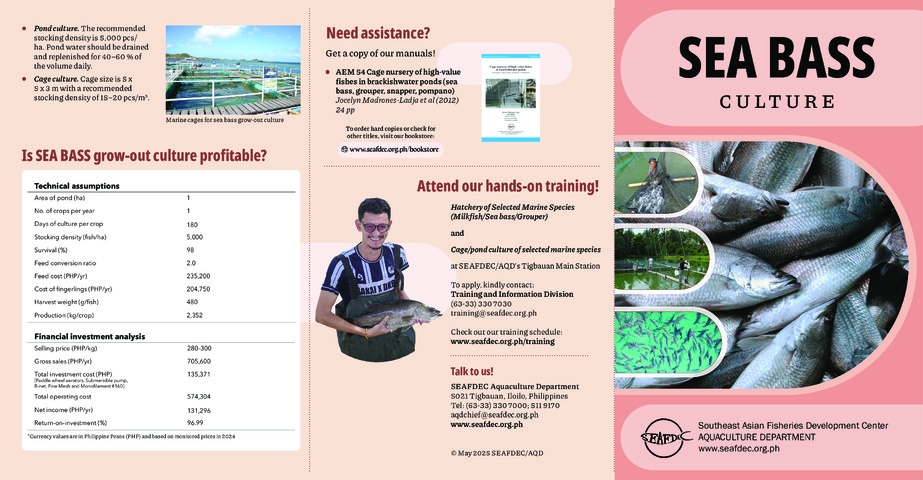
(Aquaculture Department, Southeast Asian Fisheries Development Center, 2025-05-09)This brochure provides a practical guide to the hatchery, nursery, and grow-out culture of sea bass (Lates calcarifer), a high-value food fish cultivated in Southeast Asia. It outlines best practices for broodstock ... -
Series: Aquaculture extension manual; No. 11 | NACA training manual series; No. 3
Biology and culture of sea bass (Lates calcarifer)
(Network of Aquaculture Centres in Asia, 1986)Information is presented regarding the biology and culture of Lates calcarifer in order to serve as a practical guide for extension workers and farmers. Hatchery design, seed production and hatchery techniques, culture of seabass and financial aspects of the seabass culture industry are described.