Successful translocation of mountain Lake Makuwaw with sinarapan (Mistichthys luzonensis), the "world's smallest commercial fish"

Share
Abstract
Some 75,000 pieces of live sinarapan (Mistichthys luzonensis) individuals were transferred to mountain Lake Makuwaw in San Ramon, Buhi, Camarines Sur in January to May 2001. Before the fish transfers, the lake was chosen from among four mountain lakes evaluated for their suitability for the fish. Five months before the direct live fish transfers, regular monthly seinings in the lake were done using fine-mesh push-net. No sinarapan or similar-looking small goby was found. This confirmatory survey was vital in evaluating the re-population strategy because it was ascertained that the new stock came from individuals stocked during the fish transfer activities. About 30-70% of the fish died during transport and until a day after each stocking of 15,000 per batch (with four batches a month). The minimum viable fish transfer quantity of 10,000 to 15,000 was estimated based from information on the population dynamics of the fish.
Viable stock of the fish in the lake has thrived, matured, and bred as evidenced by live juvenile and gravid adult sinarapan sampled starting July 2001. Morphometrics and biological characteristics of the Makuwaw stock do not differ significantly (a=0.05) with those of the stock from Lake Manapao where the live sinarapan translocated were taken. From knowledge of the population dynamics and aspects of the reproductive biology of the fish, the change in the fish population in the lakes was quantified. Population analyses showed that the role of natural mortality is primary and critical to re-population success.
Natural mortality is 95% and 99% for six-month and 12-month periods, respectively. Given the goby s high natural mortality, absence of pre- and post-hatching parental care, and the general vulnerability of eggs to environmental factors, the key biological determinants to successful re-population of the species are stocking at its viable quantity and meeting the basic life requirements of the fish. The social dimension related to community support and participation to strengthen network of protection for the sanctuaries is equally vital to sustain re-population efforts.
Suggested Citation
Soliman, V. S. (2005). Successful translocation of mountain Lake Makuwaw with sinarapan (Mistichthys luzonensis), the "world's smallest commercial fish". In M. L. Cuvin-Aralar, R. S. Punongbayan, A. Santos-Borja, L. V. Castillo, E. V. Manalili, & M. M. Mendoza (Eds.), Proceedings of the First National Congress on Philippine Lakes (pp. 245-256). Southeast Asian Regional Center for Graduate Study and Research in Agriculture (SEARCA).
Type
Conference paperISSN
1656-8099Collections
- LakeCon2003 [49]
Related items
Showing items related by title, author, creator and subject.
-
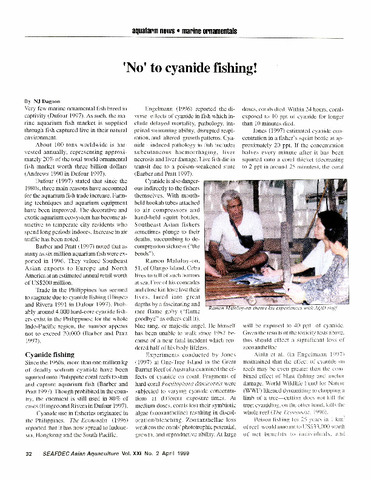
'No' to cyanide fishing!
(Aquaculture Department, Southeast Asian Fisheries Development Center, 1999) -
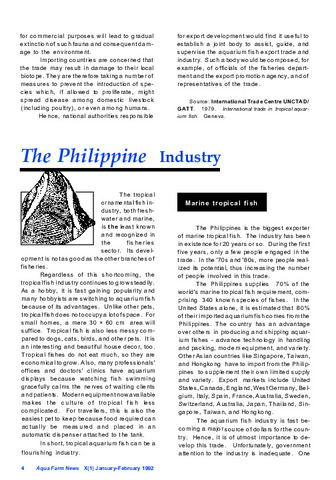
The Philippine industry: Marine tropical fish
(Aquaculture Department, Southeast Asian Fisheries Development Center, 1992) -
CRM in the Philippines: Lessons learned
(Aquaculture Department, Southeast Asian Fisheries Development Center, 1996)Philippine coastal communities can become capable fishery resource managers and that their management practices can become largely self-sustaining if the project approach focuses on assisting fishermen to learn how to help themselves. Community organization is an essential part of the process and should not be viewed as an end product in itself. There are also no quick fixes, and projects require a complex array of activities if large numbers of coastal residents are to be assisted. In some of these projects, the control of illegal fishing combined with limiting of commercial fishing to offshore areas and good coastal habitat management resulted in a doubling of daily fish catch and income for small-scale fishermen. However, even with the best of management, the total fishery harvest is limited and further increases in individual fishing income can only come from reducing total fishing effort. This will require a system of control on access to the resource to limit the number and kind of fishing gears and to divide the resource equitably. Assisting coastal communities to devise and implement realistic equitable access controls is the major challenge facing coastal resource co-management.