Flakes versus noodles as feed for the abalone Haliotis asinina, does form matter?

Share
Abstract
This paper reports the first use of thin flakes (310–315 μm thick) formulated diets as feed for the abalone Haliotis asinina. The study compared noodles and flakes prepared using refined and unrefined diets developed earlier for H. asinina (Bautista-Teruel et al., J. Shellfish Res., 35, 2016, 633). Four treatment diets in triplicates (refined flakes, MBTr-F; refined noodles, MBTr-N; unrefined flakes, MBTur-F; and unrefined noodles, MBTur-N) were used in a feeding experiment conducted in a tank facility. After three months, abalone fed MBTr-F had significantly higher mean shell length and body weight (35.92 ± 0.36 mm, 9.24 ± 0.29 g) compared with those fed MBTr-N (34.63 ± 0.37 mm, 8.22 ± 0.28 g) and MBTur-N (34.23 ± 0.36 mm, 7.66 ± 0.26 g), but did not significantly differ with those fed MBTur-F (35.40 ± 0.30 mm, 8.57 ± 0.24 g). Likewise, abalone fed MBTr-F had significantly higher mean growth rates (5.31 ± 0.08 mm, 2.59 ± 0.06 g/month), compared with those fed MBTr-N (4.90 ± 0.19 mm, 2.26 ± 0.12 g/month) and MBTur-N (4.71 ± 0.02 mm, 2.07 ± 0.06 g/month), but did not significantly differ with those fed MBTur-F (5.11 ± 0.06 mm, 2.37 ± 0.04 g/month). Survival (96.67–98.89%) and FCR (2.2–2.5) did not significantly differ among treatment diets. Between the flaked diets, MBTur-F is the cheaper option. However, the use of this unrefined diet resulted in distinct turquoise abalone shell colour, not observed in those fed MBTr-F.
Suggested Citation
Lebata-Ramos, M. J. H., Binas, J., Solis, E. F., & Balinas, V. T. (2021). Flakes versus noodles as feed for the abalone Haliotis asinina, does form matter? Aquaculture Nutrition , 27(6), 1880-1887. https://doi.org/10.1111/anu.13325
Type
ArticleISSN
1353-5773; 1365-2095Collections
- Journal Articles [1267]
Related items
Showing items related by title, author, creator and subject.
-
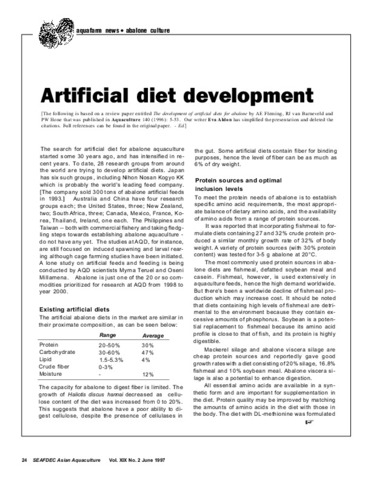
Artificial diet development [for abalone]
(Aquaculture Department, Southeast Asian Fisheries Development Center, 1997) -
Can Ulva reticulata replace Gracilariopsis heteroclada as natural food for the abalone Haliotis asinina?
Lebata-Ramos, Ma. Junemie Hazel ; (Springer, 2021-02-04)
Abalone are among the most important fishery resources with high commercial values worldwide, with Haliotis asinina being the most in demand and widely studied species in the Philippines. Abalone culture in the country mainly depends on the red alga, Gracilariopsis heteroclada, as food for cultured stocks. This however, is not sustainable as this alga is also being farmed both for agar production and human consumption. Hence, other sources of natural food need to be explored for large-scale culture of abalone. This study investigated the viability of Ulva reticulata as food for abalone. This green alga is common in the intertidal zones of the Philippines but of no commercial value. H. asinina early juveniles (N = 60, shell length 2.12–3.07 cm, body weight 1.7–5.9 g) obtained from the Abalone Hatchery of SEAFDEC Aquaculture Department were randomly distributed (n = 10) in three replicate containers and fed with G. heteroclada and U. reticulata for 15 days. After 15 days, abalone fed with G. heteroclada were significantly larger and heavier (2.82 ± 0.04 cm and 4.64 ± 0.19 g) than those fed with U. reticulata (2.62 ± 0.03 cm and 3.45 ± 0.14 g). Abalone fed with U. reticulata also exhibited weakness, hardfoot, and easily detached from the walls of the culture containers. Based on these results, despite its availability in large quantities, U. reticulata could not be solely used as an alternative natural food to G. heteroclada for abalone culture. However, its potential as a partial substitute to G. heteroclada may be further examined.
; (Springer, 2021-02-04)
Abalone are among the most important fishery resources with high commercial values worldwide, with Haliotis asinina being the most in demand and widely studied species in the Philippines. Abalone culture in the country mainly depends on the red alga, Gracilariopsis heteroclada, as food for cultured stocks. This however, is not sustainable as this alga is also being farmed both for agar production and human consumption. Hence, other sources of natural food need to be explored for large-scale culture of abalone. This study investigated the viability of Ulva reticulata as food for abalone. This green alga is common in the intertidal zones of the Philippines but of no commercial value. H. asinina early juveniles (N = 60, shell length 2.12–3.07 cm, body weight 1.7–5.9 g) obtained from the Abalone Hatchery of SEAFDEC Aquaculture Department were randomly distributed (n = 10) in three replicate containers and fed with G. heteroclada and U. reticulata for 15 days. After 15 days, abalone fed with G. heteroclada were significantly larger and heavier (2.82 ± 0.04 cm and 4.64 ± 0.19 g) than those fed with U. reticulata (2.62 ± 0.03 cm and 3.45 ± 0.14 g). Abalone fed with U. reticulata also exhibited weakness, hardfoot, and easily detached from the walls of the culture containers. Based on these results, despite its availability in large quantities, U. reticulata could not be solely used as an alternative natural food to G. heteroclada for abalone culture. However, its potential as a partial substitute to G. heteroclada may be further examined. -
Diet development and evaluation for juvenile abalone, Haliotis asinina: animal and plant protein sources
(Elsevier, 2003)Growth studies were conducted to determine the suitability of animal and plant protein sources in the diet of abalone, Haliotis asinina. Juvenile abalone with mean initial weight and shell length of 0.69±0.04 g and 11.4±0.35 mm, respectively, were fed practical diets for 84 days at a temperature range of 28–31 °C. The practical diets contained 27% crude protein from various sources such as fish meal (FM), shrimp meal (SM), defatted soybean meal (DSM), and Spirulina sp. (SP). A formulated diet (diet 1) served as the control. The diets were fed to abalone at 2–5% body weight once daily at 1600 h. Weight gain (WG), increase in shell length (SL), specific growth rate (SGR), protein efficiency ratio (PER) and feed conversion ratio (FCR) were evaluated. Highest weight gain (WG: 454%) was attained with abalone fed diet 2 with protein sources coming from a combination of FM, SM, and DSM. This value was, however, not significantly different (P<0.05) from those fed diets 4 and 1 (Control diet) with protein sources coming from FM, SM, SP and FM, DSM, SM, respectively. Abalone fed diet 3, which used both plant protein sources, DSM and SP, showed significantly lower WG (327%). Survival was generally high ranging from 85% to 100% for all treatments. The SGR showed the same trend as the percent weight gain. The FCR and PER obtained, however, were not significantly different for all treatments. The amino acid profile of diets 1, 2, and 4 simulated that of the abalone protein, which could have been a contributing factor to the higher growth rate of abalone fed these diets. Diet 3, which contained only plant protein sources, showed relatively lower methionine values compared with the abalone muscle tissue. Although abalone are considered herbivorous animals, results of this study indicate that a combination of dietary plant and animal protein sources was necessary to attain the best growth rate.