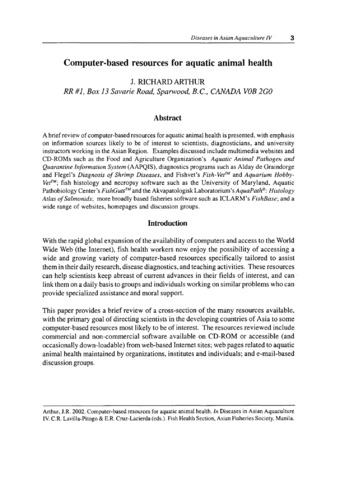
Computer-based resources for aquatic animal health

Share
Abstract
A brief review of computer-based resources for aquatic animal health is presented, with emphasis on information sources likely to be of interest to scientists, diagnosticians, and university instructors working in the Asian Region. Examples discussed include multimedia websites and CD-ROMs such as the Food and Agriculture Organization s Aquatic Animal Pathogen and Quarantine Information System (AAPQIS), diagnostics programs such as Alday de Graindorge and Flegel s Diagnosis of Shrimp Diseases, and Fishvet s Fish-Vet and Aquarium Hobby-Vet ; fish histology and necropsy software such as the University of Maryland, Aquatic Pathobiology Center s FishGuts and the Akvapatologisk Laboratorium s AquaPath©: Histology Atlas of Salmonids; more broadly based fisheries software such as ICLARM s FishBase; and a wide range of websites, homepages and discussion groups.
Suggested Citation
Arthur, J. R. (2002). Computer-based resources for aquatic animal health. In C. R. Lavilla-Pitogo & E. R. Cruz-Lacierda (Eds.), Diseases in Asian aquaculture IV: Proceedings of the Fourth Symposium on Diseases in Asian Aquaculture, 22-26 November 1999, Cebu City, Philippines (pp. 3-22). Fish Health Section, Asian Fisheries Society.
Type
Conference paperISBN
9718020160Collections
Related items
Showing items related by title, author, creator and subject.
-
Practical techniques for mapping small patches of mangroves
; Primavera, Jurgenne ; ; (Springer, 2010)
Practical mapping methods employing GPS field surveys and manual image analyses with affordable software were used to assess two mangrove sites in Aklan Province, NE Panay Island, central Philippines. The Jawili mangroves, absent from current maps, actually included 21.5 ha with 24 true mangrove species. On the other hand, the Batan Estuary mangroves, shown to be 4244 ha in available topographic maps, revealed only 406 ha of scattered patches. Actual mangrove data on specific areas worldwide is limited, especially in the Philippines where available maps show discrepancies from actual mangrove distribution. Remote sensing (RS) techniques provide promising results but require expensive setup, particularly for small areas. Therefore, financially limited users need affordable and rapid mapping alternatives. The practical techniques presented here can be immediately implemented at minimal cost and can produce useful estimates of actual mangrove area, fundamental for coastal management. Basic principles used here also have potential applications in other systems and locations. When resources are available though, additional confirmation and precise mapping are also further recommended.
; ; (Springer, 2010)
Practical mapping methods employing GPS field surveys and manual image analyses with affordable software were used to assess two mangrove sites in Aklan Province, NE Panay Island, central Philippines. The Jawili mangroves, absent from current maps, actually included 21.5 ha with 24 true mangrove species. On the other hand, the Batan Estuary mangroves, shown to be 4244 ha in available topographic maps, revealed only 406 ha of scattered patches. Actual mangrove data on specific areas worldwide is limited, especially in the Philippines where available maps show discrepancies from actual mangrove distribution. Remote sensing (RS) techniques provide promising results but require expensive setup, particularly for small areas. Therefore, financially limited users need affordable and rapid mapping alternatives. The practical techniques presented here can be immediately implemented at minimal cost and can produce useful estimates of actual mangrove area, fundamental for coastal management. Basic principles used here also have potential applications in other systems and locations. When resources are available though, additional confirmation and precise mapping are also further recommended. -
Identification of Pseudomonas sp. strain S3 based on small subunit ribosomal RNA gene sequences.
; ; Pakingking, Rolando V., Jr.; (Asian Network for Scientific Information, 2010)
Pseudomonas sp. strain S3 was isolated from Paddy (rice) field agricultural area. This organism, which can utilize a halogenated compound of D,L-2-Chloropropionic acid as sole carbon and energy source, catalyses the hydrolytic dehalogenation of both D- and L- isomers of 2-Chloropropionic acid. Identification of Pseudomonas sp. S3 is still ambiguous due to the lack of basic studies, especially their molecular genetic information. In this study, the amplified 16S rRNA gene sequence of Pseudomonas sp. S3 (Accession No. FJ968758) was compared to other nine selected gene sequences from the same group of Pseudomonas sp. and/or dehalogenase producing bacteria using in silico method. Their phylogenetic relationships were then determined. The results were analysed using MEGA4 software to ascertain its evolutionary distance by reconstructing a phylogenetic tree of these organisms. The evolutionary history and bootstrap consensus tree were inferred using the Neighbour-Joining method from 500 replicates. The tree is drawn to scale, with branch lengths (next to the branches) in the same units as those of the evolutionary distances used to infer the phylogenetic tree. The evolutionary distances were computed using the p-distance method and were in the units of the number of base substitutions per site. Based on this analysis, Pseudomonas sp. S3 16S rRNA gene was closely related to the Pseudomonas chlororaphis with genetic distance 0.170 base substitutions per site. S3 gene was also compared among known dehalogenase producing bacteria 16S rRNA genes. Results suggested that S3 was closely related to the Pseudomonas sp. R1 with a genetic distance 0.040 base substitutions per site. From present study, evolutionary relationships of 16S rRNA gene of Pseudomonas sp. S3 were elegantly illustrated by phylograms, comparable to a pedigree showing which microorganisms are most closely related. -
Digital curation projects: A study of selected academic and research repositories in the Philippines
; Alayon, Stephen (Nanyang Technological University, 2016)
The paper examines digitization and preservation initiatives in selected academic and research libraries in the Philippines. It identifies the drivers for the projects, practices followed, and issues encountered. Most of the projects were initiated by the librarians in cooperation with information and communication technology personnel. The selection of the materials for digitization was based on demand, the condition of the print format, and importance of the materials for future use. Conversion into microfilm from digital format, use of Internet mirror sites, and off-site repositories of data on hard disks were some of the preservation methods practiced by libraries. Challenges faced by digital curation activities include the need to develop digital curation skills of information professionals and researchers, and to develop the information infrastructure of the institutions and the country.