
Understanding Current Challenges and Future Prospects in Integrated Multi-Trophic Aquaculture (IMTA) Research
Browse by
Contents
- FOREWORD (JIRCAS)
- FOREWORD (AQD)
- About the Workshop
- Acknowledgement
-
The Ecology of Prospective Species for IMTA
-
Overview and history of IMTA, from ancient to modern times
– M. Kodama -
Sandfish Biology and Ecology: Prospects and Challenges for IMTA in the Tropics
– J. Altamarino -
Gracilariopsis heteroclada as an extractive species in an aquaculture system
– M.R. Luhan -
Integrating bivalves in IMTA system using earthen ponds
– M.J.H. Lebata-Ramos, E.F. Solis, R. Sibonga, J. Mediavilla, S. Novilla -
Cage and pen culture of milkfish Chanos chanos
– A. Gaitan
-
Overview and history of IMTA, from ancient to modern times
-
Evaluation of Environmental Impacts and Current Challenges in IMTA
-
IMTA as a possible countermeasure for reduced aquaculture productivity in Japan
– S. Watanabe -
Growth Performance of Milkfish (Chanos chanos) Cultured in Marine Pen designed for Integrated Multi-Trophic Aquaculture (IMTA)
– M. Kodama, R.A. Diamante, N. Salayo, R.J. Castel -
Environmental Impact and Growth Performance of IMTA species in Marine Pen Culture System
– R.A. Diamante, M. Kodama, N. Salayo, R.J. Castel
-
IMTA as a possible countermeasure for reduced aquaculture productivity in Japan
-
Economic Evaluation and Social Implementation of IMTA for Small-scale Aquaculture
-
Economic performance and roles of local communities in the adoption of multi-species aquaculture
– T. Miyata -
Small-scale IMTA of Milkfish in Pens: The Pandaraonan, Guimaras, Philippines Experience
– R.J. Castel, N. Salayo, M. Kodama, R.A. Diamante -
Evaluation of Livelihood Assets in Community-Based On-Farm Demonstration of IMTA in Milkfish Mariculture in Guimaras, Philippines
– N. Salayo, M. Kodama, R.J. Castel, R.A. Diamante, Q. Montinola
-
Economic performance and roles of local communities in the adoption of multi-species aquaculture
-
Annex
- Program
- List of Participants
- Working Committee
- Workshop Photos
- About the Editors
Recent Submissions
-
Understanding current challenges and future prospects in Integrated Multi-trophic Aquaculture (IMTA) research. Proceedings of the JIRCAS-SEAFDEC/AQD Joint Workshop on IMTA research held at SEAFDEC/AQD, Tigbauan Main Station, Iloilo, Philippines on 6-8 August 2019
(Aquaculture Department, Southeast Asian Fisheries Development Center; Japan International Research Center for Agricultural Sciences, 2022-07)This proceeding is a compilation of the 10-year achievements in IMTA research conducted by JIRCAS and SEAFDEC/AQD researchers and their collaborators, covering topics such as ecological characterization of target species, ... -
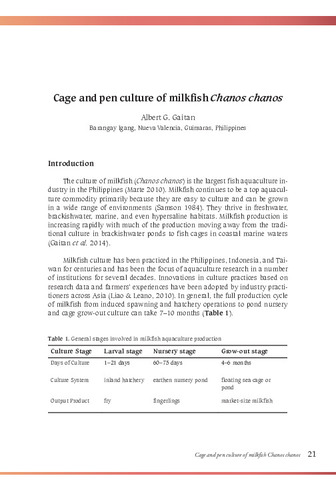
Cage and pen culture of milkfish Chanos chanos
(Aquaculture Department, Southeast Asian Fisheries Development Center; Japan International Research Center for Agricultural Sciences, 2022-07) -
IMTA as a possible countermeasure for reduced aquaculture productivity in Japan
Watanabe, Satoshi ; ; ; Hasegawa, Natsuki ; (Aquaculture Department, Southeast Asian Fisheries Development Center; Japan International Research Center for Agricultural Sciences, 2022-07)
-
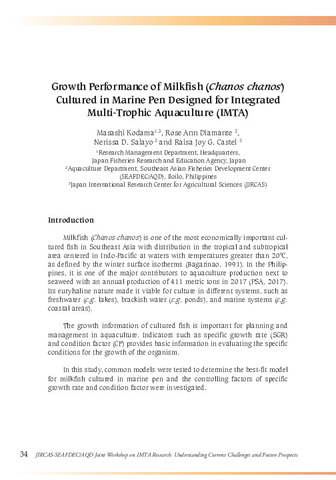
Growth performance of milkfish (Chanos chanos) cultured in marine pen designed for integrated multi-trophic aquaculture (IMTA)
(Aquaculture Department, Southeast Asian Fisheries Development Center; Japan International Research Center for Agricultural Sciences, 2022-07)In this study, common models were tested to determine the best-fit model for milkfish cultured in marine pen and the controlling factors of specific growth rate and condition factor were investigated. -
Environmental impact and growth performance of IMTA species in marine pen culture system
(Aquaculture Department, Southeast Asian Fisheries Development Center; Japan International Research Center for Agricultural Sciences, 2022-07)In this study, locally available marine species were tested, milkfish (Chanos chanos) as the fed species, seaweed (Kappaphycus alvarezii) as inorganic-extractive species for the water column, and sandfish (Holothuria scabra) as organic-extractive species on the sediments. This study aims to verify and improve IMTA systems suitable for farm conditions in coastal areas in the Philippines, with emphasis on mitigating the environmental impacts of mariculture of milkfish. -
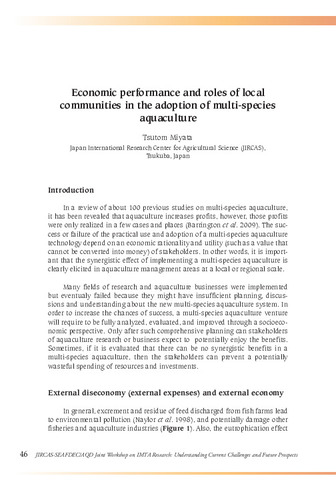
Economic performance and roles of local communities in the adoption of multi-species aquaculture
Miyata, Tsutom (Aquaculture Department, Southeast Asian Fisheries Development Center; Japan International Research Center for Agricultural Sciences, 2022-07)
-
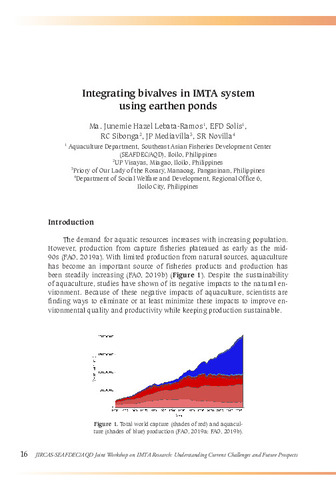
Integrating bivalves in IMTA system using earthen ponds
Lebata-Ramos, Ma. Junemie Hazel; Solis, Ellen Flor ; Sibonga, Rema ; ; (Aquaculture Department, Southeast Asian Fisheries Development Center; Japan International Research Center for Agricultural Sciences, 2022-07)
This study aimed to integrate the mangrove clam Anodontia philippiana, which has the capacity to assimilate sulfide in a pond culture system with milkfish Chanos chanos and seaweeds Gracilariopsis heteroclada. Specifically, it aimed to know the effects of integrating other commodities on the growth and survival of milkfish, the primary culture species in IMTA in ponds. -
Small-scale IMTA of milkfish in pens: The Pandaraonan, Guimaras, Philippines experience
(Aquaculture Department, Southeast Asian Fisheries Development Center; Japan International Research Center for Agricultural Sciences, 2022-07)This study examines IMTA as an option for small-scale fish farmers to grow multiple species in the same area in the coastal waters of Barangay Pandaraonan in Nueva Valencia, Guimaras, Philippines. The study aimed to explore the feasibility of an economically profitable IMTA system where milkfish are grown with sandfish and seaweeds. -
Sandfish biology and ecology: Prospects and challenges for IMTA in the tropics
Altamirano, Jon (Aquaculture Department, Southeast Asian Fisheries Development Center; Japan International Research Center for Agricultural Sciences, 2022-07)
-
Evaluation of livelihood assets in community-based on-farm demonstration of IMTA in milkfish mariculture in Guimaras, Philippines
(Aquaculture Department, Southeast Asian Fisheries Development Center; Japan International Research Center for Agricultural Sciences, 2022-07)This study showed the need to develop the livelihood assets of rural communities to enable them to engage in aquaculture-based income generating activities. The SLA evaluation showed that the benefits in terms of its contribution to livelihood asset build-up is generally positive. While human, social and environmental capacities were improved, the financial and physical assets were dissipated and insufficient for many stakeholders with keen interest to participate in the communal project. Therefore, the recommendation is to organize more and bigger collaborative projects, such as this IMTA of milkfish, with emphasis on sustainable livelihood asset development to create significant economic impact to target beneficiaries. -
Gracilariopsis heteroclada as an extractive species in an aquaculture system
Luhan, Maria Rovilla (Aquaculture Department, Southeast Asian Fisheries Development Center; Japan International Research Center for Agricultural Sciences, 2022-07)
The study was conducted within the integrated finfish broodstock facility complex of SEAFDEC/AQD at Tigbauan, Iloilo, Philippines. The broodstock facility has a water recirculating system. The 500-ton capacity broodstock/spawning tanks were stocked with 25 grouper (Epinephelus coioides) and 90 milkfish (Chanos chanos) breeders. Water from the broodstock tanks passes through the sedimentation tank, then through the filter tank before it goes back to the broodstock tanks. The filter tank has an area of 20 m2, a water depth of 25 cm, and a water flow rate of 43 L sec-1 (≈3720 m3 day-1). -
Overview and history of IMTA, from ancient to modern times
(Aquaculture Department, Southeast Asian Fisheries Development Center; Japan International Research Center for Agricultural Sciences, 2022-07)



 RSS 1.0