User acceptance of IAMSLIC digital fisheries library

Download URL
core.ac.ukDate
2018Author
Page views
897ASFA keyword

AGROVOC keyword
Geographic names

Metadata
Show full item recordShare
Abstract
The International Association of Aquatic and Marine Science Libraries and Information Centers (IAMSLIC) through the Aquatic Commons Board approved the deployment of IAMSLIC Digital Fisheries Library in the Philippines during the 2015 Conference. The digital library utilized the LibraryBox, a portable, open source distribution tool. This standalone wireless access is ideal for fisheries schools in the area due to limited or no Internet access and intermittent electrical power conditions. With the aim of providing access to SEAFDEC Aquaculture Department (AQD) publications in these schools, more than a thousand publications that were already made available in SEAFDEC/AQD institutional repository were also added in the box. The box contained over 26,000 publications, reports, articles and documents on all aspects of fisheries that are freely available. SEAFDEC/AQD is the first institution in the country to launch t he project in July 2016 using LibraryBox. Five boxes were distributed in Philippine fisheries libraries devastated by Typhoon Yolanda or hazed by fire. This study examined the factors that influence student’s acceptance and attitude towards the IAMSLIC Digital Fisheries Library. A survey was distributed to selected fisheries and marine biology undergraduate students in the Philippines. Relevance, perceived usefulness, perceived ease of use, screen design and behavioral intention to use the digital library were determined.
Keywords
IAMSLIC digital fisheries library LibraryBox fisheries students technology acceptance modelDescription
Abstract only.
Suggested Citation
Alayon, S. B., & Watkins, S. G. (2018). User acceptance of IAMSLIC digital fisheries library. In D. Barr (Ed.), Blurring the Edges: The Osmosis of Ideas. Proceedings of the 43rd Annual IAMSLIC Conference, October 22-26, 2017, Honolulu, Hawaii (p. 3). International Association of Aquatic and Marine Science Libraries and Information Centers (IAMSLIC).
Type
Conference paperISSN
2380-0399Collections
- Conference Proceedings [300]
Related items
Showing items related by title, author, creator and subject.
-
Unifying the art, science and business of aquaculture through the information resources and services of SEAFDEC Aquaculture Department Library
Alayon, Stephen ; Superio, Daryl ; ; Nemiz, Elvi S. (Secretariat, Southeast Asian Fisheries Development Center, 2013)
Established in 1973 in Tigbauan, Iloilo, Philippines, the Aquaculture Department (AQD) is one of four Departments of the Southeast Asian Fisheries Development Center (SEAFDEC). AQD is mandated to conduct scientific research to generate aquaculture technologies relevant and appropriate for the region; develop human resources; and produce, disseminate and exchange information on aquaculture. AQD is committed to sustainable development and the responsible stewardship of aquaculture resources through science-based research and the promotion of appropriate technologies and information relevant to the Southeast Asian region (SEAFDEC/AQD, 2009). The need to disseminate AQD’s research results is as important as the conduct of research in fisheries and aquaculture as referred to in the Code of Conduct for Responsible Fisheries (Wilkinson and Collins, 2007). In cognizance of the role that AQD should play with respect to its function of disseminating and exchanging information on aquaculture, the AQD Library was established to support the information needs of AQD scientists and staff. In addition, the Library also provides services to visiting researchers, local and international trainees and students, as well as the diverse users from AQD’s partner institutions. During the strategic planning workshop conducted by AQD in 2009, one of the goals identified was for AQD to strengthen the capacities of the aquaculture sector. Matching with such goal, the Library and Data Banking Services Section of the Training and Information Division identified its information dissemination and services target for 2012. Primarily, AQD Library aims to improve accessibility to archived and updated information, and to create a digital library collection of AQD publications and documents. In keeping up its goal of providing quality, current and relevant information, the Library continues to avail of quality print and non-print information resources, to ensure that it keeps abreast of the advancements in aquaculture and fulfil the diverse information needs of users. The Library also introduces innovations in its services with the purpose of unifying the art, science and business of aquaculture, and strengthens its local and international linkages for efficient sharing of knowledge and resources.
; Superio, Daryl ; ; Nemiz, Elvi S. (Secretariat, Southeast Asian Fisheries Development Center, 2013)
Established in 1973 in Tigbauan, Iloilo, Philippines, the Aquaculture Department (AQD) is one of four Departments of the Southeast Asian Fisheries Development Center (SEAFDEC). AQD is mandated to conduct scientific research to generate aquaculture technologies relevant and appropriate for the region; develop human resources; and produce, disseminate and exchange information on aquaculture. AQD is committed to sustainable development and the responsible stewardship of aquaculture resources through science-based research and the promotion of appropriate technologies and information relevant to the Southeast Asian region (SEAFDEC/AQD, 2009). The need to disseminate AQD’s research results is as important as the conduct of research in fisheries and aquaculture as referred to in the Code of Conduct for Responsible Fisheries (Wilkinson and Collins, 2007). In cognizance of the role that AQD should play with respect to its function of disseminating and exchanging information on aquaculture, the AQD Library was established to support the information needs of AQD scientists and staff. In addition, the Library also provides services to visiting researchers, local and international trainees and students, as well as the diverse users from AQD’s partner institutions. During the strategic planning workshop conducted by AQD in 2009, one of the goals identified was for AQD to strengthen the capacities of the aquaculture sector. Matching with such goal, the Library and Data Banking Services Section of the Training and Information Division identified its information dissemination and services target for 2012. Primarily, AQD Library aims to improve accessibility to archived and updated information, and to create a digital library collection of AQD publications and documents. In keeping up its goal of providing quality, current and relevant information, the Library continues to avail of quality print and non-print information resources, to ensure that it keeps abreast of the advancements in aquaculture and fulfil the diverse information needs of users. The Library also introduces innovations in its services with the purpose of unifying the art, science and business of aquaculture, and strengthens its local and international linkages for efficient sharing of knowledge and resources. -
Tigbauan Main Station
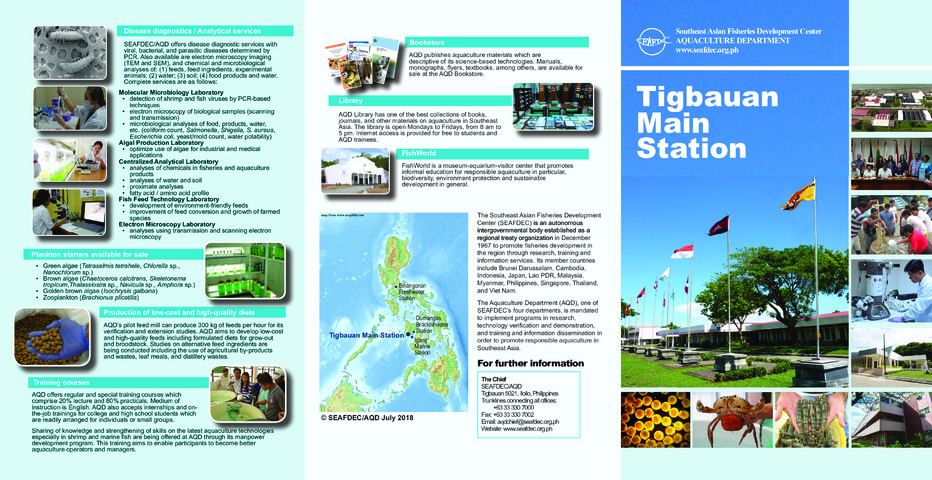
(Aquaculture Department, Southeast Asian Fisheries Development Center, 2018)Established in 1973, the Tigbauan Main Station (TMS) is the SEAFDEC/ AQD headquarters located on the south coast of Panay Island. The 40-hectare complex includes various research laboratories, hatcheries, and broodstock ... -
Does age matter?: The information-seeking behavior of Filipino aquaculture researchers
Superio, Daryl (Taylor & Francis, 2018)
Findings of previous studies revealed that regardless of the objective, age does affect the information-seeking behavior of an individual. Likewise, this study found the same results. Although all of the younger Filipino aquaculture researchers preferred the Internet to begin their search process, it was found that they were more frequent library users, and more reliant on librarians than their older counterparts. Likewise, they preferred the combination of print and electronic formats when reading. Thus, they would print and save the retrieved electronic copy of information at least very often. The study is a valuable addition to the information-seeking behavior studies on Filipinos, and the first to tackle the effects of age on the information-seeking behavior of Filipino aquaculture researchers.