Cage culture of tropical eels, Anguilla bicolor pacifica and A. marmorata juveniles: Comparison of growth, feed utilization, biochemical composition and blood chemistry

View/
Date
2022-11-02Page views
1,524ASFA keyword

AGROVOC keyword
Taxonomic term

Metadata
Show full item recordShare
Abstract
This study examined the performance and suitability of two tropical anguillid eels, Anguilla bicolor pacifica and A. marmorata, under cage culture conditions. Juvenile eels (1.73 ± 0.14 g body weight) of each species were stocked in triplicate hapa net cages (1 × 1 × 1.5 m; 30 eels/cage) suspended in outdoor tanks. Growth, feed utilization, biochemical composition and blood chemistry of the two species were compared after 210 days. Except for survival, mean final body weight (FBW), weight gain percentage (WG), specific growth rate (SGR) and yield of A. bicolor pacifica (64.51 ± 13.07 g, 3514 ± 690%, 2.14 ± 0.12%/day, 1534 ± 380 g/m3) were significantly higher than that of A. marmorata (7.77 ± 2.90 g, 356 ± 125%, 0.89 ± 0.16%/day, 178 ± 89 g/m3). In comparison with A. bicolor pacifica, significantly lower feed intake (FI), feed efficiency (FE) and protein efficiency ratio (PER) observed in A. marmorata suggest the need to develop eel diets with feeding stimulants to improve feed acceptance. Biometric indices, body proximate and amino acid composition were not significantly different between the two species. However, serum glutamic oxaloacetic transaminase (GOT), glutamic pyruvic transaminase (GPT) and total protein (TP) in A. bicolor pacifica were significantly higher than that in A. marmorata. These findings suggest that the differences in growth performance and feed utilization between the two anguillid eel species are related to feed palatability, and that A. bicolor pacifica appears to be a suitable species for cage culture because of its faster growth.
Subjects
Eels
Suggested Citation
Aya, F., & Garcia, L. M. (2022). Cage culture of tropical eels, Anguilla bicolor pacifica and A. marmorata juveniles: Comparison of growth, feed utilization, biochemical composition and blood chemistry. Aquaculture Research , 53(17), 6283-6291. https://doi.org/10.1111/are.16101
Type
ArticleISSN
1355-557X; 1365-2109Collections
- Journal Articles [1267]
Related items
Showing items related by title, author, creator and subject.
-
Alternate day feeding as a cost-effective strategy for tank culture of the Pacific shortfin eel Anguilla bicolor pacifica
Aya, Frolan ; ; Romana-Eguia, Maria Rowena R. ; (College of Agriculture and Food Science, University of the Philippines Los Baños, 2023-09)
There is a growing interest in the aquaculture of tropical anguillid eels as an export commodity. However, studies on feeding strategies, and the present demand to reduce feed costs need to be addressed to ensure the economic viability of eel farming. In this study, the effects of daily (DF) and alternate day (ADF) feeding on growth, feed utilization, body composition, blood chemistry, liver and intestinal morphology, and economic viability in the Pacific shortfin eel Anguilla bicolor pacifica were examined. Each feeding group of 30 elvers (166.25 ± 16.23 g mean initial wt) were randomly stocked in triplicate 4 m3 outdoor concrete tanks. These were fed for 155 d with formulated eel powder diet (49.77% crude protein; 10.21% crude lipid) made into a paste. Growth and survival were not significantly different between the two feeding groups. However, feed efficiency was improved in the ADF group, with significantly higher protein efficiency ratio (0.63) than in the DF group (0.39). Feed conversion ratio (FCR) was lower in ADF (3.85) than in the DF group (6.44), resulting in a 40% reduction in total feed consumption. Biometric indices, body proximate composition, and blood chemistry were not significantly affected. Likewise, liver and intestinal morphology showed no apparent alterations between groups. Partial costs-and-returns analysis showed that ADF yielded higher net profit and profit index. These results suggest that feeding on alternate days promote compensatory growth, better feed utilization, and normal physiological condition of A. bicolor pacifica, and reduce feed cost in the rearing process. Therefore, alternate day feeding should be promoted as a sound feed management strategy in the tank culture of tropical anguillid eels.
; ; Romana-Eguia, Maria Rowena R. ; (College of Agriculture and Food Science, University of the Philippines Los Baños, 2023-09)
There is a growing interest in the aquaculture of tropical anguillid eels as an export commodity. However, studies on feeding strategies, and the present demand to reduce feed costs need to be addressed to ensure the economic viability of eel farming. In this study, the effects of daily (DF) and alternate day (ADF) feeding on growth, feed utilization, body composition, blood chemistry, liver and intestinal morphology, and economic viability in the Pacific shortfin eel Anguilla bicolor pacifica were examined. Each feeding group of 30 elvers (166.25 ± 16.23 g mean initial wt) were randomly stocked in triplicate 4 m3 outdoor concrete tanks. These were fed for 155 d with formulated eel powder diet (49.77% crude protein; 10.21% crude lipid) made into a paste. Growth and survival were not significantly different between the two feeding groups. However, feed efficiency was improved in the ADF group, with significantly higher protein efficiency ratio (0.63) than in the DF group (0.39). Feed conversion ratio (FCR) was lower in ADF (3.85) than in the DF group (6.44), resulting in a 40% reduction in total feed consumption. Biometric indices, body proximate composition, and blood chemistry were not significantly affected. Likewise, liver and intestinal morphology showed no apparent alterations between groups. Partial costs-and-returns analysis showed that ADF yielded higher net profit and profit index. These results suggest that feeding on alternate days promote compensatory growth, better feed utilization, and normal physiological condition of A. bicolor pacifica, and reduce feed cost in the rearing process. Therefore, alternate day feeding should be promoted as a sound feed management strategy in the tank culture of tropical anguillid eels. -
Effect of stocking density on growth, biochemical composition and blood parameters in the Pacific shortfin eel Anguilla bicolor pacifica elvers
Aya, Frolan; ; Garcia, Luis Maria ; Romana-Eguia, Maria Rowena R. (College of Agriculture and Food Science, University of the Philippines Los Baños, 2024-09)
This study examined the effect of stocking density on growth, biochemical composition, and blood parameters of the Pacific shortfin eel Anguilla bicolor pacifica. Elvers (1.95 ± 0.14 g body weight) were randomly stocked in indoor tanks and reared over 186 d at three stocking densities (0.3, 0.6, and 0.9 kg m-3) set up in triplicates. Except for survival and biometric indices, elvers maintained at 0.3 and 0.6 kg m-3 densities exhibited higher growth and feed utilization than those held at 0.9 kg m-3. Yield increased with stocking density, which were significantly higher at 0.6 and 0.9 kg m-3. RNA/DNA ratio did not reflect growth rate, but trends in survival and RNA/DNA ratio with stocking density were positively related. In contrast to body proximate composition, increasing stocking density resulted in significantly higher erucic acid (22:1n-9) and total saturated fatty acid levels at 0.6 and 0.9 kg m-3 densities, respectively. Serum glutamic pyruvic transaminase activity was significantly elevated at 0.6 kg m-3, while total protein, glucose, and triglycerides slightly decreased with increasing stocking density. Results suggest that Pacific shortfin eel elvers can be reared in indoor tanks at a stocking density of 0.3 – 0.6 kg m-3 to achieve acceptable growth, feed performance, and health condition. -
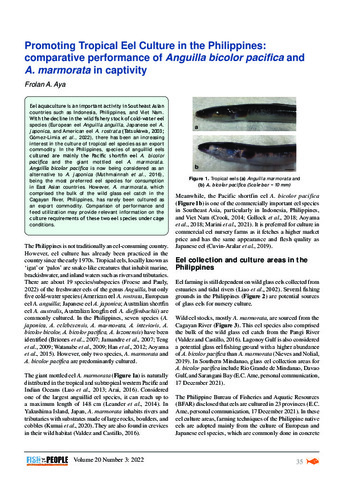
Promoting tropical eel culture in the Philippines: Comparative performance of Anguilla bicolor pacifica and A. marmorata in captivity
Aya, Frolan (Secretariat, Southeast Asian Fisheries Development Center, 2023-02)
Eel aquaculture is an important activity in Southeast Asian countries such as Indonesia, Philippines, and Viet Nam. With the decline in the wild fishery stock of cold-water eel species (European eel Anguilla anguilla, Japanese eel A. japonica, and American eel A. rostrata (Tatsukawa, 2003; Gómez-Limia et al., 2022), there has been an increasing interest in the culture of tropical eel species as an export commodity. In the Philippines, species of anguillid eels cultured are mainly the Pacific shortfin eel A. bicolor pacifica and the giant mottled eel A. marmorata. Anguilla bicolor pacifica is now being considered as an alternative to A. japonica (Muthmainnah et al., 2016), being the most preferred eel species for consumption in East Asian countries. However, A. marmorata, which comprised the bulk of the wild glass eel catch in the Cagayan River, Philippines, has rarely been cultured as an export commodity. Comparison of performance and feed utilization may provide relevant information on the culture requirements of these two eel species under cage conditions.