Inclusion of live mud polychaete (Marphysa iloiloensis) in the feeding regime improved the hatchery performance of domesticated Indian white shrimp (Penaeus indicus)
閲覧/開く
日付
2023-03-07著者
Page views
NaNASFA keyword

AGROVOC keyword
Taxonomic term

Metadata
アイテムの詳細レコードを表示するShare
抄録
A 60-day feeding trial was conducted to evaluate the effect of inclusion frequency of hatchery-bred mud polychaete, Marphysa iloiloensis, as part of a combination diet on the reproductive performance and larval quality of domesticated P. indicus. The two treatments were fed with a combination of formulated diet, mussel, squid, and mud polychaete with once (T1) and twice (T2) a week inclusion in the feeding regime. In contrast, the control group was fed only a diet combination of mussels, squid, and formulated diet. There was no significant difference in the mean survival of male and female broodstock in all treatments upon termination (\(p\gt0.05)\). Shrimp in T1 and T2 performed significantly better than the control in terms of spawning frequency (\(p=0.037)\) and fertilization rate (\(p=0.001)\), while T1 had significantly high re-maturation (\(p=0.038)\). The survival, spawning, hatching rate, egg, and nauplii production did not differ significantly among treatments (\(p\gt0.05)\). Also, no difference in the gonado-somatic index (GSI), hepato-somatic index (HSI), spermatophore weight, and sperm count was found among diet treatments (\(p\gt0.05)\). Post larvae from T1 and T2 performed significantly better than the control after 25 (\(p=0.008)\) and 30 (\(p=0.009)\) minutes of abrupt exposure to freshwater, respectively. Therefore, even once weekly, mud polychaete inclusion is sufficient to improve the reproductive performance of P. indicus broodstock and produce offspring with boosted resistance in the hatchery.
Suggested Citation
Estante-Superio, E., Mandario, M. A., Santander-Avancena, S., Geanga, T. M. M., Estepa, F. D., & Mamauag, R. E. (2023). Inclusion of live mud polychaete (Marphysa iloiloensis) in the feeding regime improved the hatchery performance of domesticated Indian white shrimp (Penaeus indicus). Regional Studies in Marine Science , 62, 102923. https://doi.org/10.1016/j.rsma.2023.102923
Type
ArticleISSN
2352-4855Collections
- Journal Articles [1266]
Related items
Showing items related by title, author, creator and subject.
-
Series: Aquaculture extension manual; No. 19
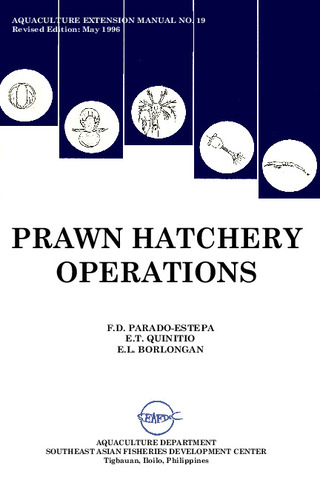
Prawn hatchery operations
; Quinitio, Emilia T. ; (Aquaculture Department, Southeast Asian Fisheries Development Center, 1996-05)
The manual, an updated version of the 1984 SEAFDEC/AQD manual, presents the underlying principles and step-by-step instructions of prawn larval and post-larval rearing. The techniques described are not only applicable to Penaeus monodon, but may also be modified and applied to other penaeid and metapenaeid species. The following aspects are covered: Site selection; Life cycle; Hatchery design and planning; Hatchery operations; Diseases; and Economics.
; (Aquaculture Department, Southeast Asian Fisheries Development Center, 1996-05)
The manual, an updated version of the 1984 SEAFDEC/AQD manual, presents the underlying principles and step-by-step instructions of prawn larval and post-larval rearing. The techniques described are not only applicable to Penaeus monodon, but may also be modified and applied to other penaeid and metapenaeid species. The following aspects are covered: Site selection; Life cycle; Hatchery design and planning; Hatchery operations; Diseases; and Economics. -
Series: Aquaculture extension manual; No. 19
Prawn hatchery operations
; Quinitio, Emilia T.; (Aquaculture Department, Southeast Asian Fisheries Development Center, 1991-02)
The manual, an updated version of the 1984 SEAFDEC/AQD manual, presents the underlying principles and step-by-step instructions of prawn larval and post-larval rearing. The techniques described are not only applicable to Penaeus monodon, but may also be modified and applied to other penaeid and metapenaeid species. The following aspects are covered: Site selection; Life cycle; Hatchery design and planning; Hatchery operations; Diseases; and Economics. -
Evaluation of plant proteins as partial replacement for animal proteins in diets for Penaeus indicus and P. merguiensis juveniles
(Society of Israeli Aquaculture and Marine Biotechnology, 2002)The growth rate and survival of two white shrimps, Penaeus indicus and P. merguiensis, fed diets in which fishmeal was partially replaced with plant protein sources were investigated in three trials. In trial 1 with P. indicus, soybean, yeast and leaf meals of kangkong, papaya and Cassia tora L. were screened as partial substitutes for fishmeal. The total biomass of shrimp fed 20% yeast (20yeast) was highest but not significantly different than that of shrimp fed 10yeast and 10papaya. Survival was highest with 20yeast, 10papaya and 10yeast. Shrimp fed Cassia tora L. had the highest weight gain and SGR but their survival was similar to those fed poor performing diets. In trial 2 with P. merguiensis, the ingredients were modified by decreasing fishmeal and increasing the yeast and soybean substitution. The biomass of the shrimp fed 10 yeast was similar to that of the shrimp fed 20yeast and 26 soybean, the weight gain and SGR were similar to shrimp fed 20yeast while survival was highest but not different from 20yeast and 26 soybean. In trial 3 with P. indicus, weight gain and SGR were best with 20yeast and 34soybean. However, biomass and survival did not differ among replacement levels. The performance of the white shrimp varied with different levels of yeast and soybean meal incorporation. The response of P. indicus was best with 20yeast (15% by weight) or 34soybean meal (34% by weight) while that of P. merguiensis was with 10yeast (7% by weight), 20yeast (15% by weight) or 26soybean meal (26% by weight). Partial replacement of fishmeal with yeast or soybean meal would result in lower feed costs but the use of these feeds needs further refinement since survival was low in all treatments. Rearing techniques, such as increasing the feeding frequency, simulating deep pond conditions or using adequate substrates, should be refined.