SEAFDEC nursery pond system solves prawn fry survival problems
- Global styles
- MLA
- Vancouver
- Elsevier - Harvard
- APA
- Help

Date
1978-11Page views
795ASFA keyword
AGROVOC keyword
Taxonomic term
Metadata
Show full item record
Share
Abstract
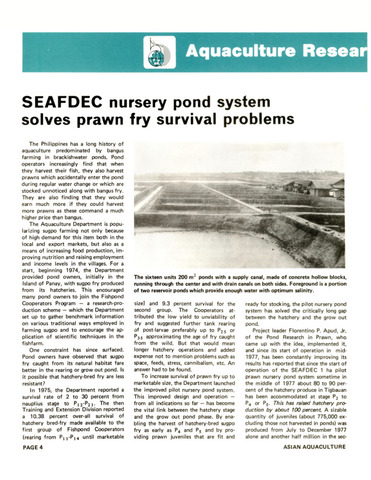
Prawn culture has been encouraged in the Philippines as an alternative to fish (bangus), since the former provides a higher income, better nutrition, and increased employment. The Aquaculture Department has made sugpo fry (Penaeus monodon ) available to pond owners, but these hatchery-bred fry are found to be much less viable than those from natural habitats. This has prompted the launching of an improved pilot nursery pond system which enables fry to be harvested as early as P4 and P5 stages, using improvements in design and operation to solve the critically long gap between the hatchery and the grow-out pond. By this method, hatchery production has been raised by about 100 percent, and a commercial size nursery has now been established capable of accommodating 2.4 to 5 million fry per operation, or 15 to 40 million per year.
Keywords
sugpoSuggested Citation
SEAFDEC/AQD (1978). SEAFDEC nursery pond system solves prawn fry survival problems. Asian Aquaculture , 1(5), 4-5, 7. http://hdl.handle.net/10862/6430
Type
magazineArticleISSN
0115-4974Collections
Related items
Showing items related by title, author, creator and subject.
-
Shrimp grow-out culture techniques in the Philippines
Gicos, Apolinario (Aquaculture Department, Southeast Asian Fisheries Development Center, 1993)The major commercial shrimp species in the Philippines belong to the genus Penaeus and Metapenaeus. The important penaeid shrimps are: P. monodon (giant tiger shrimp or sugpo); P. japonicus and P. semisulcatus (tiger shrimp and bulik or sugpo); and P. merguiensis and P. indicus (white shrimp and Indian white shrimp or putian). The giant tiger shrimp is the major species cultured in ponds while the others are incidental crops. There are 210,000 ha of potential and existing brackishwater ponds in the Philippines (Fig. 1). Because most of these are underdeveloped, present technologies are aimed at improving production or encouraging the development of new areas. Brackishwater fishfarming in the country is primarily centered on milkfish (Chanos chanos) (Table 1). Shrimp used to be merely an incidental crop when postlarvae from the wild enter the milkfish ponds. In the last decade, many traditional milkfish growers recognize the market of shrimps, primarily the giant tiger shrimp. Polyculture of milkfish and shrimp was practiced, and the fishfarmers shifted to shrimp monoculture when price of shrimp in the international market went up. In the mid-70s, SEAFDEC/AQD developed and extended its shrimp hatchery technology, and hatcheries proliferated throughout the country. Seed supply became abundant, encouraging more people to invest in grow-out culture. However, production remained low and inconsistent since the growout technology remains largely an art. When Taiwanese grow-out technology was introduced in the country and research in shrimp was intensified in the Department of Agriculture, University of the Philippines, and SEAFDEC/AQD, new coastal areas were developed particularly in Negros Island where vast tracts of sugarland and rice land were converted to shrimp ponds. Milkfish ponds were also renovated for shrimp culture. There are four shrimp culture levels in the country, namely: traditional, extensive, semi-intensive, and intensive which vary mainly in pond design, stocking density, feeds and feeding, and water management (Table 2). Only the semi-intensive and intensive culture systems are discussed. -
Brackishwater integrated farming systems in Southeast Asia
De la Cruz, Catalino R. (Aquaculture Department, Southeast Asian Fisheries Development Center, 1995)Integrated aquaculture-agriculture systems are more common in fresh water than in brackish water. Nevertheless, southeast Asian countries already have considerable research and experience in brackishwater integrated farming systems. In the Philippines, the effects of animal wastes on water quality and production of fish have been studied: chicken wastes on the mixed culture of milkfish Chanos chanos, tilapia Oreochromis niloticus, and shrimp Penaeus indicus; chicken and cattle manures on P. monodon and Artemia; and swine wastes on tilapia O. mossambicus. In Indonesia, about 60 hectares of fish farms have crops (pumpkin, spinach, cassava, maize, and chili) or livestock (cattle, goat, sheep, chicken, and duck) grown on the dikes of milkfish ponds. In Vietnam, culture of the giant prawn Macrobrachium rosenbergii, Scylla serrata and marine shrimps has been integrated with coastal rice farming. Aquaculture-silviculture is a flourishing venture in Vietnam and Indonesia and gaining ground with experimental sites in Thailand and the Philippines. The seaweed Gracilaria has been cultured with fishes and shrimps in Taiwan, Vietnam, Thailand, and the Philippines. The production of Artemia cysts and biomass has been integrated with salt-making and fish or shrimp farming in the Philippines and Thailand. Production inputs and outputs from these integrated farming systems vary widely and socioeconomic information is nil. It is imperative to conduct follow-up research and evaluation of each system in terms of production and socioeconomics. -
Aquaculture in Malaysia
Kechik, Ismail bin Awang. (Aquaculture Department, Southeast Asian Fisheries Development Center, 1995)Aquaculture in Malaysia is experiencing rapid growth. Total production in 1992 amounted to 79,699 tons valued at RM 207.4 million. These figures are 23% and 25% higher than the previous year's. Semi-culture of the cockle Anadara granosa was still predominant, contributing about 70% of the total output. Culture and production of the oyster Crassostrea iredalei is still insignificant. Sea bass Lates calcarifer constituted over 80% of the production from marine cages. Cage culture of grouper Epinephelus sp., snapper Lutjanus sp. and pompano Trachinotus blochii were also done in much smaller scale. The mangrove snapper Lutjanus argentimaculatus was recently spawned in captivity and larvae and juveniles were produced. In 1992, the tiger shrimp Penaeus monodon constituted about 87% of brackishwater pond production. Pond culture of the white shrimp P. merguiensis and the mudcrab Scylla sp. is at the experimental stage. Red tilapia hybrid was the major freshwater species cultured in cages, with 1,486 tons harvested in 1992. Freshwater pond production was valued at RM 100.85 million, 22% of which was due to the eel Anguilla japonica. Production of freshwater ornamental fishes is also becoming significant. Other exotic species recently bred and cultured are the African catfish Clarias gariepinus and the pacu Piaractus brachypomus. The indigenous freshwater catfish Mystus nemurus and carp Probarbus julleini have recently been bred in captivity and cultured experimentally. Lately, there have been attempts to culture non-conventional species such as the bullfrog Rana catesbeiana, the soft-shell turtle Trionyx sinensis, and aquatic ornamental plants.