The pawikan album: The sea turtles captured around Panay and Guimaras Islands, Philippines

View/
Date
2010Author
Page views
1,630ASFA keyword

AGROVOC keyword
Taxonomic term

Geographic names

Metadata
Show full item recordShare
Abstract
SEAFDEC FishWorld worked with fishers and government officers to document 93 sea turtles captured by fishing gears along the coasts of Panay and Guimaras Islands, Philippines in 2000-2009: three leatherbacks Dermochelys coriacea (128-150 cm curved carapace length), two loggerheads Caretta caretta (77 cm), 18 olive ridleys Lepidochelys olivacea (47-69 cm), 18 hawksbills Eretmochelys imbricata (20-89 cm), and 52 green turtles Chelonia mydas (30-108 cm). Most green turtles were caught in near shore fish corrals, and most olive ridleys by gill nets and long lines. Of the 18 hawksbills, 2 adults were caught in fish corrals, 3 juveniles were entangled in nets in Iloilo Strait, 6 were pets off our people,and 7 were captives at a turtle feeding station near a known hawksbill nesting site in Lawi, Guimaras. Sixty documented turtles were released, 47 of them with monel or inconel tags of the Pawikan Conservation Project, Department of Environment and Natural Resources. The others died from entanglement, serious injuries, slaughter for market, and diseases. Six female green turtles had multiple fibropapillomas; two died, three were released, and the latest one healed well after the surgical removal of several large tumors and was released. One green turtle brought to FishWorld has advanced shell rot, is unable to submerge, but is doing well on a diet of red seaweed Gracilaria. Three pet hawksbills were retrained for life at sea; one was released after 17 months, another after 57 months, but one is still at FishWorld as Conservation Ambassador. The most important result of FishWorld's work in the past 10 years is that many captured sea turtles were checked for health condition, treated where necessary or possible, tagged, and released back to sea. In addition, data on 93 sea turtles were gathered that can be used in the continuing effort to monitor the locations, risks and threats, health and diseases, and movements of these endangered species.
Subjects
Sea turtles
Suggested Citation
Bagarinao, T., Doyola-Solis, E. F., & Fernando-Teves, J. E. (2010). The pawikan album: The sea turtles captured around Panay and Guimaras Islands, Philippines. Aquaculture Department, Southeast Asian Fisheries Development Center. https://repository.seafdec.org.ph/handle/10862/6443
Type
BookISBN
9789718511978Format
83 p. : ill.
Collections
Related items
Showing items related by title, author, creator and subject.
-
Seasonal changes and coliform load of Jalaur river, province of Iloilo, Panay island, Philippines
; ; Pakingking, Rolando V., Jr. ; (Silliman University, 2010)
Determination of the presence/absence of coliforms as the pollution indicator bacteria, total coliform count (TCC) and fecal coliform counts specifically Echerichia coli were carried out on specific sampling points in Jalaur River namely: Banban Pequeño (upstream), Calinog, Moroboro, Dingle, Passi near Sugar Central Mill and National Power Corporation (NPC) (midstream), and Nabitasan, Leganes (downstream) during the wet and dry months. Samples were analyzed using a defined technology, the Colilert® method, and its accuracy was verified with the conventional method (APHA Standard Methods). Results showed that coliforms were present in all sampling sites. In Calinog, total coliform count (TCC) was high (900 x101 MPN/100 ml) in July. Increased coliform abundance was associated with high rainfall due to animal wastes that were carried by runoffs. In September, Passi, near NPC, TCC and E. coli counts were 640 x101 and 630 x 101 MPN/100 ml, respectively. Reduction in counts in January, February and March was observed. Sediments in Passi near Sugar Central Mill during milling time in February showed a high TCC of 116 x 104 MPN/100 ml which was attributed to reduced current and disturbance, and silty loam sediments texture that favored bacterial adsorption to sediments. Dingle site exhibited a domination of other coliforms over E. coli in January and March. In Leganes, highest TCC of 551 x 101 MPN/100 ml was obtained in September. Coliform loads varied by season which was influenced by the availability of the nutrients and tolerance range to physical and chemical factors in the environment. Variability of the resultant interaction can also be attributed to climate changes such as extreme weather events—El niño phenomenon and increased nutrient loadings during heavy rains hence, increased coliform concentration in the river. The presence of coliforms in Jalaur River is indicative of contamination that can be aggravated by climate changes and implies that a potential health risk associated with pathogens causing water-borne diseases is present.
; (Silliman University, 2010)
Determination of the presence/absence of coliforms as the pollution indicator bacteria, total coliform count (TCC) and fecal coliform counts specifically Echerichia coli were carried out on specific sampling points in Jalaur River namely: Banban Pequeño (upstream), Calinog, Moroboro, Dingle, Passi near Sugar Central Mill and National Power Corporation (NPC) (midstream), and Nabitasan, Leganes (downstream) during the wet and dry months. Samples were analyzed using a defined technology, the Colilert® method, and its accuracy was verified with the conventional method (APHA Standard Methods). Results showed that coliforms were present in all sampling sites. In Calinog, total coliform count (TCC) was high (900 x101 MPN/100 ml) in July. Increased coliform abundance was associated with high rainfall due to animal wastes that were carried by runoffs. In September, Passi, near NPC, TCC and E. coli counts were 640 x101 and 630 x 101 MPN/100 ml, respectively. Reduction in counts in January, February and March was observed. Sediments in Passi near Sugar Central Mill during milling time in February showed a high TCC of 116 x 104 MPN/100 ml which was attributed to reduced current and disturbance, and silty loam sediments texture that favored bacterial adsorption to sediments. Dingle site exhibited a domination of other coliforms over E. coli in January and March. In Leganes, highest TCC of 551 x 101 MPN/100 ml was obtained in September. Coliform loads varied by season which was influenced by the availability of the nutrients and tolerance range to physical and chemical factors in the environment. Variability of the resultant interaction can also be attributed to climate changes such as extreme weather events—El niño phenomenon and increased nutrient loadings during heavy rains hence, increased coliform concentration in the river. The presence of coliforms in Jalaur River is indicative of contamination that can be aggravated by climate changes and implies that a potential health risk associated with pathogens causing water-borne diseases is present. -
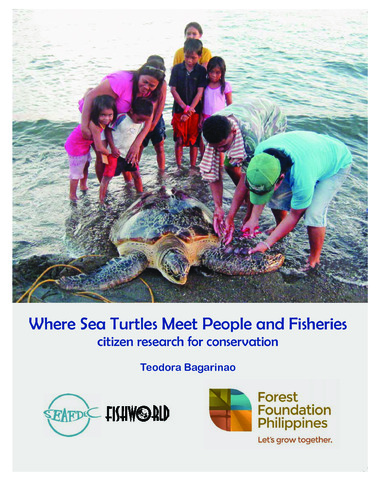
Where sea turtles meet people and fisheries: Citizen research for conservation
Bagarinao, Teodora (Aquaculture Department, Southeast Asian Fisheries Development Center; Forest Foundation Philippines, 2025)
Since 2000, SEAFDEC FishWorld has served as a focal point for community engagement in marine biodiversity conservation, with a particular emphasis on sea turtle protection in the waters surrounding Panay and Guimaras Islands. This book presents the outcomes of a long-term initiative involving the documentation, tagging, release, and care of sea turtles incidentally captured in local fisheries. It provides a permanent record of 335 sea turtles, including documentary photographs of 214 individuals, and offers extensive data and new insights into the status and ecology of these endangered species in Philippine waters. The volume details the interactions between sea turtles, fishing gear, and coastal communities, highlighting collaborative efforts among FishWorld, fishers, and government agencies to promote conservation and reduce turtle capture. Written for fishers, conservation practitioners, government officers, educators, and the general public, the book combines scientific information with accessible, pictorial presentation. It contributes significantly to national efforts to raise awareness, foster community participation, and strengthen the protection of sea turtles and the marine ecosystems that sustain them. -
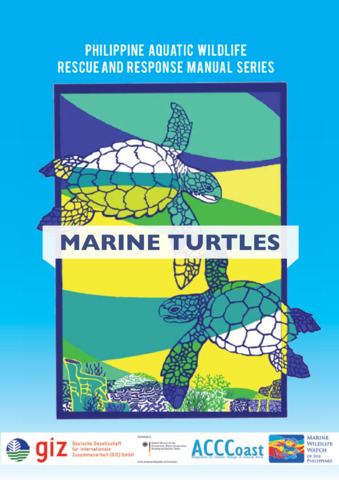
Philippine Aquatic Wildlife Rescue and Response Manual Series: Marine Turtles
(Marine Wild Fauna Watch of the Philippines, Inc., 2014)This manual addresses the lack of information materials on how to deal with marine turtle encounters in the Philippine seas to ensure that the proper treatment and intervention is provided. The manual also responds to the Comprehensive Action Plan for Threatened, Charismatic, and Migratory Species of the Sulu-Sulawesi Marine Ecoregion (SSME), which has been identified as the first priority seascape the Coral Triangle Initiative (CTI). The Tri-National Committee of the SSME developed the Comprehensive Action Plans (CAP) that identified seven Key Result Areas (KRAs) to improve the status of marine turtles in the SSME, as follows: (a) Identify best practices in minimizing threats to marine turtle populations and their habitats; (b) Develop and implement nesting habitats and management programs to maximize hatchling production and survival; (c) Provide recommendations on specific features or criteria in marine protected area (MPA) design and MPA network design in relation to the protection and management of marine turtles in SSME waters; (d) Undertake initiatives to promote reduction of incidental capture and mortality of marine turtles; (e) Conduct turtle population habitat research and monitoring protocols; (f) Develop guidelines for MPA network design for marine turtles; and (g) Publish information to promote best practices and successes for marine turtle conservation. This manual is an important step to address gaps and issues on threatened marine wildlife in the Philippines to better protect and conserve marine biodiversity in the Coral Triangle.