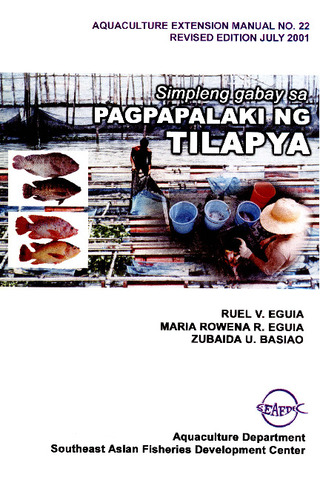
Pagpapalaki ng tilapya
View/

Date
2001-07Page views
NaNASFA keyword

AGROVOC keyword

Geographic names

Metadata
Show full item recordShare
Abstract
The manual discusses tilapia culture methods in concrete tanks, net cages, and fishponds. It details the species of tilapia cultured in the Philippines, which include Oreochromis niloticus, O. mossambicus, O. aureus. It covers the following: site selection; construction of netcages and its modules; fishpond construction and pond preparation; criteria for fry selection; stocking; netcage and pond management including water quality management; and harvest. The manual also lists the agencies involved in tilapia research and development in the Philippines; defines some technical terms in a glossary, and lists some useful references.

Description
Text in Filipino.
Suggested Citation
Eguia, R. V., & Eguia, M. R. R., & Basiao, Z. U. (2001). Pagpapalaki ng tilapya (2nd Ed.). Tigbauan, Iloilo, Philippines: Aquaculture Department, Southeast Asian Fisheries Development Center.
Type
BookISBN
9718511512Series
Aquaculture extension manual; No. 22Format
57 p. : ill. (some col).
Collections
Related items
Showing items related by title, author, creator and subject.
-
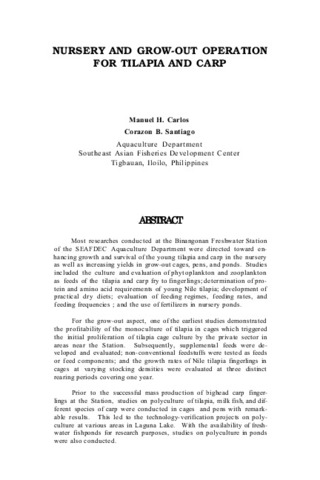
Nursery and grow-out operation for tilapia and carp
(Aquaculture Department, Southeast Asian Fisheries Development Center, 1988)Most researches conducted at the Binangonan Freshwater Station of the SEAFDEC Aquaculture Department were directed toward enhancing growth and survival of the young tilapia and carp in the nursery as well as increasing yields in grow-out cages, pens, and ponds. Studies included the culture and evaluation of phytoplankton and zooplankton as feeds of the tilapia and carp fry to fingerlings; determination of protein and amino acid requirements of young Nile tilapia; development of practical dry diets; evaluation of feeding regimes, feeding rates, and feeding frequencies ; and the use of fertilizers in nursery ponds. For the grow-out aspect, one of the earliest studies demonstrated the profitability of the monoculture of tilapia in cages which triggered the initial proliferation of tilapia cage culture by the private sector in areas near the Station. Subsequently, supplemental feeds were developed and evaluated; non-conventional feedstuffs were tested as feeds or feed components; and the growth rates of Nile tilapia fingerlings in cages at varying stocking densities were evaluated at three distinct rearing periods covering one year. Prior to the successful mass production of bighead carp fingerlings at the Station, studies on polyculture of tilapia, milk fish, and different species of carp were conducted in cages and pens with remarkable results. This led to the technology-verification projects on polyculture at various areas in Laguna Lake. With the availability of freshwater fishponds for research purposes, studies on polyculture in ponds were also conducted. -
Series: Aquaculture extension manual; No. 36
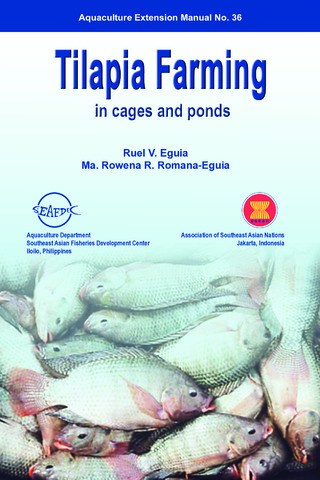
Tilapia farming in cages and ponds
; Romana-Eguia, Ma. Rowena R.This 40-page manual describes the farming practices for tilapia in cages, pens, ponds, and tanks. Also details selection of quality seedstock, maintenance of stock (feeding, water management), and harvesting. A list of ... (Aquaculture Department, Southeast Asian Fisheries Development Center, 2004)
-
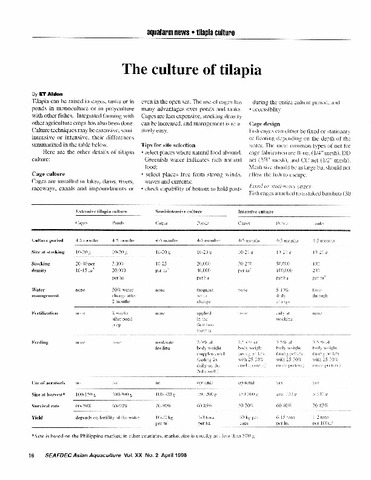
The culture of tilapia
(Aquaculture Department, Southeast Asian Fisheries Development Center, 1998)